30 Best Books Set in the Medieval Era
 Reading Time: 13 minutes
 Fiction and Non-Fiction Must-Reads for History Lovers
Medieval literature is a genre that evokes strong imagery: colossal cathedrals, crusading knights, tragic troubadours, virtuous virgins, warring kings and queens, peasants and priests, fervent faith, epic battles, and catastrophic conquests. This collection of thirty books reflects those images.
Books on Medieval Europe explore the period from 500 to 1500 CE, a 1000-year span that transports you back to the tumultuous time that gave rise to modern empires, globalized Christianity and Islam, and the early roots of the world as we know it. “The nearer people are to power, the less they see” (Barbara Tuckman). Fortunately, in books—both fiction and nonfiction—we can see and learn about the people and powerful forces that shaped the Middle Ages.
Whether you’re drawn to the political intrigue of English courts, the heroism of battlefield epics, or the everyday life of townspeople and mystics, the following 30 books offer an immersive journey into the medieval world.

30 Best Books Set in the Medieval Era
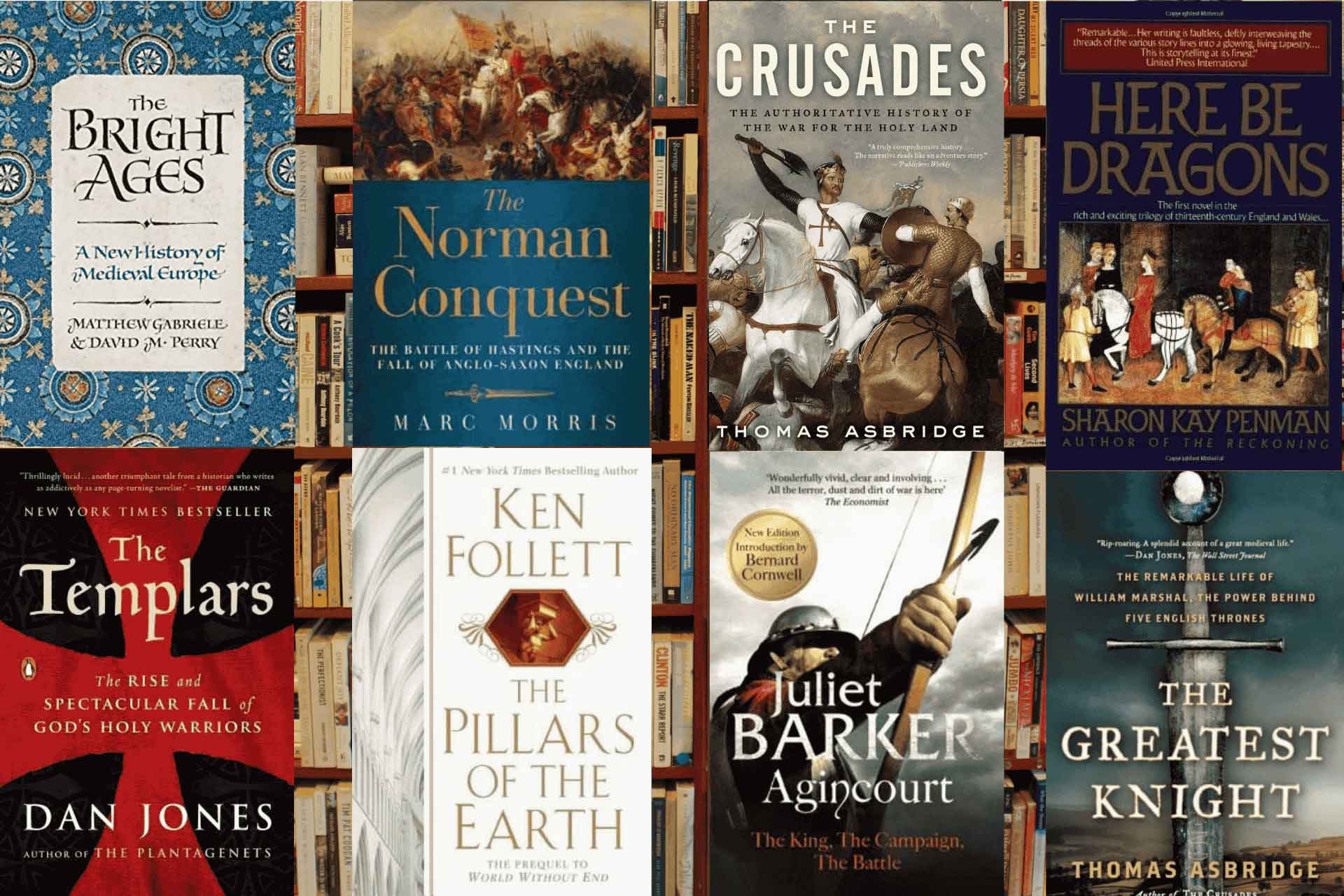
1. The Pillars of the Earth – Ken Follett
(Fiction, Cathedral Construction in 12th-Century England)


Topic: The building of a cathedral in the fictional town of Kingsbridge during the 12th century.
Summary: Spanning the themes of love, betrayal, and ambition, Follett’s novel is set against the monumental task of cathedral building. Exploring the lives of characters from every level of society, from builders to clergy, the story presents a powerful depiction of the social and political challenges of the time. It’s a gripping tale of determination and vision in medieval England.
2. The Name of the Rose – Umberto Eco
(Fiction, Murder Mystery in a 14th-Century Monastery)


Topic: A series of mysterious deaths in an Italian monastery during the 14th century.
Summary: Semiotics, biblical scholarship, medieval history, and literary theory all play a role in Eco’s densely plotted murder mystery. As William investigates the killings, he discovers more than bodies: the case involves a theological and philosophical controversy as well. The book is a profound meditation on heresy, faith, and the pursuit of knowledge.
3. A Distant Mirror: The Calamitous 14th Century – Barbara W. Tuchman
(Non-Fiction, Comprehensive History of the 14th Century)


Topic: The tumultuous events of the 14th century, including the Black Death and the Hundred Years’ War.
Summary: A sweeping portrayal of a century of plague, war, and social revolution. As Tuchman sees it, through the life of the French nobleman Enguerrand de Coucy. This epic chronicle of a whole era is a mirror for our times.
4. The Inquisitor’s Tale: Or, The Three Magical Children and Their Holy Dog – Adam Gidwitz
(Fiction, Young Adult Adventure in 13th-Century France)


Topic: The journey of three children and their dog in medieval France.
Summary: The book tells the historical and fantasy story of the three boys as outlaws. Gidwitz weaves actual history into a story that borrows from “The Canterbury Tales”. Gidwitz says the book “asks questions about faith and friendship and justice.” It is a fun and readable book that gives young readers a sense of what medieval France was like.
5. The Accursed Kings Series – Maurice Druon
(Fiction, Political Intrigue in 14th-Century France)


![La reina estrangulada [The Strangled Queen]: Los Reyes Malditos 2...](https://m.media-amazon.com/images/I/51t4jrzzcIL._SY445_SX342_QL70_FMwebp_.jpg)

Topic: The downfall of the Capetian dynasty and the lead-up to the Hundred Years’ War.
Summary: Dubbed “the original Game of Thrones,” Druon’s series dramatizes the scandals, betrayals, and power struggles of French royalty. The novels are based on the political intrigue that rocked medieval Europe. It’s an addictive saga of ambition and downfall.
6. The Greatest Knight: The Remarkable Life of William Marshal – Thomas Asbridge
(Non-Fiction, Biography of a Medieval Knight)


Topic: The life and legacy of William Marshal, a prominent knight in medieval England.
Summary: Asbridge tells the story of Marshal’s journey from the younger son of a minor noble to the regent of England. The biography details chivalric culture, feudal politics, and the role of the knight. It is an engaging portrait of loyalty and service in a time of chaos.
7. Katherine – Anya Seton
(Fiction, Romantic Historical Novel in 14th-Century England)


Topic: The love affair between Katherine Swynford and John of Gaunt.
Summary: Seton chronicles their fiery and long-lasting bond that challenged conventions. The book explores themes of love, power, and redemption in medieval England. It’s an ageless story of romance and endurance.
8. The Bright Ages: A New History of Medieval Europe – Matthew Gabriele and David M. Perry
(Non-Fiction, Reevaluation of the Middle Ages)


Topic: Challenging the notion of the “Dark Ages” by highlighting the era’s vibrancy.
Summary: The authors do an excellent job of dispelling the notion that the so-called Middle Ages were ‘dark’. The history of the Middle Ages is covered from the cultural, scientific, and intellectual perspectives. The work brings out the complexity and advancements made during this period of history. A highly engaging read that restructures the notion of medieval history.
9. The Buried Giant – Kazuo Ishiguro
(Fiction, Post-Arthurian Britain Fantasy)


Topic: A journey of an elderly couple in a mythical post-Arthurian Britain.
Summary: Ishiguro is a writer of memory, of love, and of loss in a country lost in forgetfulness. Fantastical, but written through with human feeling, it’s a moving and troubling book. Is it a memory? It’s a beautiful and elegiac novel, lyrical and disquieting.
10. The Norman Conquest: The Battle of Hastings and the Fall of Anglo-Saxon England – Marc Morris
(Non-Fiction, Detailed Account of the Norman Conquest)


Topic: The events leading up to and following the Battle of Hastings in 1066.
Summary: Morris’s is a thorough analysis of the invasion that changed the face of England. He discusses the political, cultural, and military sides of the conquest. The book presents an accessible and engaging account of a pivotal moment in history.
11. The Crusades: The Authoritative History of the War for the Holy Land – Thomas Asbridge
(Non-Fiction, Crusades and the Holy Land)


Topic: A comprehensive account of the Crusades, spanning the 11th to 13th centuries.
Summary: Asbridge details the often brutal and complicated history of conflict between Christians and Muslims in the Holy Land. Providing an account that is even-handed in its use of both Western and Middle Eastern sources, he examines the diverse motivations, myths, and realpolitik at play in the region. It is an accessible, well-researched, and thoroughly gripping account that brings the cultural and religious conflicts of the period to life.
12. Doomsday Book – Connie Willis
(Fiction, Time-Travel Science Fiction set in Medieval England)


Topic: A 21st-century historian is sent back to 14th-century England during the Black Death.
Summary: A mix of science fiction and historical realism, Willis blends a suspenseful and emotional story about an experiment in time travel gone awry. The heroine must survive the terrors of plague-ridden England while her fellow scientists in the future struggle to return her. Tackling fate, compassion, and the resilience of the human spirit, the novel is deeply moving.
13. In the Wake of the Plague: The Black Death and the World It Made – Norman F. Cantor
(Non-Fiction, Cultural Impact of the Black Death)


Topic: The effects of the 14th-century bubonic plague on Europe.
Summary: Cantor demonstrates how the Black Death profoundly impacted Europe’s economy, religion, and society. He provides the stories of real people who were touched by the pandemic. He also connects the seeds of modernity to the plague. The book is an easy read, but it carries significant implications.
14. Here Be Dragons – Sharon Kay Penman
(Fiction, Historical Romance in 13th-Century England and Wales)


Topic: The life of Princess Joanna and her marriage to Welsh prince Llewelyn the Great.
Summary: Penman blends history and fiction in this tale of power and influence, loyalty and love, set against the tumultuous backdrop of King John and Llewelyn’s reign. The novel provides a strong sense of the politics of medieval Britain and the personal relationships within royal marriages. It’s full of detail and pathos.
15. The Time Traveler’s Guide to Medieval England – Ian Mortimer
(Non-Fiction, Social History in Guidebook Style)


Topic: A practical and immersive guide to daily life in 14th-century England.
Summary: Mortimer treats us to a travelogue through history. He details the sights, smells, clothing, customs, and much more. As you read, you discover what it was really like to live, eat, worship, and work in medieval towns and villages. It is a lively, colourful, and instructive book for all lovers of history.
16. A World Lit Only by Fire: The Medieval Mind and the Renaissance – William Manchester
(Non-Fiction, Narrative History of Late Medieval Europe)


Topic: The cultural and political landscape of the late Middle Ages.
Summary: Manchester weaves a gripping, readable history of the medieval world’s transition into the Renaissance. From Magellan to Luther to the Borgias, he covers superstition, religion, and power. Not an academic history, it is a compelling, provocative read.
17. Ivanhoe – Sir Walter Scott
(Fiction, Chivalric Romance in 12th-Century England)


Topic: A noble knight returns home from the Crusades to find England divided by Norman and Saxon tensions.
Summary: Mixing history with romance, adventure, and political intrigue. Ivanhoe fights against injustice, wins the love of a lady, and meets Richard the Lionheart and Robin Hood. The novel played a significant role in shaping the modern-day romantic notion of the Middle Ages.
18. The Templars: The Rise and Spectacular Fall of God’s Holy Warriors – Dan Jones
(Non-Fiction, Knights Templar History)


Topic: The origin, influence, and downfall of the Knights Templar.
Summary: Jones applies a journalist’s eye to the history of this mysterious medieval order. From Jerusalem to the French royal courts, the Templars’ story is one of war, wealth, secrecy, and betrayal. The book strips away fact from legend, making for a thrilling read.
19. The Anarchy: The Darkest Days of Medieval England – Stephen D. Church
(Non-Fiction, Civil War Between Stephen and Matilda)


Topic: The 12th-century civil war for the English throne known as The Anarchy.
Summary: Church describes the violent, anarchic conflict between King Stephen and Empress Matilda, which devastated England. He highlights the war’s toll on ordinary people and the erosion of royal power. It’s a fascinating tale of ambition, fealty, and anarchy.
20. The Song of Roland – Anonymous
(Fiction, Medieval Epic Poem – Chanson de Geste)


Topic: The heroic last stand of Charlemagne’s nephew Roland against the Saracens.
Summary: One of the earliest and most renowned French works, this epic poem extols feudal loyalty and Christian valor. Roland’s heroism makes him a paragon of knightly chivalry. It is still the primary source on the ideals of medieval chivalry.
21. The Medieval World – Peter Linehan and Janet L. Nelson
(Non-Fiction, Scholarly Survey of the Middle Ages)


Topic: A comprehensive study of medieval Europe’s political, religious, and cultural evolution.
Summary: Linehan and Nelson assemble the finest historians to examine the evolution of Europe from the end of the Roman Empire to the dawn of the Renaissance. From kingship to the Church, law and order to warfare, and work to everyday life, the diversity and vibrancy of the medieval world are laid bare. Offering a wide range of insights, the collection combines deep and cutting-edge scholarship with clear and engaging prose to provide a vital overview of a formative period long before the age of revolutions.
22. World Without End – Ken Follett
(Fiction, Sequel to The Pillars of the Earth)


Topic: Life in Kingsbridge 200 years after the events of The Pillars of the Earth.
Summary: The second book in Follett’s series, The Second Sight, once again features four individuals. The four try to overcome and master plague, war, and personal ambition, as they go from rags to riches and back again. The cathedral town is once again at the center of intrigues, romance, and technology. It’s an epic story of survival and social change.
23. Magna Carta: The Birth of Liberty – Dan Jones
(Non-Fiction, Political History of England’s Most Famous Charter)


Topic: The creation, impact, and myth of the Magna Carta.
Summary: Jones recounts the story of King John’s tyrannical government and the rebellion that made him sign Magna Carta in 1215. He shows how the document became a foundational piece of constitutional government. It’s a gripping legal and political drama with enduring worldwide consequences.
24. The Book of Margery Kempe – Margery Kempe
(Non-Fiction, Autobiography of a Medieval Mystic)


Topic: The spiritual visions and pilgrimages of a 15th-century English woman.
Summary: Regarded as the first English autobiography, this book offers an account of Kempe’s colorful religious experiences and controversial public displays of devotion. Her voice is unique, eccentric, and emotionally transparent. The work offers a rare female perspective on medieval piety and gender.
25. When Christ and His Saints Slept – Sharon Kay Penman
(Fiction, Civil War in 12th-Century England)


Topic: The war between Stephen and Matilda for the English crown.
Summary: Penman dramatizes The Anarchy in all its glory. The court politics and battle scenes are equally riveting. Penman’s characters are three-dimensional, and she stays true to history—a must-read for history and fiction lovers.
26. The Decameron – Giovanni Boccaccio
(Fiction, Frame Narrative During the Black Death)


Topic: Ten Florentines escape the plague and entertain one another with stories.
Summary: This timeless classic features 100 tales of love, wit, and morality against the backdrop of the plague in 1348. Boccaccio brings humor and realism to the spirit and contradictions of the time. It is the cornerstone of Renaissance literature, born in a medieval time of crisis.
27. Medieval Europe – Chris Wickham
(Non-Fiction, Broad Survey from Fall of Rome to the Renaissance)


Topic: A comprehensive re-evaluation of medieval Europe’s transformation.
Summary: Wickham surveys economic, political, and cultural transformations on the continent. His approach critically interrogates anachronistic “Dark Ages” clichés and presents evidence-based revision. This is a highly readable yet academically robust study suitable for both the general public and historians.
28. Agincourt – Juliet Barker
(Non-Fiction, Battle of Agincourt 1415)


Topic: The legendary English victory against the French in the Hundred Years’ War.
Summary: Barker sets Henry V’s victory in its full military and political context. Sifting through evidence from contemporary sources, she examines logistics, strategy, and the reality of medieval warfare. It is a masterful retelling of one of England’s most famous battles.
29. The Canterbury Tales – Geoffrey Chaucer
(Fiction, Poetry, Pilgrimage Narrative)


Topic: A group of pilgrims tell stories on the road to Canterbury in 14th-century England.
Summary: This classic English text comprises a diverse range of stories, spanning from the comedic to the romantic, the moral to the satirical. Chaucer’s colorful cast comprises individuals from every stratum of medieval society, providing an excellent portrayal of life during that era. It is still as enjoyable as it is a fantastic resource into the past.
30. The Knight in History – Frances Gies
(Non-Fiction, Social Role of Knights in the Middle Ages)


Topic: The rise and evolution of knights across the medieval world.
Summary: Gies examines the evolution of the knight from a feudal fighter to a chivalric figure. Their involvement in war, court, and literature is explained with clarity and historical insight. The book is accessible and enlightening for those interested in the real lives behind the armor.
Why the Medieval Era Still Captivates Readers Today
We’re all fascinated by the Middle Ages. Fear and faith. Enlightenment and superstition. Heroism and horror. 30 books, both fiction and non-fiction, about the people, the events and the culture of this often misunderstood time in history. Knights. Crusades. Plagues. Everyday people living in extraordinary times. Let these books take you back in time and enhance your knowledge of the period that continues to influence our culture, our laws and our literature today.
If you’re looking for historical epics or in-depth academic studies, this list is sure to have something to interest any fan of the medieval times.


