

Eric Haraldsson Bloodaxe: The Rise and Fall of a Feared Viking King
 Reading Time: 14 minutes
Eric Haraldsson Bloodaxe was a notorious Viking ruler in the 10th century. He was a warlike, driven king, remembered and feared to this day for his bloody deeds, ambition, and feuds with close relatives. Descendant of Harald Fairhair, Eric Haraldsson came to the Norwegian throne only to be deposed and set off in search of another realm beyond the sea. After many adventures, Eric landed in York, where he would go on to be the final Norse king of the city, meeting an ignominious end in 954.
In later tradition, Eric comes down to us under the epithet ‘Bloodaxe’. He is frequently depicted as a brutal king, killing several of his brothers in order to become King. The sagas paint him as an incredibly powerful and dangerous fighter, with designs on the whole of Scandinavia and Britain. It is remarkably hard to disentangle the real King Eric Haraldsson from this Bloodaxe figure. Much of what we know of him was written down many generations after his lifetime, forcing us to piece together his reign from the various sagas, skaldic poems, and material remains.
This took place at a time of significant flux among the Viking kingdoms. Norway saw the emergence of a stronger, more unified kingship, while the other Scandinavian Kings in England fought to maintain their position against the growing English kingdom. In doing so, they display many of the key features of their rule: the brutality involved in attaining and retaining the crown, the ties between Kings and their kin, and the ultimate end of the Norse Kingdom in York.
Eric Haraldsson: Born Into Norway’s Viking Royal Dynasty
Eric Haraldsson is thought to have been born towards the close of the 9th century, most commonly placed c.885-895. His exact date of birth, however, can only be guessed. In the post-Norse tradition, he is given as one of the many sons of King Harald Fairhair, who came to dominate much, if not all, of Norway. The extent to which Harald actually achieved this unification is debated by historians today, but his legacy has undeniably had a major impact on subsequent views of Norwegian history.
As noted above, Harald’s court and extended family comprised many sons. Later accounts generally state that Eric was born to Ragnhild, a figure linked with the high nobility of Denmark, meaning he also had strong ties outside of Norway. Of course, these details are known only from the sagas, composed many generations after Eric lived.
It goes without saying that Eric would have grown up aware of the requirements for establishing himself as a king. An army was required to enforce and defend any territory claimed, together with the backing of local jarls and command of sufficient wealth. A number of rival candidates may exist from any particular royal house, and force and the support of others would frequently outweigh any strict ‘right’ to the throne.
The Young Viking Warrior and His Early Raids
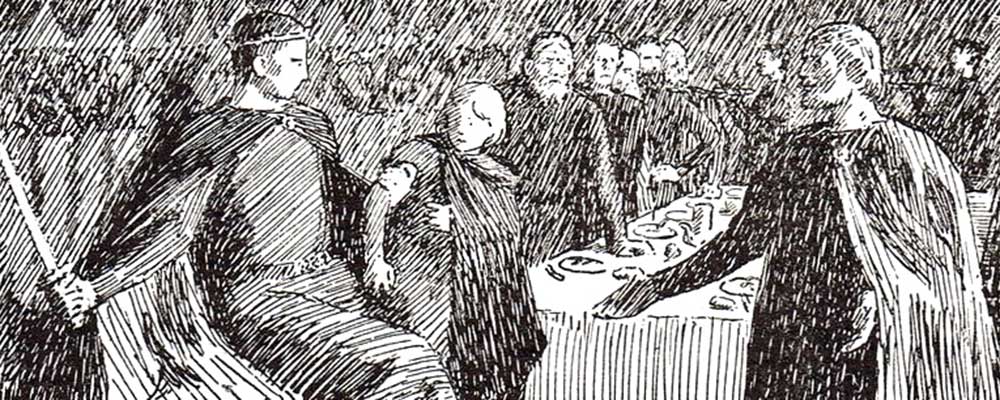
The later sagas present a picture of Eric as a warlike and capable young man who traveled widely around the Baltic and further North. He acquired riches, retinues, and martial expertise. In some cases, the sagas recount his expeditions to or from Denmark, the Baltic, and England, and paint him as a princely figure eager to make his name.
These were all familiar pursuits of Scandinavian kings in the Viking period. The lines between raiding, trade, and mercenary service were blurred, and those who prospered abroad could enrich themselves and their following with silver, arms, ships, and other booty. All would form part of the warrior bands that underpinned a king’s strength.
Of course, little can be said with certainty about Eric’s exploits while still young. As noted above, most of our information comes from subsequent saga-writing, which tended to cast its protagonists in more conventional heroic molds. While some elements of these stories may go back to older sources, we should not assume that any of them represent first-hand testimony. We can only say that Eric went on to become one of the leading rivals in Norway before ruling the Viking kingdom of Northumbria.

Why Was Eric Haraldsson Called Bloodaxe?
The epithet Bloodaxe is so inextricably linked to Eric Haraldsson that historians cannot escape using it. There is no clear answer to where this comes from, though. Some medieval sources state that it was earned during his fight with other brothers over control of Norway, in which he killed a number of them. The idea of a vicious royal fratricide fit the connotations of ‘blood’ and ‘axe’.
His full Old Norse name was Eiríkr blóðøx, commonly rendered into English as Eric Bloodaxe. We do not know from any extant source how or why the title came to be applied to him. Perhaps it simply indicated his prowess as a fighter, or arose from the possibly spurious tales of his treatment of his kin, or indeed grew in the period following his death.
It further demonstrates the problems inherent in seeking to piece together the events of the Viking Age. By assigning striking bynames to each king, the medieval chroniclers gave themselves a ready means of describing these individuals and cementing the legend around them. As a result, we must consider whether Eric Haraldsson actually lived up to his byname.
The Bloody Struggle for Norway’s Throne
In both Norwegian and Icelandic tradition, Harald Fairhair is said to have tried to apportion the kingdom among his various sons towards the end of his life. As a result, multiple power bases developed in Norway, and each prince sought to outmaneuver and subdue the others. Of these, Eric appears to have been particularly formidable given his background as a warrior and the prestige associated with his royal ancestry.
The sagas go on to report that Eric slew a number of his own siblings in pursuit of this goal. Depending on which account is considered, these included Ragnvald, Bjørn Farmann, and Olaf Haraldsson. There is some uncertainty about the individual cases, but what became clear was Eric’s willingness to go to such lengths to gain control of the land.
This also highlights a difficulty common to many kingdoms of this period. There had been no development of a strong, all-encompassing monarchy, nor the mechanisms (i.e., legal framework, office-holding, etc.) to ensure the King’s rule was observed throughout the realm. Consequently, rival kings or jarls could entice followers by offering riches, security, and power, and even if one was ultimately triumphant, this may prove difficult to extend to all regions.
Eric took the throne upon the death of Harald Fairhair in the estimated date range of c.930-933. However, his reign was short-lived. He was again deposed by a fellow kinsman and forced to abandon the kingdom of Norway.
Gunnhild: The Powerful Queen Beside Eric Bloodaxe
A key character in Eric’s saga is his wife, Gunnhild. She features prominently in the Norse historical tradition under the name Gunnhild, Mother of Kings. As we can see from various medieval texts, she was a formidable and astute figure who sought to shape the course of events around her husband and sons. In some versions of the sagas, she is further depicted as possessing magical powers and being highly scheming, but these claims must be treated with caution.
There are no reliable details about Gunnhild’s parentage. Medieval sources differ on whether she originated among the great kindreds of North Scandinavia or within the Danish royal family. Consequently, nothing definitive can be said about her. However, it is evident from subsequent Norwegian historiography that she retained considerable status and influence in the region following Eric’s demise.
They had several sons, one of whom was Harald Greycloak, future King of Norway. Through these sons and other kin, Eric could project his power far into the future. Though stripped of the Kingdom of Norway, Gunnhild and her offspring continued to feature prominently in Scandinavian politics.
Håkon the Good Challenges Eric Bloodaxe
Eric Haraldsson’s time on the Norwegian throne was brief. He faced a formidable rival in his younger half-brother Håkon the Good. Medieval sources record that Håkon grew up for some years at the English court of Æthelstan, giving him a background that set him apart from most Norwegian contenders.
Upon his return to Norway, Håkon was able to garner the backing of several key magnates. In the latter tradition, this was aided by the negative image that Eric had cultivated among the other princes. As such, Håkon was able to assemble the various magnate groups unhappy with the current ruler.
Bloodaxe was ousted from Norway and left the country, c. mid-930s. We have no certain knowledge of how this happened, but the sagas offer different accounts. Either Eric withdrew voluntarily to avoid further bloodshed, or he saw his base crumble.
Nevertheless, Eric continued to seek power beyond the borders of Norway. The sea route to the continent opened up many kingdoms and empires ruled by Scandinavians. Beyond the North Sea was also Northumbria, and its long association with the Vikings promised further prospects for Eric Bloodaxe.
From Norway to England: The Viking Kingdom of York
From the 10th century onwards, York was a key focus of the Viking political presence in England. After its conquest by the Great Heathen Army in 866, the city and surrounding area came under successive kings who retained close ties to the Irish world and Scandinavia. As Jórvík to the Vikings, the city grew to be a major hub of trade.

Nonetheless, the Anglo-Saxon expansion increasingly encroached on the Viking-held lands of Northumbria. In 927, York fell to King Æthelstan, and the following English monarchs sought to bring the whole kingdom under their rule. Nevertheless, various factions within Northumbria, including the native elite, ecclesiastics, and established Scandinavian communities, continued to pursue their own agendas.
In these circumstances, the arrival of a king of Norse stock with a martial background was likely to draw significant Scandinavian backing. Of course, any claim Eric Haraldsson Bloodaxe made on York would inevitably clash with the English and rival Norse kings.
The later sagas state that Æthelstan gave Eric some form of authority over Northumbria. However, as we shall see, this conflicts with our best English sources, whose earliest reasonably certain reference to Eric’s reign at York dates to the 940s, after the rule of Æthelstan ended. We should therefore be wary of accepting this account.
Eric Bloodaxe Becomes King of York
Little information is available about Eric’s activities as ruler of Northumbria. Some of the sources appear unreliable or at least inconsistent. The Anglo-Saxon Chronicle records that the Northumbrians chose Eric as their king in 948, leading to war with the English king Eadred. The Chronicle describes him as a Scandinavian king whose presence posed a threat to English domination of the region.
As a result, Eadred marched his army into Northumbria, devastating several settlements and lands, including those near Ripon. As they withdrew, the Northumbrians launched an attack on the English. The Chronicle relates that Eadred declared he would return and continue his ravages, after which the Northumbrian magnates deserted Eric and submitted to English authority.
Thus, Eric Haraldsson’s initial period as king in York came to an abrupt end, as it had in Norway. This illustrates once more the extent to which the Danes relied on the support of key magnates in order to establish themselves. Clearly, this was still insufficient for Eric.
However, the contest for York did not end there. Further uncertainty marked Northumbria in the subsequent period, and other rivals vied for the crown.

The Rivalry Between Eric Bloodaxe and Olaf Sihtricsson
Eric’s main competitor was Olaf Sihtricsson, also called Olaf Cuarán, a Norse Scandinavian ruler who had powerful connections to both Norse Dublin and Northumbria. He came from the Uí Ímair family, who controlled many of the key kingdoms of the Viking world across the Irish Sea for several generations.
The example of Olaf demonstrates how Viking kings operated on an international stage. They would travel often between Ireland, Northumbria, and other territories, exploiting their kin networks and military alliances to advance their fortunes. York was clearly a highly desirable prize for many reasons, including its wealth, symbolic importance, and strategic location.
When Eric was driven out for the first time, Olaf took control of Northumbria. But the balance of power shifted once more, and Eric Haraldsson Bloodaxe retook the city c.952. There is some uncertainty over the precise chronology, but it appears that Eric held the throne at York on two separate occasions.
This was therefore a significant achievement, allowing him to recover a kingdom after being expelled from both Norway and York. As before, this success would only be possible if he could navigate the competing factions within the region- especially those that undermined his initial rule.

The Final Reign of Eric Bloodaxe in Northumbria
Eric Haraldsson’s second period as king of York extended to around 954. In this period, Northumbria continued to be a borderland of competing Scandinavian kings and the rising English kings. It was open to local magnates to align themselves with any of the Scandinavian kings as long as this suited them, or abandon them when English pressure loomed to great to resist.
The Archbishop of York and several other prominent men in Northumbria were key players in local politics. As far as we know from the medieval sources, Archbishop Wulfstan became embroiled in the competing claims of various Scandinavian kings, but how directly connected he was to Eric is unclear.
Consequently, Eric’s hold over his realms was at best precarious, contingent on a shifting array of allies who might at any point turn against him. In many ways, this echoed the circumstances of his reigns in Norway, where powerful local magnates controlled his fate.
Once more, by 954 Eric found his power base collapse. On this occasion, there was no further realm to which he could flee.
The Death of Eric Bloodaxe at Stainmore
Eric Bloodaxe died in 954 at Stainmore. This was a pass across the Pennine hills, providing a link from the north of England to the West. There is little clarity about the events surrounding Eric’s demise, though subsequent accounts give a graphic description of him and his followers being slain.
According to the Anglo-Saxon Chronicle, Eric was driven out of Northumbria, and King Eadred took over the realm. No further details are given about the last engagement Eric fought. Medieval chroniclers such as Roger of Wendover place the killing at Stainmore and name his foe as Maccus or Macon in varying versions of the story.
However, in the poem known as the Eiríksmál, written to commemorate Eric following his death, there is no mention of these events. Instead, the poem depicts Eric making his way to the hall of Valhalla, and Odin preparing to welcome him with the other Einherjar, or brave warriors.
As might be expected, the poem draws heavily on the values of the Viking warrior elite. Eric’s defeat and death allow the author to focus on his bravery as a warrior and his standing as a king. While it does not tell us much about the circumstances of his death, we can learn much about the image his men sought to portray of him.
Eric Bloodaxe’s death marked not only the end of his ambitions but a turning point in English History. The time was drawing near when York would cease to have an independent Norse King.
The End of Viking Kingship in York
With Eric Bloodaxe driven out and killed in 954, the period of Scandinavian kings over York came to a close. This had spanned around 100 years, with many different Scandinavian monarchs taking control at various points. Under King Eadred, the process of consolidating Northumbria within the Kingdom of the English was advanced further than any prior West Saxons had achieved.
Of course, Scandinavians still played a significant role in life in the north. Whether as direct settlers or later generations, they left an indelible mark on the region in terms of vocabulary, toponymy, commerce, legal systems, and social practice. Some aspects of this continued to be evident in York for some time.
This transition did not bring an immediate period of peace and political normality after Eric’s demise. The North retained its own particular character and strong magnates, and its interactions with the South were multifaceted. However, one distinct period of history had now closed, characterized by repeated incursions of foreign Scandinavian kings upon York.
Following Eric, many members of his line sought the Norwegian kingship, including his son Harald Greycloak, who succeeded as King of Norway. As a result, the Bloodaxes would play a major role in the Scandinavian kingdoms for several centuries.
Eric’s bloodline could also trace back to Harald Hardrada. Both descended from the House of Harald Fairhair. Under the accepted sagas, Eric was Harald’s great-great-uncle. Over 100 years later, in 1066, Harald himself invaded England but perished at Stamford Bridge.
Eric Bloodaxe in Norse Sagas and Viking Poetry
Eric Haraldsson is best known through the Icelandic and Norwegian sagas of the Middle Ages. Heimskringla, Fagrskinna, Egils saga, and others detail episodes from his reign, kinship, and rivalries with contemporaries. They were composed several centuries after him and mix elements of tradition with fiction.
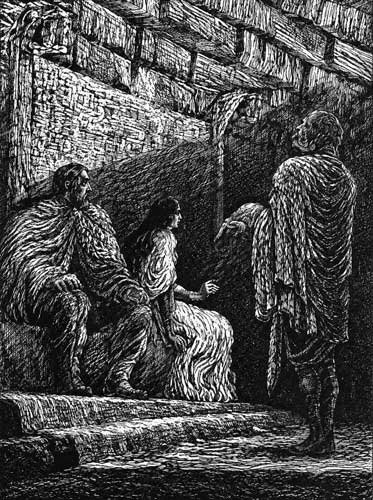
In particular, Egils saga casts him and his wife Gunnhild as antagonists to the great Icelandic skald Egill Skallagrímsson. At one point, Egill supposedly averts death at Eric’s hands by writing a laudatory poem called Höfuðlausn (Head Ransom). This serves to illustrate the elevated role of the skald in securing and augmenting a king’s status.
Naturally, these passages should not be taken literally. All that remains of Egils saga is a 13th-century manuscript, approximately 300 years removed from the events described. Some stanzas will reflect earlier composition, but we need to be careful to separate this from subsequent authorial invention.
Similar caveats apply to tales of Eric’s alleged brutality, his dealings with Gunnhild and his disputes with his brothers. All give us some indication of how the Scandinavian peoples recalled their Viking Age kings, but may not reflect any actual events.
The Lasting Legacy of Eric Haraldsson Bloodaxe
Eric Haraldsson Bloodaxe has a particular significance among the Vikings. Not only was he involved in the series of conflicts over control of the Norwegian throne, but he was also one of the last Scandinavian kings to rule in the north of England. As such, his life provides an insight into the methods available to the Viking Kings to extend and maintain their rule in this region.
Furthermore, Eric has gone on to develop a mythological status. He bears a title that suggests a ferocious warrior and murderer, yet medieval skalds also said he was admitted to the hall of the gods after his death. Of course, there is an actual King of Norway who fell somewhere between these two extremes.
In the context of Norway, Eric is part of a line of Kings who played a key role in the consolidation of the Norwegian Kingdom. In England, he was the last of the Scandinavian Kings of York, and his death signaled the close of a period of considerable Viking influence.
It is this combination of royal aspiration, familial strife, banishment, return to power, and gruesome end that ensures his continued interest to historians. Many Vikings rose and fell, but few achieved Eric Bloodaxe’s longevity.


