
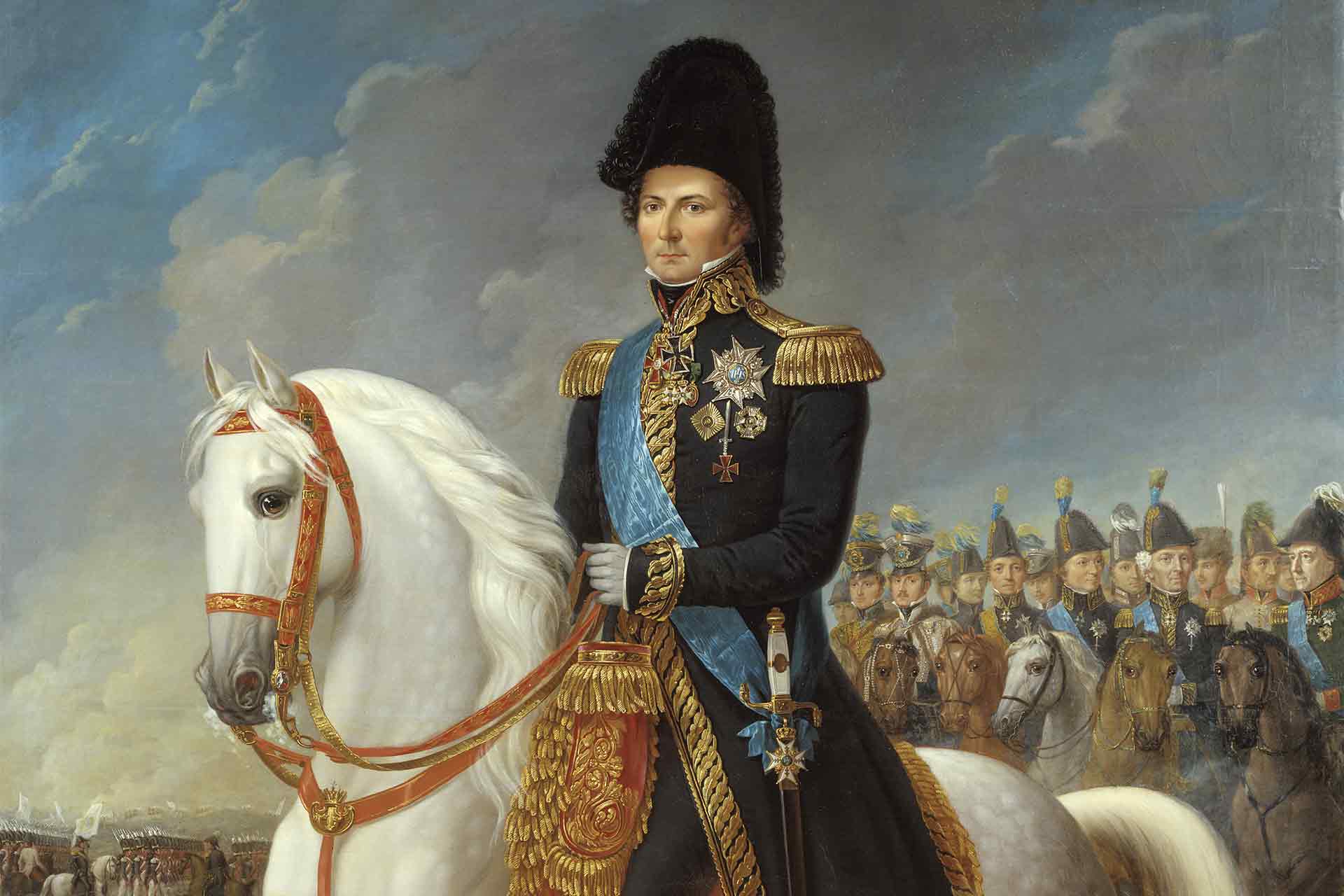
The Unlikely King of Sweden: Jean-Baptiste Bernadotte
 Reading Time: 12 minutes
 In the tumultuous wake of the French Revolution and the Napoleonic Wars, few lives were as unlikely as that of Jean-Baptiste Bernadotte. Born in 1763, the son of a simple French lawyer, Bernadotte clawed his way through the ranks of the Revolutionary army to become one of Napoleon Bonaparte‘s most effective marshals. But his life’s work was not yet complete, for in one of the most surprising twists of the era, he would leave the tricolor to ascend the Swedish throne as King Charles XIV John.
Sweden’s own dynastic troubles and the waning of Napoleonic power created an opening for Bernadotte, a no-nonsense soldier-statesman, to step in and take the reins. His is a story of political winds, the fortune of war, and the indomitable will of a man who defied the expected arc of his time.

Jean-Baptiste Bernadotte’s Early Life and Military Career
Jean-Baptiste Bernadotte was born on January 26, 1763, in the southern French town of Pau in the province of Béarn. The eldest son of an ambitious family, his father, a local prosecutor, died while he was still young. Unable to enter either law or the church on a grand scale, at age 17 he enlisted in the French Royal Army as a common soldier in the Régiment de Royal-Marine in 1780.
The French Revolution, beginning in 1789, transformed France and its army. Aristocratic officers were replaced, with command positions open to those who were both able and loyal to the new Republic. Bernadotte made the most of the opportunities. By 1793, he was a colonel, respected by both his superiors and his men. He was unflappable in a crisis and a strict disciplinarian.
Bernadotte distinguished himself during the Wars of the First Coalition, seeing action on the Rhine front. He commanded troops during the advance into the Palatinate and did an excellent job of organizing his forces and maintaining unit cohesion amid chaotic battles. Bernadotte had a reputation as a fair leader and as a tactically astute officer. He was popular with Republican military leaders, and his name was associated with many politically influential individuals and factions.
In 1797, Bernadotte was made commander of a division in Italy. His role in the successful campaigns in this area made him one of the war’s heroes. Bernadotte was involved in the occupation of key towns and was commended by his superiors for the skill with which he handled civilians and prisoners. He used the occasion to increase his political reputation. Still, he was always careful to avoid being closely associated with any one faction or person, even as the most powerful of the generals became more involved in the revolutionary government.
Bernadotte was appointed briefly as French ambassador to Austria in 1798. His conduct in Vienna offended the Austrian court, especially when he dared to raise the French tricolor above the Austrian double eagle. He was summarily expelled, but his actions did nothing to harm his reputation with the French, who saw it as a diplomatic slight. The action helped to build his image as a staunch Republican. By 1800, Bernadotte was one of the most well-known and well-regarded generals in France, and although he was not at the top, he was on the edge of power.

Marshal of France Under Napoleon
In 1804, Bernadotte was one of the 18 original Marshals of the Empire, who formed Napoleon’s new elite group of military commanders. The position was a logical one for a man of his growing prestige and proved to be the basis for a sometimes-uneasy relationship with the Emperor. By 1804, Jean-Baptiste Bernadotte had years of battle experience, during which he had demonstrated excellent political and military skills.
His new role in Napoleon’s government was extensive, as he served a leading role in many of his campaigns. He took part in the Ulm Campaign of 1805 as commander of a corps that helped trap the Austrian forces there. He also fought at Austerlitz, though his role there was less significant, and his corps later saw action at Auerstedt and Wagram. These last two battles completed the work of establishing French supremacy in Europe.

During his service under Napoleon, Bernadotte at times questioned the Emperor’s orders or otherwise showed a streak of independence that chafed against the command structure of Napoleon’s government. In 1806, for example, after the Battle of Auerstedt, Napoleon ordered Bernadotte to attack the retreating Prussian army. Jean-Baptiste Bernadotte was blamed for not assisting Davout more vigorously.
Davout’s victory at Auerstedt was one of the most one-sided in history, in which a French corps, commanded by Davout, defeated a Prussian army that was twice the size in a headlong rout. The marshals who had not been involved in the fighting (Bernadotte was on the other side of the field) did not appear in force to help Davout or cover his flanks, and Napoleon blamed Bernadotte for the perceived lack of support.
Napoleon nearly court-martialed him for this, but he was able to stave off this punishment through the intervention of his friends in the government and military. His popularity among the rank-and-file soldiers and his record of fairness and honesty also worked in his favor in this episode. Bernadotte continued to serve Napoleon in various commands, as he was pretty effective in his actions, and Napoleon respected him. However, Bernadotte was also seen as somewhat of a loose cannon who might be tempted to go his own way.
The political and social differences between Bernadotte and Napoleon were even more significant. Bernadotte, like other Republican generals in the French army, had always been uncomfortable with the increasingly autocratic nature of Napoleon’s rule. He had held on to many of the ideals of the Revolutionary period. For that and other reasons, some in the imperial government, as well as Napoleon himself, considered the Marshal a possible rival for power. Bernadotte’s marriage to Désirée Clary had also made his relationship with Napoleon more awkward. Désirée had been Napoleon’s former fiancée, and her marriage to Bernadotte had occurred without Napoleon’s consent, much to his displeasure.
The friction between Napoleon and Bernadotte continued even as the latter was given increasingly essential commands. In 1808, he was put in charge of northern Germany, including the Hanseatic cities. His task was to ensure the movement of supplies to the army in Poland, and he effectively organized the supply and administration of this critical area. However, his sense of personal independence and his overall sense of rectitude and fairness often put him in conflict with an emperor who demanded absolute loyalty and unquestioning obedience from his subordinates.
By 1810, these tensions had come to a head between Napoleon and Bernadotte. In that same year, the unusual opportunity would be presented to Jean-Baptiste Bernadotte, which would make him king of Sweden.


Sweden’s Succession Crisis and Bernadotte’s Election
Bernadotte was first elected to the Swedish throne in 1810. At that time, Sweden was experiencing a dynastic crisis. King Charles XIII of Sweden had no heir, and his natural son, Prince Charles August, whom the king had adopted as his successor, had just died. Sweden, which had lost Finland to Russia, needed a strong ruler, and the Swedish Riksdag (parliament) decided to search for a new heir. They turned out to be looking beyond the country’s borders.

The Swedish Riksdag received proposals from many candidates, but Jean-Baptiste Bernadotte had several arguments in his favor. For one thing, Bernadotte was a skilled politician and strategist who had won the respect of many during the wars with his bravery and military skills. Also, some Swedes did not forget the humane treatment that Bernadotte had accorded their countryman captured during the war. In addition, he could distance himself from Napoleon if necessary, which could become a trump card and provide Sweden with political insurance.
The Swedes invited Bernadotte to become king of Sweden, and he readily accepted. For Bernadotte, the invitation was a chance to rise above the turbulent and perilous politics of the Napoleonic court. In August 1810, the Swedish Riksdag elected him Crown Prince. The heir to the throne became the adopted son of Charles XIII and received the name Karl Johan. A commoner with no royal blood, Bernadotte was not a traditional choice, but he made a vow to protect the Lutheran state church and to maintain the constitutional monarchy. Bernadotte’s accession to the throne was thus welcomed by even the most conservative groups of Swedish nobility.
Bernadotte was the first foreign commoner to become the heir to a foreign throne through merit and charisma, and not by birthright.
From French Marshal to Swedish Prince
Bernadotte’s transition to life in Sweden and his position as crown prince were managed with resolve and diplomacy. An outsider with no royal blood, he learned Swedish, converted to Lutheranism, and outwardly demonstrated respect for the country’s laws and political culture. He grew in popularity by maintaining a reputation as a man of peace and stability who could bring military power without the excesses of despotism. Bernadotte also demonstrated an impressive level of self-discipline and a new dedication to the mundane, which was well received in Sweden.
His relationship with the French emperor, with whom he had once been very loyal, cooled from his election onward, as the two could never be entirely comfortable with each other. Bernadotte and his wife had served at the French court for a time, but Napoleon never fully trusted him. They had been growing apart for some time before the prince’s election in Sweden. As Napoleon grew more bellicose and his hold over Europe weakened, Bernadotte saw an opportunity to advance his nation’s interests rather than work for the continued expansion of the French empire.

The clearest evidence of Bernadotte’s departure from the French position occurred during the War of the Sixth Coalition (1812–1814), when, as Crown Prince, he commanded the Swedish contingent to fight alongside Britain, Prussia, Austria, and Russia. He successfully led the campaign, which helped block further French expansion, and during the Battle of Leipzig, he helped engineer a key defeat for the emperor. Although many of his high-ranking subordinates were Frenchmen, and his son was born in France, Bernadotte felt that Sweden’s future lay with the coalition. He remained convinced that he was acting in Sweden’s best interests.
In France, Bernadotte’s name became a byword for treason, although he was also praised for his political skill. In Sweden, he became known as a level-headed, capable leader, and the transition from French general to respected European prince was almost complete. He had taken his place on the international stage as not an agent of empire, but as a voice of restraint and equilibrium.

King Charles XIV John of Sweden and Norway
Jean-Baptiste Bernadotte officially became King Charles XIV John of Sweden and Norway in 1818, ushering in a new royal dynasty that would continue to this day. The choice of a foreign general as king was controversial, and his rule was not without challenges. Charles XIV John’s rise to power represented not just the triumph of a commoner but also the resilience of Sweden as a nation in the post-Napoleonic era.
Charles XIV John’s coronation ushered in a new era for Sweden and Norway, as he set about consolidating his rule and modernizing the country. While some aristocrats resented his commoner background, Charles XIV John’s rule was largely seen as successful, in part due to his cautious, measured approach and his ability to maintain the monarchy’s stability during a time of great change and upheaval.
During his reign, Charles XIV John worked to strengthen internal stability and modernize the country. He supported infrastructure projects, such as roads and canals, as well as agricultural reforms. He also sought to maintain a neutral stance in European affairs, avoiding further involvement in continental wars. Charles XIV John’s reign was also marked by efforts to balance the constitutional monarchy with a strong centralized authority. He often leaned towards executive control, which sometimes clashed with liberal reformers.
Charles XIV John’s reign was marked by the consolidation of the union between Sweden and Norway, established in 1814 by the Treaty of Kiel. While Norway had its own constitution and parliament, Charles XIV John worked to maintain the personal union between the two countries for several decades. His ability to maintain the union through diplomacy rather than military force was a testament to his development from battlefield commander to statesman.
In many ways, the king’s transformation from a revolutionary soldier to a monarch was complete. Despite his authoritarian tendencies, he provided Sweden and Norway with a period of relative peace and stability, and his reign was marked by political conservatism but also steady governance.
Charles XIV John died in 1844, leaving behind a legacy of stability and institutional continuity. In many ways, he died as much the founder of a royal house as he did a former soldier under Napoleon. Charles XIV John’s transformation from a commoner to a king was not only a remarkable personal journey but also a reflection of the broader historical currents of the time. He died not as a revolutionary general, but as a monarch who had secured peace for his adopted countries, founded a royal house, and ushered in a new era for Sweden and Norway.

Legacy and Historical Impact
Jean-Baptiste Bernadotte’s ascension from a French commoner to the throne of Sweden and Norway is a unique tale of social and political mobility in European history. As the son of a provincial lawyer in Pau, France, he climbed the ranks of the revolutionary army not by privilege but through merit, ambition, and a certain personal charm. By accepting the Swedish crown in 1810, he embarked on a journey that would transform a republican general into a constitutional monarch and the founder of a royal dynasty.
Bernadotte’s legacy is etched in the continued existence of the dynasty he founded, which still reigns over Sweden today. His descendants have navigated the complexities of modernization, the world wars, and Sweden’s development into a modern welfare state. It is in this continuity and stability that Bernadotte’s impact is most profoundly felt—a testament to his political acumen and adaptability to new roles without an overbearing attachment to his revolutionary past.
Under the rule of Charles XIV John, Sweden was largely insulated from the turmoil that engulfed much of Europe during the Napoleonic Wars. Bernadotte’s influence on the European stage, particularly his role in the Sixth Coalition and the subsequent defeat of Napoleon, was significant. His leadership helped to re-establish Swedish neutrality, steering the country on a path of non-alignment that would characterize Scandinavian diplomacy for centuries to come.
Reflecting on his legacy, it is clear that Bernadotte’s impact was both practical and symbolic. He was a bridge between the revolutionary France of his youth and the more conservative, monarchical society of Sweden. He showed that personal and national identities could be fluid, adapting to the changing tides of political landscapes. In his life story, we see how ambition and the pursuit of national interest can intersect to create a lasting historical legacy. Jean-Baptiste Bernadotte remains a significant figure in European history, remembered both for his martial prowess and his statesmanship as king.