

A Throne on the Run: Portugal’s Atlantic Exodus
 Reading Time: 12 minutes
 Europe was at war. Napoleon had his eyes set upon Portugal. The Napoleonic Wars had unleashed a rolling crisis of marching armies, tumbling thrones, and old powers reeling on the brink of extinction. In 1807, Napoleon Bonaparte’s armies, trouncing the Continent under their boot heels, were at Portugal’s door. The kingdom was being punished for refusing to join Napoleon’s trade blockade against the British. Cornered by invasion, collapse, and war, the Portuguese crown took the unprecedented step of fleeing rather than surrendering or fighting a losing battle. As one contemporary remarked in disbelief: “the seat of monarchy itself took to the sea.”
The Portuguese removal of its royal court to Brazil was a unique moment in the history of a European empire ruling from its colony. This oceanic escape remade Rio de Janeiro as an imperial capital and reversed the balance between colony and crown. Portugal’s Atlantic odyssey reinvented empire, hastened Brazilian independence, and rewrote global power in ways very few could have foreseen.

Napoleon’s Shadow Over Iberia
In the early 1800s, Napoleon Bonaparte was fighting a war without weapons, an economic battle to weaken his enemies and finance his European hegemony. The Continental System was his answer to subduing British power: he ordered the countries of Europe to blockade British goods and ban all British ships from their ports. This policy was self-defeating, of course; only by weakening the economies of his allies could Napoleon hope to enforce it.
Portugal was an old ally of Great Britain and the British Empire’s single most important trading partner. Napoleon’s ultimatum to the Portuguese government was simple: either blockade Britain or face invasion. On the other hand, compliance with the Continental System would be financial suicide. As one Portuguese statesman put it, obedience to Napoleon would mean “a slow death without honor.”
France had long sought to dominate the Iberian Peninsula, and when Portugal refused Napoleon’s order, Spain was tasked with delivering the verdict. In October 1807, the Spanish government allowed French troops to cross into Spanish territory to invade Portugal. Before the Spanish knew it, the French had overthrown the Spanish monarchy, and Spain was under French control. The Treaty of Fontainebleau, secretly agreed to between France and Spain, called for the dismemberment of the Portuguese Kingdom and the complete subjugation of the Iberian Peninsula to France. Lisbon was in Napoleon’s crosshairs, and time was not on Portugal’s side.
Prince Regent João faced a difficult decision: either defy Napoleon and risk having his country occupied by foreign armies, or obey orders and lose Portugal’s most important trading partner. With the British fleet at his disposal and time running out, the Prince Regent of Portugal chose exile as the best course of action. On November 29, 1807, the royal family fled the country, beginning a long sea journey that would take the Portuguese court to Brazil.
The Royal Escape Across the Atlantic (1807–1808)
In November and December 1807, as French troops advanced on the Portuguese capital, Lisbon, Prince Regent João came to a momentous and unprecedented decision in European history: the court would embark and go into exile. He would not surrender to Napoleon, nor would he attempt to hold out against the French military might. João chose exile as a means to preserve Portugal’s independence. The decision was an act of desperation, yet a rational one: better for the monarchy to live to fight another day.

The British Royal Navy took care of the rest. On a host of ships along the Tagus River, João and his family, courtiers and servants, soldiers and clergymen, archives, paintings, gold, and official documents were loaded as fast as possible. Lisbon “was seen abandoned in a single night,” an eyewitness to the events would later write. The ships set sail and faced one of the worst winter Atlantic crossings on record.
The number of passengers could have reached 10,000 to 15,000 people, on a fleet of over a dozen ships, not all of them part of the royal convoy. Disease, food and water scarcity, and overcrowding were part of the journey. João and the court would arrive in Brazil in early January 1808, after a stopover in Salvador, before continuing to Rio de Janeiro.
What had just crossed the Atlantic was no mere household: the Royal Household was the state. Portugal had not been conquered; it had relocated. The Atlantic went from being a colonial periphery to the center of an empire in motion.
By the time the French entered Lisbon, they encountered a capital that had been hollowed out. The royal palace was silent, the government offices were empty, and the insignia of state had disappeared. Napoleon’s envoys informed him that they had a country without a court, without ministers, and without a king to intimidate or overthrow. The occupation had secured a territory but not an acquiescence. The state of Portugal had eluded them.
Napoleon was said to have been enraged by the flight. He had wanted to bend Portugal to his will or replace its dynasty, not run after an expatriated monarchy over the horizon. The escape had infuriated him and revealed one of his rare humiliations: a European throne had slipped through his fingers. As one Frenchman expressed it incredulously, Portugal had “saved itself by sailing away.” The vacated capital stood as a silent reproach to imperial hubris, showing that sometimes power could be wielded by not staying to fight.

Rio de Janeiro Becomes an Imperial Capital
.The arrival of the court in Rio de Janeiro transformed the city almost overnight from a colonial port into the capital of a world empire. No European monarchy had ever before resided permanently overseas. Streets that had once been designed for colonial administration were now the site of royal ceremonies, foreign ambassadors, and all the pomp and business of empire.
As one observer noted, Brazil was no longer a colony but “the seat of the monarchy itself.” Institutions of rule were quickly re-created. Royal councils, ministries, courts of justice, and treasury offices were soon functioning. The Banco do Brasil was founded, censorship was relaxed, and the use of the printing press (strictly forbidden in Brazil for decades) was authorized. All of these developments marked a radical change: the colony was no longer governed by institutions that operated through Lisbon but directly by the court in Rio.
Life in the capital, too, was remade by the presence of the court. Libraries, academies, theaters, and scientific societies were created or expanded by royal order. Artists, scholars, and engineers of all kinds accompanied the court from Europe, along with a host of nobility who reshaped elite culture and ceremony in the city. A new sense of hierarchy marked social life as the nobility became more visible.
Meanwhile, urban expansion followed rapidly. Brazilian ports were opened to the world in 1808 (breaking Portugal’s centuries-old trade monopoly), and commerce with the world (especially Britain) skyrocketed, leading to an explosion of population and wealth in Rio de Janeiro. This rapid urban growth put pressure on housing and basic infrastructure, contributing to growing inequality.
Hosting a European capital had a profound impact on Brazil, fundamentally changing its identity. The court’s relocation in Rio elevated colonial elites, fostered a new political confidence, and sowed the seeds of political autonomy. The colony was no longer peripheral but imperial.
Brazil’s Elevated Status
The arrival of the Portuguese court also brought an abrupt end to Brazil’s status as a closed colony. João’s first significant act was the 1808 edict opening Brazilian ports to the ships of friendly nations, undoing centuries of mercantilist policy that had restricted trade to Lisbon. British and other merchants soon arrived, and Brazil became a full participant in global trade. “From prohibition to abundance almost overnight,” remarked a contemporary, as goods, money, and ideas began to circulate with a freedom never before experienced in Brazil.
In addition to the growing royal institutions in Rio, Brazil was no longer ruled at a distance. Ministries, courts, and councils were fully functional and resident in Rio de Janeiro, where policy and decisions were made that previously would have been decided in Europe. Laws were published locally, not printed and shipped across the Atlantic. In practical terms, the political reality of Brazil had changed: no longer was the country a colony that was ruled from Portugal. Instead, it was the place where Portugal now ruled. The locus of power had shifted with the court, and with it the empire’s center.

João would formalize this in 1815 with the declaration that Brazil was a kingdom equal in status to Portugal in the United Kingdom of Portugal, Brazil, and the Algarves. The change also came with another fundamental shift in nomenclature, with the use of “colony” for Brazil essentially abandoned. In one stroke, Portugal’s new king made an unprecedented move in European imperial history: a colony had become a co-capital of empire, with Rio joining Lisbon in both name and function.
The implications were dramatic. Brazilian elites could now access offices and honors previously denied to them. The economy expanded, the cities grew, and new cultural institutions were founded with royal patronage. At the same time, however, Portugal was diminished by the move, its talent and attention sapped by the transfer of the court to Brazil and with it the center of imperial gravity now pulled decisively across the Atlantic.
By transferring sovereignty to Rio, the monarchy irrevocably altered the dynamics between the colony and the metropole. When the court returned to Europe years later, Brazil could never be reabsorbed in the same form. The very act of ruling had prepared the ground for independence, since an empire that could be moved was an empire that would never again be the same.
Consequences for Portugal
The king and court’s departure proved to be a “catastrophic decision” for Portugal. With the loss of the court, there was a marked economic regression. All trade routes were directed to Brazil, and the flow of customs revenue dried up completely. Ports were effectively abandoned by the government and dominated by British merchants, protected by wartime alliances. Lisbon, the former centre of the Portuguese Empire, became the capital of a small, largely self-contained principality. “We had become,” wrote one pamphleteer of the time, “a kingdom without a king, and a nation without direction.”
Politically, the country also suffered. The many councils that effectively ran the country in the king’s absence had no authority. The British military advisers to the government had an inordinate influence, which increased public bitterness. Widespread resentment also festered at the sight of the Portuguese being treated as a colony by its own colony. As one observer remarked of the situation in 1808, “we should have to suffer occupation, taxes, and misery in the mother country while they, across the sea, hold all the privileges.”
The widespread resentment developed into a force for political change when, following the Napoleonic Wars, many officers, merchants, and reformers started calling for the introduction of constitutional rule, the end of absolutism, and a return of the king to Portugal. The fact that the court remained in Brazil and, to the public’s mind, had treated Portugal as a satellite of its own colony was considered a great humiliation. The growing liberal movement in Portugal grew increasingly vociferous as the country’s political situation developed. In 1820, liberal forces from Porto invaded the capital, demanded a constitution, imposed limits on the monarchy, and restored Lisbon as the seat of the government.
Pressed by the circumstances and fearing more loss of control, King João VI reluctantly returned to Lisbon in 1821. However, the damage had already been done. The court’s absence and the relocation of the kingdom to Brazil weakened royal authority in Portugal, strengthening the liberal movement and accelerating Brazil’s independence. Portugal had been radically diminished and transformed by this shift in the seat of power.
Seeds of Brazilian Independence
With the court in Brazil, the colony suddenly became the center of the empire. Local merchants, landowners, and bureaucrats began to have access to the power, patronage, and institutions that had previously been the exclusive domain of Lisbon. When the ports were opened and administrative authority decentralized, Brazil began to exercise power in practice, not just in theory.
Brazil’s new autonomy as the center of the empire only increased when it was elevated to a kingdom equal to Portugal in 1815. The institutions and personnel that made Rio a metropole also produced an elite accustomed to privilege. As one observer wrote, they were “accustomed to command rather than obedience,” with significant psychological effects.
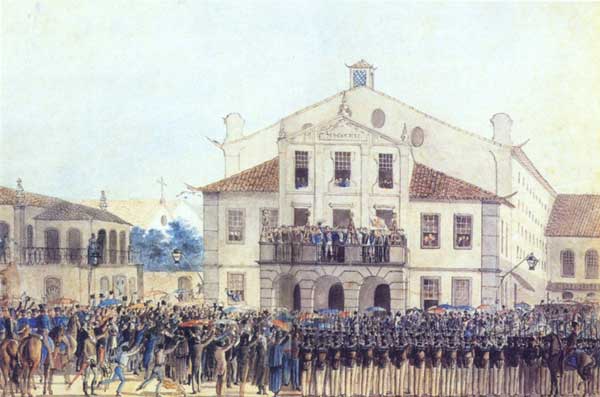
The delicate balance between colony and metropole was broken when João VI returned to Portugal in 1821, in response to demands from the Liberal Revolution. Portuguese lawmakers tried to roll back Brazil’s autonomy, proposing measures to close institutions and return political power to Lisbon. Brazilian elites were rightly alarmed at the threat of a renewed colonial regime.
Fortunately for them, João had left behind his son, Dom Pedro, as regent in Rio de Janeiro. The young prince was able to position himself with the Brazilian side and successfully resist orders to return to Portugal. In January 1822, Dom Pedro famously declared, “If it is for the good of all and the general happiness of the nation, I am ready: tell the people that I stay.”
A break with Portugal soon followed. On September 7, 1822, Dom Pedro issued a declaration of independence and began to reign as emperor. As he reportedly shouted, “Independência ou Morte!” By moving the capital to Brazil, Portugal had inadvertently set in motion the region’s final separation.
A Unique Moment in World History
Portugal’s flight to Brazil was without precedent or equal. In terms of empire, no European imperial power ruled from a colony rather than the continent before or since. For a time, Rio de Janeiro, rather than Lisbon, was the seat of the world’s greatest monarchy. Lisbon, in turn, became a lesser, provincial city and, by default, an occupied territory. No other European power would ever again take such an extreme step.
The reversal of imperial order changed Atlantic geopolitics. In particular, Britain, as the regime’s protector, derived substantial benefits from trade and naval access to Brazilian waters and commerce. In geopolitical terms, the move redrew the map of the Atlantic world, which became more Brazil-centered and less Lisbon-centered, both politically and economically. Power was now shifting to the west.
In the end, the flight saved the monarchy at its point of greatest vulnerability. João VI escaped Napoleon’s grasp and continued to rule without losing the dynastic legitimacy that made his kingship tenable. However, the monarchy’s new life came at a price, as strengthening Brazil weakened its authority over its largest colony.
Once the court returned to Europe, the empire could not be restored. Instead, Brazil’s independence quickly became a fait accompli. Portugal was left weakened but not destroyed, since the throne itself had been preserved, while its empire was not.
When Survival Changed History
Portugal’s flight across the Atlantic achieved its immediate purpose: the crown endured while much of Europe bent under Napoleon. The monarchy escaped capture, preserved legal authority, and continued to rule—albeit from an unexpected shore. Yet survival came with a price. By relocating power to Rio de Janeiro, Portugal altered the balance of its own empire, weakening the metropole even as it strengthened the colony. As one contemporary remarked, the kingdom had been “saved, but transformed.”
The legacy of that decision still echoes. Brazil emerged with institutions, confidence, and autonomy that made independence inevitable, while Portugal entered a long period of adjustment and decline. More broadly, the episode revealed how a crisis can upend established orders. When states act to survive, they may succeed—only to discover they have reshaped the world in the process.


