
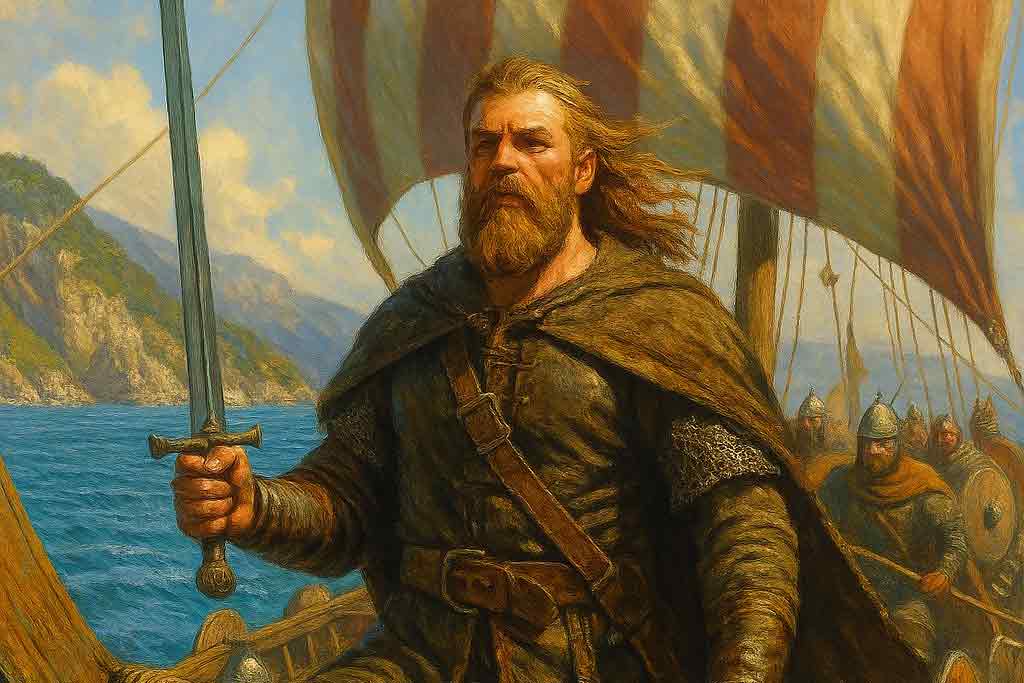
Bjorn Ironside: The Most Adventurous Son of Ragnar Lothbrok
 Reading Time: 10 minutes
 A Viking Legend Takes to the Seas
Few names in Viking history are as well-known as Ragnar Lothbrok. A legendary Viking warrior, the most feared Viking of his day, Ragnar was supposedly responsible for raids across Europe. He was said to have fathered many children, all of them great heroes in their own right, but perhaps none has captured the imagination quite like Bjorn Ironside.
The son of Ragnar, Bjorn, was a figure who appears in both the sagas and the continental chronicles. He was a mighty warrior and one of the most intrepid and daring explorers of the Viking Age. Frankish chroniclers wrote of Bjorn ravaging the lands of Gaul with his men, while sailing as far south as the Mediterranean. Scandinavian sagas described his adventures as a clever and brave seafarer. The son of Ragnar Lothbrok, Bjorn had a name that sounded like no man could best him.

Early Life and Lineage
The origin and parentage of Bjorn Ironside, like many figures from the Viking Age, are mired in legend and conflicting traditions. In the Saga of Ragnar Lodbrok, his mother is given as Aslaug, the daughter of the legendary hero Sigurd and the shieldmaiden Brynhild. In another tradition, one which gained popularity through Saxo Grammaticus’s Gesta Danorum, Bjorn was born to Ragnar and Lagertha, a fierce and independent warrior woman. While the true identity of Bjorn’s mother may never be known with certainty, these sagas are consistent in their portrayal of his birth to a family of legendary lineage and his upbringing as a true son of Norse values: hardy, fierce, and independent.
Rising among his brothers, especially those like Ivar the Boneless, Sigurd Snake-in-the-Eye, and Halfdan Ragnarsson, Bjorn’s youth was marked by the formation of one of the most feared Viking sibling groupings in history. While the sagas suggest a closeness between Bjorn and Ivar, they also make clear the different paths each would choose, with Bjorn focusing more on distant campaigns and maritime exploration. It would be these campaigns with the Great Heathen Army in England and continental Europe, however, that would forge an unbreakable bond between them.
From a young age, Bjorn displayed an aptitude for warfare and sea raids that foreshadowed his later life. Accompanying his father on several early raids, Bjorn developed a keen sense for battle and command, quickly building a reputation for himself as a daring and effective warrior. The sagas recount that Ragnar, impressed by his sons’ thirst for adventure and conquest, bestowed upon them ships of their own to command. Bjorn made his mark in independent raids with a temerity and strategic acumen that would define his career. These early forays into Viking raids laid the groundwork for his later legendary journeys to lands far beyond the well-trodden coasts of Scandinavia.
While much of Bjorn Ironside’s early life is lost to legend and the fog of time, it is clear that he demonstrated the hallmarks of the man he would become: strength, independence, and a wanderlust for distant shores. Whether he was the son of Aslaug or Lagertha is perhaps less important than the lasting impact he would have on Viking history. As the sagas reveal, from his earliest days, Bjorn was set on a path not just to fight, but to explore, to conquer, and to lead far from his native homeland.
Legendary and Historical Sources
A great deal of information about Bjorn Ironside is taken from both saga literature and historical chronicles. In The Saga of Ragnar Lodbrok and The Tale of the Sons of Ragnar, Bjorn is mentioned as one of Ragnar’s sons who were destined for greatness from birth. In both works, Bjorn is written as a great and daring raider who traveled to faraway lands, defeated many powerful enemies, and returned home with great riches. The sagas also describe Bjorn as a descendant of a mythical family line, further muddying the waters between fact and fiction in his life.
In Frankish and Arabic sources, some writings indicate the historical nature of Bjorn’s exploits. In particular, in Frankish sources, including the Annals of Saint Bertin, it was reported on the campaign of a Viking leader later identified as Bjorn, who participated in the siege of Paris in 845 AD. The Arab historian al-Masudi also recorded the story of a Viking leader who led his troops to the Mediterranean Sea, which is also described in the sagas about Bjorn’s campaigns.
The problem with much of the study of Bjorn Ironside comes from trying to deduce a historical record from sagas. Oral storytelling in Viking culture was full of symbolism and heroism, a quality that was further elevated in saga literature, with prose intended to thrill audiences. On the other hand, much of the writing from European sources at the time was about the Vikings, often written in a state of fear or awe, which also affected the biases in those works. Bjorn, thus, falls into a gray area between folklore and real history, which makes him all the more interesting.
At the same time, there are many overlaps among the sources that corroborate the existence of an influential Viking leader named Bjorn, who was very active in the mid-9th century and impacted much of Europe. Whether he is regarded as a man of myth or a man of history, Bjorn Ironside is a symbol of Viking world ambition, both a real person who lived during a turbulent period of European history and a legendary adventurer.

Raids in France and the Mediterranean
One of Bjorn Ironside’s most famous feats was the Viking Siege of Paris in the year 845 AD. A large Viking fleet, according to Frankish sources like the Annals of Saint Bertin, under the leadership of a chieftain called “Reginfred” or “Berno” sailed up the Seine River and ravaged Paris. Many historians accept that this chieftain was Bjorn Ironside, acting either on his own or in his father Ragnar Lothbrok’s name. The raid sent shockwaves through Paris, culminating in Charles the Bald, the King of West Francia, paying the Vikings a ransom of 7,000 livres of silver to depart. This was a massive sum at the time and only added to Bjorn Ironside’s legend.
Capitalising on his success in Francia, Bjorn went on to take a fleet of Viking ships through the Strait of Gibraltar into the Mediterranean Sea, entering a sphere that had, until this point, been relatively unexplored by Norse raiders. Bjorn and his army would go on to ravage several settlements in the Mediterranean in the process, becoming one of the first Vikings to ever venture in force into the Mediterranean basin. The Mediterranean campaign was both audacious and transformative; it enabled greater opportunities for raiding and trade in new lands.
In the Tale of the Sons of Ragnar, it is written that Bjorn and his warriors set about ravaging the coastlines of Spain and southern France. Their ships ransacked cities and wealth along the coast of Algeciras and the Balearic Islands. The impact of these raids was catastrophic on the populations of the Mediterranean coast. Arabic historical sources such as al-Masudi corroborate the presence of Viking ships on the shores of the Mediterranean in the mid-9th century. Al-Masudi described them as northern barbarians who appeared with the fury of fire and disappeared just as quickly.
Bjorn’s fleet of ships is also believed to have reached the coasts of North Africa, where it met fierce resistance and unfamiliar geography. Little is known about the outcome of these African adventures, but their very occurrence highlights the audacity and seafaring expertise of Viking explorers in Bjorn’s command. Bjorn’s expansion of Norse horizons into previously unexplored and hostile territories made him a pioneer of Viking seafaring.
Possibly the most well-known of all of the tales from Bjorn’s Mediterranean adventure is the raid on the Italian city of Luna. Mistaking it for the city of Rome, the Vikings made landfall on its shores, and Bjorn is said to have hatched a plan to secure a quick victory. He is said to have faked his own death, and in his will requested a Christian burial in the city’s walls. His coffin was brought in, only for Bjorn to leap out of it with a sword and open the city gates to his men. The story is likely apocryphal, but it is no less indicative of Bjorn’s reputation for guile as well as his courage.
Bjorn Ironside’s Mediterranean ventures established him as a Viking of unprecedented vision. While most Norse warriors were content to raid along the coastlines they knew, Bjorn ventured his fleet into uncharted waters far from home. His expeditions around France, Spain, Italy, and possibly North Africa redefined the scope of Viking influence and made him one of the most mythologized men of the Viking Age.

Return to Scandinavia and Rule in Sweden
It is suggested that Bjorn Ironside returned from his extensive pillaging of the Francia, Spanish, and Mediterranean coasts of Europe back to Scandinavia full of treasure and glory. The saga chronicles depict Bjorn as a returning hero who brought wealth and tales of foreign lands and bold adventures. He was well-received upon his return, and his reputation as one of the most successful Viking raiders of his time was cemented. The Tale of the Sons of Ragnar even states that Bjorn Ironside’s fame was comparable to that of his already illustrious father.
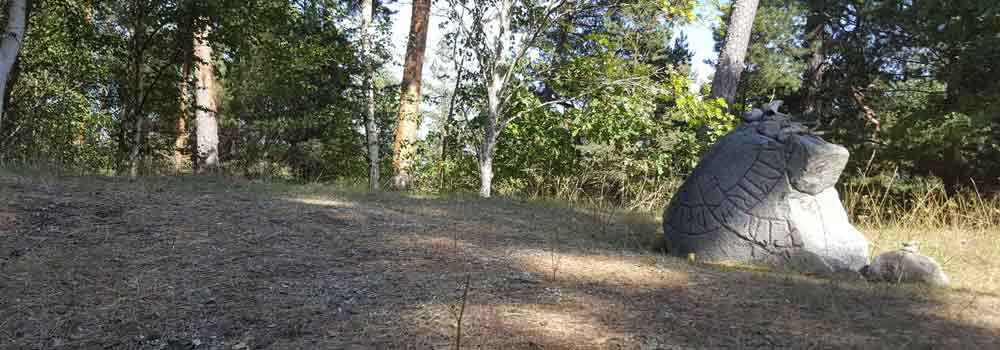
Bjorn Ironside, according to Norse oral history and tradition, was a king in Sweden. The sagas state that he founded the Munsö dynasty, which ruled in the Lake Mälaren area, and that his seat of power was the Kingdom of Uppsala, a regional power in Scandinavia that served as both a political and spiritual hub during the Viking Age. While no archaeological evidence has been found to tie Bjorn directly to the Munsö burial mounds, tradition maintains that this is the case.
This period of Bjorn’s life marked a significant change in his status from warrior to king. He is said to have ruled with the same tactical acumen with which he had waged war. His reign focused on strengthening and organizing the area, with control of trade routes and regional alliances likely a focal point. As with most of his reign, it must be reconstructed from saga literature. The transition from raider to king reflects Viking society’s shift from warrior bands to more structured, sedentary communities.

As much as he was a king, his reputation was founded in his identity as an adventurer. Skaldic poets within his court likely focused on glorifying his seafaring journeys, and the retelling of his brave deeds became central to his legacy. This myth-making process served to embellish the legends of Bjorn Ironside and to carry his name into future generations. Bjorn Ironside’s later life as a legendary king is representative of the larger Norse movement from pillaging and raiding to settlement and permanence.
Saga tradition states that Bjorn left behind a lineage and a dynasty that would continue to hold sway over the region for generations after his death. The dynasty he supposedly founded is considered to be one of the ancestors to later Swedish Kings. As with much of his early life, the veracity of these claims is up for debate, but in saga tradition, Bjorn is always portrayed as a vital king and patriarch. As an established figure in both recorded history and myth, Bjorn Ironside is a Norse historical figure who is a connection between the Viking world of conquest and the larger monarchal structure that was on the rise in Scandinavia.
His return to Scandinavia was not the conclusion of his saga but a new beginning that only further defined his already impressive legacy. He was a king who brought a different kind of strength and stability to the region. Still, as a legend, he was immortal, leaving behind a legacy of leadership and thrilling exploration, and a legacy that would continue to mold Viking identity in the years to come. In one way or another, Bjorn’s reign in Sweden is a necessary piece of his broader mythos.
The Legacy of a Viking Explorer
The life of Bjorn Ironside was a microcosm of the Viking Age – a time of intrepid exploration, brutal raids and conquest, and empire-building. From the sack of Paris to the shores of the Mediterranean, his larger-than-life exploits helped define the era of Viking expansion. In contrast to many of his contemporaries, Bjorn transitioned from pirate to king, establishing a legacy in Sweden that outlived him. His audacious spirit and thirst for adventure set him apart, making him one of the most legendary sons of Ragnar Lothbrok.
Saga sources claim that Bjorn founded the House of Munsö, which ruled parts of Sweden and other Scandinavian territories for many generations. Scholars place them variously in the 9th to 11th centuries, based on interpretations of the sagas and scant historical records. In any case, they are thought to have governed a fiefdom that extended from central to southern Sweden. Thus, whether more history or more myth, Bjorn Ironside’s enduring legend serves as a shining example of the Viking explorer, undaunted by distant horizons and fated for greatness.


