
Philip IV’s Blueprint for Destroying the Knights Templar
 Reading Time: 21 minutes
 On Friday, October 13, 1307, a few minutes before dawn, officials of the King of France began arresting Knights Templar throughout the kingdom. The arrests occurred nearly simultaneously—in an unprecedented feat of communication, men were taken before messengers could warn the others, Templar commanderies were ransacked, and documentation seized. Medieval Europe was as amazed by the efficiency of the operation as it was by the charges leveled against the Templars. Overnight, a disciplined religious order had become synonymous with organized crime.
Philip IV of France, known as “the Fair,” had ordered the arrest of the Knights Templar. Philip was determined to assert as much power as possible in his kingdom and heal the financial woes that plagued his reign. The Templars were targeted because they answered only to God; they were rich, international, and beholden to no king.
This article demonstrates that the Templars were not, in fact, dismantled by disgruntled former members or popular outrage. They were dismantled through financial manipulation, propaganda, legal action, and pressure on Pope Clement V. Philip IV’s example serves as a lesson for how absolute power can allow rumor to become evidence, evidence to justify torture, and “confessions” to silence dissent.

The Knights Templar Before the Fall
The Knights Templar began as a small group of knights formed in the early 12th century to protect pilgrims traveling to and from Jerusalem. They were unusual: monks who fought. Templars were expected to adhere to monastic codes of conduct, but they were warriors first and foremost. As the order grew, it carried this duality with it: an ideal of spiritual warrior-hood that granted it high status in feudal Europe.
To join the order, brothers took vows of poverty, chastity, and obedience as in traditional monastic orders, then swore to apply their martial skills in defense of the Holy Land. The order’s rule, written in 1129, strictly regulated Templar behavior and prescribed a life that balanced obedience and poverty. It was intended to restrain knights who were accustomed (even in war) to considerable independence, who went into battle armed and rode on horseback.
In the field, the Knights Templar were heavy cavalry and effective garrison troops. Their rapid deployment and tenacity on the battlefield made them valuable. They were particularly praised for their ability to hold dangerous border territories. Within the crusader states, they developed into a professional force loyal not to feudal lords but to Christ. As such, they were both a dependable tool of war for unruly kings and a welcome source of professional manpower.
This martial potency was matched by an administrative one. Gifts from supporters and donors gave the order extensive tracts of land, farms, mills, rents, and revenue. Individual Templar Houses, known as commanderies, dotted Europe and served as estates that funded Templar activity in the Holy Land. Their broad distribution allowed the Templars to act with a level of independence and infrastructure that was uniquely medieval.
They grew financially powerful, too. Trusted with valuables, deposits, and transfers, the Templars were able to offer travelers and nobility the ability to move wealth without the danger of having to transport coin. It was a convenience that only served to increase the Templars’ influence in court; being able to access resources or store wealth could mean the difference between starting a campaign and seeing it fail before it began.
The Templars were also protected by the Church. The papal bull Omne datum optimum (1139) placed them directly under the protection of the Pope and bolstered their privileged status. Unlike most monastic orders, the Templars could claim direct access to Rome for authority. Local church leaders could not interfere in Templar affairs, which made them immune to many royal demands as well.
Once vital and imposing, the Knights Templar existed in an awkward position with European kings. Most respected and relied on the order for their martial and financial prowess. Both kings and the Pope feared what might happen should an order, armed with wealth and the insulation of papal protection, decide to follow an agenda of its own.
So long as the crusades were a central focus that problem could be set aside. When the needs of kings grew more immediate and crusading a distant memory those same qualities caused the Templars downfall.
Why Philip IV Turned on the Knights Templars
Philip IV’s war on the Knights Templar began with a cash-strapped monarchy. The king engaged in expensive wars and faced perennial budget crunches, so he consistently looked for ways he could bring funds into the treasury. This background is important because the Templars weren’t just spiritual warriors. They were a major banking network with estates, deposits, and administrative capabilities of their own.

The immediate pressure of debt heightened the king’s interest. Philip had borrowed from large financiers and used arrests and seizures as a form of fiscal policy in the past, even targeting creditors. By this point, the crown’s financial woes were also political: Whoever could tap into credit, records, and systems of repayment could shape the monarchy’s capacity to wage war and govern territories.
But so was political centralization. Philip sought to bring royal power to bear on institutions that positioned themselves as above the crown, and his conflicts with the papacy several years prior illustrated this tendency. Philip rejected any notion that royal taxation and authority should be limited by external powers. The French kingdom was sovereign, and he intended it to act like one. An order loyal only to the pope did not fit into this scheme.
The Templars were a vulnerable target. Secretive, in possession of valuable records, and sprawling international group, they were both powerful and singular. To Philip, they looked like a state within a state, with armor, riches, and the protection of papal immunity.
Philip’s war on the Templars was also about disabling a rival power center. Information and templar property would likely be redirected to someone after their fall, but in the short term, the monarchy attained assets and intelligence that could be used against one of the wealthiest organizations in Christendom. Fear of being next would haunt other groups.
A purely destructive approach would have left Philip with fewer tools for forcing Templar cooperation. The addition of heresy gave Philip’s campaign an urgency that carried throughout Europe, and questioning produced confession-like statements that could be used to justify taking action. “Pardon and favor” were to be promised to those who gave said statements, according to one summary of the arrest orders.
Pulling the entire effort off required leverage over the pope. Clement would have to legitimize attacks on a religious order, so weakening his temporal authority in areas like taxation was key. Already, Philip had been through a long conflict with Clement’s predecessor, so he was aware of how much pressure a French king could successfully place on Rome. Renewed pressure helped turn a domestic arrest campaign into an international persecution.
Setting the Stage
Philip IV’s decision to persecute the Templars was not a sudden decision. First, he had to lay the groundwork for the persecution. Years of stories were collected, rumors verified, and hearsay massaged into something resembling a pattern. Proof in the medieval courtroom was often simply testimony and rumor. The crown needed enough voices to justify extreme measures.
In various forms, whispers had circulated for years. Talk of secret rituals, unusual practices during initiation, and illicit immorality. Voices of discontented insiders mingled with those who hated the order for its riches and influence. But the king’s agents sifted through these rumors like prospectors searching for gold.
Informants were valuable because they provided details. Vague charges like “heresy” could be raised anytime, but they couldn’t be acted upon. Officials needed scenes and conversations, rituals and language that sounded plausible. Little files were built on every credible report: laundry lists of charges, names to track down, and questions to ask during interrogation. Build enough potential testimony into a standardized format, and it becomes easy to coerce confessions to fit the mold.
Public opinion was primed as information was collected. The Knights Templar were popular but secretive. Secrecy lends itself to whispered speculation. Lewd accusations about blasphemy and homosexuality were given just enough credence to spread quickly. The goal wasn’t necessarily to persuade the public, but to ensure that few would raise their voice when arrests were made.
Philip framed the assault as a purge of sin rather than a power play. If corruption could be attached to the order in enough circles, attacking them became an act of protecting the faith. Belief in the charges mediated sympathy for the Templars, and doubting the king quickly became unthinkable. In short, Philip intended to put his opposition on the defensive: who wanted to publicly support or defend heresy?
Coordination was key. Such an attack needed to spread across the entire kingdom in one fell swoop. Plans had to be made in secret, preserved by trusted advisers. Orders had to be ready to transmit faster than any word of those orders. Regional governors needed lists of names, inventories of holdings, and contingency plans for holding prisoners.
The emphasis on planning wasn’t limited to arrests, either. Property lists, seals, and account books were worth as much as prisoners on day one. If Philip could grab every document and treasury on day one, he could write the narrative on day two. In Philip’s campaign, built around the Templars’ purported illegalities as evidence against them, information and money were ammunition.
By the time the arrests would finally begin, the facts had already been established. Rumors had been consolidated into charges, whispers had been amplified to soften public reaction, and politicians had been primed to strike as one. Philip’s strategy was powerful because it marginalized resistance before the Knights Templar could even say a word in their defense.

Friday the 13th, 1307
On Friday, October 13, 1307, Philip IV oversaw one of the most coordinated raids in medieval history. Officials across France were given the same orders—to arrest the Templars before they could alert one another. Surprise was everything. The entire Templar network was paralyzed, scrambling to understand what was happening while the perfect official explanation was staged.
How coordinated were the raids? Orders were written ahead of time. Executable instructions were delivered to local authorities so that arrests and seizures could happen simultaneously. As historian Dan Jones puts it, “Each set of royal agents… arrest[ed] the brothers and impound[ed] their property.”

Priority arrests were placed not just on Templar knights but also on their houses. The arrest schedules would isolate commanders, while searches would secure “commanderies”—administrative hubs from which Templars were often dispatched. Personnel would be arrested. Assets would be frozen. Houses would be sealed. Official communication would be impossible.
Important Knights Templar leaders across Europe were arrested that morning as well. Jacques de Molay, Templar Grand Master, was taken into custody in Paris alongside the king’s other orders. Arresting leadership on day one was important. Removing leaders insulated the monarchy from organized resistance and vested it with more “evidence” that the order itself was at fault, not simply rebellious members.
Gold was seized. Documents were taken. Royal officials were instructed to secure seals, treasure, and “official papers” as they saw fit. Templar records would be seized or locked under royal authority. Contracts, accounts, and internal Templar communications would now be in the king’s possession. Property would be disputed later—but everyone knew who held the deed on day one.
Templar prisoners were isolated from one another. Separating prisoners protected the arrests from coordinated messaging, but it would also allow individual Knights Templar to be interrogated privately. Philip IV could accuse and apply pressure. He could check answers against conflicting/confessions and build “patterns” of guilt.
1307 wasn’t the end of the Templars—it was the beginning of their downfall. In less than twenty-four hours, rumor was transformed into orthodox narrative; in less than one day, a protected religious order became a prisoner of the state. Friday the 13th became unlucky because it was when Philip decided to move fast.
Building the Case: Charges and Interrogations
Arrests were one thing; confessions were another. Philip IV couldn’t just imprison the Templars—he had to build a case that would hold water. To do so, officials interrogated men about acts of “heresy,” specifically denying Christ, spitting on the cross, and engaging in obscene practices during initiation rites. Templars were also charged with idolatry, sodomy, and trining moons with their lips—all juicy distractions from the lack of hard evidence.
Suspects were fed specific questions about specific acts to ensure their stories were flush with consistent details. These testimonials were often replicated from man to man so that if several accused Templars described the same ghastly details of their “initiation,” it looked independently verified.
Torture also factored into the effectiveness of questioning. According to some accounts, Templars in Paris were waterboarded, boiling oil was shoved under doors targeting the prisoners’ feet (aka “fire torture”), and they were otherwise brutalized until they admitted to the charges against them.

The cycle then repeated itself, with each confession becoming proof that soon encouraged the others to confess. If a Templar admitted to spitting on the cross, it didn’t just show he was guilty—as far as the crown was concerned, it gave legal investigators reason to distrust everyone else.
Jacques de Molay, the order’s Grand Master, was not immune to these tactics. De Molay confessed to some charges in October 1307, “probably under torture,” but denied others. This was good enough for Philip: if the Grand Master confessed to some charges, history would remember him as a confessed criminal.
Slowly but surely, these “confessions” were woven into a full-fledged plot. If the crimes were systemic among Knights Templar in one commandery, the logic went, then why not across the entire kingdom? Evidence took a backseat to rumors, pulled confessions given under torture.
Needless to say, interrogation played a crucial role in the downfall of Templars across Europe. Raids destroyed the order’s hierarchy, while confessions gave Phillip IV the tools to finish it off.
Cornering the Papacy
Philip IV’s biggest hurdle wasn’t stone or steel. It was jurisdiction. As a religious order, the Templars answered only to the pope. If Philip wanted to dress up their destruction as lawful, he needed Pope Clement V to hear the case… or at least not intervene.
Early on, Clement resisted because the Templars had long been faithful servants of the Church. They fell directly under papal jurisdiction, after all. But Clement was a politically weak pope, and that weakness stemmed from Philip. Clement was the French pope in a world where Philip had already fought the Church and lived to tell about it. All of his subsequent decisions were filtered through that power imbalance.
Philip used leverage to make what should have been an exclusively French police action into an emergency of the Church itself. Once arrests were underway and confessions were flowing, the king couched any hesitation as harm: delay meant the guilt of silence if heresy was at hand. Clement faced pressure to take “action” even if he believed the quality of evidence was lacking.

This made it a fight over who had the authority to judge. Philip’s courts could arrest and torture, but only the Pope could officially condemn a papal order or authorize its dissolution. Clement tried to maintain control of the judicial process, but he paid a political price for moving against France.
This came to a head on November 1307, when Clement signed the bull Pastoralis praeeminentiae. It ordered Christian kings to arrest Knights Templar and take their assets on behalf of the Church. What had been a mostly French affair became continental. In practice, it universalized Philip’s narrative.
Lots of European rulers and churchmen outside France were suspicious at that point, and it worked out differently place to place. But universal extension was valuable to Philip because it made international refuge harder for Templars. It also made everyone feel like this was about more than one king’s politics: if the pope called for action globally,
The final act took place at the Council of Vienne (1311–1312). According to Encyclopedia Britannica, there was no comprehensive trial. Instead, Clement suppressed the order by an act of the papacy under intense pressure from Philip. The decision allowed Clement to protect the prerogatives of papal authority, but resolved the jurisdictional conflict in Philip’s favor.
The Trial Machine and Political Theater
Philip IV’s approach relied on presenting politics as a form of purification. By defining Templars as heretics, prosecuting them as such became salvaging Christianity rather than consolidating control. If Templars were theological threats, purging them cleansed. Hearing “confessions” purified the church, and arresting leaders purified the kingdom.
Trials as theater emphasized that view. Trials, announcements, and rote denunciations cultivated a sense of inevitability. The monarchy wanted observers to feel they were witnessing justice, not expropriation. The more overtly legal it appeared, the safer Philip felt proceeding.
As such, much of the forcing function was hidden. Threats and trickery secured cooperation during interrogations. Keeping defendants apart robbed them of a unified story. Commit something to writing, and it could be paraded forever, long after the threats leading to that “confession” were sealed away. Legalism functioned as performance, and performance isn’t fair, but it can be effective.
Secrecy also played into the case, based on assumptions of the time period. Templars’ private rituals and internal discipline were construed as evidence of conspiracy. If they had secrets, then officials argued the worst kind of rumors must be true. Secrecy was guilt, and guilt was cause enough to take down an organization.
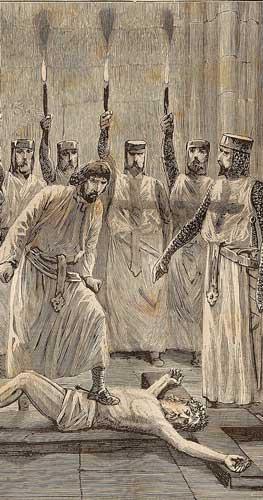
Doubt and distrust fractured the order from within. Some knights caved to the pressure and named names, but many clarified their “confessions” when given the chance to speak privately. Many never wavered, maintaining their innocence all along. These inconsistencies were important because they allowed the worst “confessions” to be treated as truth while painting retraction as weakness or deception.
Retraction was risky business. After confessing as a heretic, taking back one’s statement was equivalent to relapsing. The price of safety became riskier still. One was encouraged to convict themselves, stay quiet, and hope for the best.
Owing to machinations like these, the operation against the Knights Templar became a “trial machine.” Law, intimidation, and pageantry became parts of a self-sustaining purpose: destroying the Templars by any means necessary. Philip didn’t need all members to believe their targeted order was guilty, just enough knights that honesty looked like insanity.
Dissolution and Redistribution
By 1312, the question was not whether some Templars were guilty, but what to do about the order itself. Pope Clement V decided at Vienne that suppression was preferable to definite judgment. The Templars ceased as a legal entity with the issuance of the bull Vox in excelso, dated March 22, 1312, which suppressed the order and lifted papal protection.
Suppression was not exactly followed by absolution. On the contrary, like pulling a rug out from under a warehouse, it set off a logistical landslide: thousands of properties, along with their tenants, rent rolls, attendant contracts, and expectations, were suddenly deprived of a legal owner. The solution adopted by the papacy was simply to maintain, as nearly as possible, the charitable intentions of earlier donations by transferring most of the Templar property to another.
The details of that transfer were spelled out in Ad providam of May 2, 1312. Templar lands and commanderies were granted (de consilio fratrum nostrorum) to the Knights Hospitaller, according to the official narrative. This bureaucratic magic transformed the property into a formal bridge between the Templar archives and Hospitaller aspiration. The bull even attempted crusading language, expressing hope that property would “be of advantage to the holy Land.”
In France, at least, Philip made sure his own kingdom did not emerge unrewarded from this great transaction. After 1307, the offices had already taken physical control of many Templar commanderies, their records, and movables. Where lands should have passed directly to Hospitaller control, the crown could withhold the moment of transfer, levy “expenses,” and otherwise maintain leverage over property and parchment.
Local communities noticed less theology than bureaucracy. Now they paid their rent to a Hospitaller commander, or to the royal receiver acting on his behalf. New account books had to be reconstructed, existing tenants reregistered, and miscellaneous questions of property—the location of fields, who owned the mill, rights of fishing or collecting tolls—raised and settled afresh. Where the transition created exceptions and special arrangements, as in Champagne and Lorraine, implementation slowed further.
Even the question of personnel requires decisions. Few Templars were executed, but many were imprisoned for years. Others were assigned to different houses; still others quietly released under supervision into ordinary life. Something approaching a retirement problem was layered upon the logistical challenges. What to do with several hundred men who had spent years serving the Templars? Many could be watched or contained, but some needed reassignment.
Ultimately, dissolution and redistribution finished the job that arrest began. The order was eliminated by papal decree. Its property shuffled away through medieval legalese. Its people quietly dispersed, eliminated as a discrete entity. Wherever the Hospitallers gained title to Knights Templar buildings, the French monarchy gained something much larger: the assurance that a king could destroy a papal institution—and then help decide who benefited.


The Endgame: Jacques de Molay and Symbolic Closure
By 1314, Philip still faced one lingering issue. The story was real, but people needed closure. Jacques de Molay was the last Grand Master. While he drew breath, events could still feel contingent. Arrests were one thing, but unless everyone knew the order was guilty, its dissolution would look premature—like an investigation whose conclusions could still be questioned.
The denouement boiled down to simple yes-or-no answers. Would senior leadership publicly declare themselves guilty? Philip wanted commitments. After years of hearings and manipulations, many Templars flip-flopped on key details. Confessions were extracted, revoked, and reaffirmed. The ideal scenario for the crown involved everyone meekly bowing out with a public confession. Everyone but de Molay and a couple of stubborn supporters, for whom everything was at stake—personal honor, collective memory, the legacy of their lives.

Phillip IV’s position was threatened when the leading Knights Templar, in the end, flipped back on their confessions. Ambiguity jeopardized Philip’s design. To rescind the statements in public implied that the previous confessions were coerced or false. It exposed the planned “purification” as a cover story for political torture. Rumors could undermine convictions. In medieval Europe, rumors could end careers. Rumors were politics.
Execution was the solution. If everyone pleaded guilty, then everyone was punished—the last members executed publicly. Not only did execution punish members, but it also anchored the official story. It warned dissenters that this case was closed. It also signaled to supporters that the king was not afraid to see his plans through, against even the most sacrosanct institution protected by Rome.
Leadership mattered because legitimacy is consolidated in leaders. Breaking the last Grand Master on charges the king endorsed would send a message to lesser officials, nobles, and even competitive orders. Next time they picked a fight with the monarchy, they would remember how easily Philippe IV drove the chips all the way down. Philip needed obedience, not true believers.
De Molay’s execution provided the visual “full stop” Philip needed. In March 1314, Jacques de Molay and the preceptor Geoffroi de Charney were condemned as relapsed heretics and burned publicly in Paris on an island in the Seine, turning a legal campaign into a warning staged before the city. Many later accounts stress that de Molay recanted earlier admissions at the end, which made the crown’s response swift and final.
According to later chroniclers, de Molay met his death boldly, and some accounts report an ultimate appeal to Divine judgment – a kind of courthouse the king could not enter. Legend inflated the famous “curse” in which he summoned the powerful to answer before God, but it speaks to how vividly people recognized the moral stakes of the hour. By the execution, the event was seared into memory as something more than administrative procedure; it was a conflict of power and principle.
Philip’s intended lesson for Europe was unequivocal: no corporate status, no holy insignia, and no papal dispensation would avail an order that the king determined to destroy. Their demise had to seem certain, legal, and final. That symbolic conclusion—public, irrevocable, and unforgettable—was the endgame of transforming coordinated arrests into a lasting political triumph.
Consequences for France and Medieval Europe
In tangible, logistical ways, Philip IV’s destruction of the Knights Templar confirmed the might of the French monarchy. He made it clear that the crown could effectively organize an operation across the kingdom, seize an order’s assets, and direct the legal narrative even as factual evidence was challenged. Logistically, it broadened precedents for what medieval states could do to a formerly privileged institution.
The actions of Phillip IV set a precedent for conducting power in the language of purification. By casting this assault on the Knights Templar as an investigation of heresy, the crown justified coercion in the name of piety. Philip set an example for other corporate institutions – religious orders, trade guilds, even the nobility – that the machinery of royal procedure could become a weapon if the king chose to designate them as threats to religion and order.
Finally, it weakened the perceived power of the Church. Templars were suppressed not through a decisive trial that examined the charges, but by papal decree under heavy political duress. Clement V’s constrained response at the Council of Vienne showcased how the papacy could be strong-armed into commands with material and institutional implications.
This mattered on the ground in the eastern Mediterranean, where the military orders were central institutions for crusading. They kept estates across Europe to finance conflict against Muslims in Outremer, managed fortifications, and supplied professional soldiers in the field. If crusading was a machine – however rusty in 1307 – the Templars were one of its motors.
Officially, the papacy attempted to mitigate this by ordering that Templar holdings would be redistributed to the Hospitallers under Ad providam. Property would remain within the Church, and lands designated for war would still fight wars for Christendom, rather than being absorbed into private patrimony. But even this privilege did not help the Hospitallers quickly absorb new wealth, nor could the order simply reanimate the Templars’ reach or influence.
Crusading had political hurdles even in better times. In the aftermath of the scandal, the Hospitallers could not simply pick up where the Templars left off. Philip had shown that he could control the process of transition – if not every scrap of land – by deploying the crown’s resources. The monarchy’s early seizures were followed by “expenses” and intentional slowdowns that allowed Philip to leverage Hospitaller acquisition of Templar property.
Legend ultimately eclipsed bureaucracy. Conspiracy theories about a sudden vanishing of an underground empire filled with riches spawned myths of secret treasure, hidden contingents, and encrypted wisdom–legends that ensured the Knights Templar would remain “alive” in cultural consciousness centuries after their legal dissolution. Philip may have won the political battle, but the Templars earned an immortal legacy that Europe will never completely dissociate from.

Philip IV and the Knights Templar: Blueprint, Legacy, and Warning
Philip IV didn’t merely crush the Knights Templar through one act of accusation. He had a template. Finance provided incentive, intimidation provided opportunity, jurisprudence provided the illusion of due process, and pressure applied to the pope gave Philip a domestic crisis with international consequences. The arrests were not divorced from the interrogations, and the trials were not divorced from either. They were phases of a comprehensive effort made to ensure any opposition was futile and disbelief treasonous.
Why does this work of repression continue to resonate? Because the plan feels so methodical. History shows how rapidly an institution can be exposed when its only defenses are reputation and authority from afar. The Templars were rich, militaristic, and networked all over Europe, but they couldn’t escape a centralized government that dominated jails, documentation, and messaging. When the monarchy confiscated records and interrogated leadership, the order couldn’t communicate collectively.
What makes this episode so fascinating is that it still feels modern. History provides the blueprint on how modern leaders can turn hearsay into arrests, arrests into confessions, and confessions into an excuse to ruin a political foe. It also reminds us how “process” can become spectacle—just enough order to placate partners, just enough aggression to silence others.
700 years later, the Knights Templars’ legend lives on because many components of their demise feel medieval and eerily familiar. Institutions can get too comfortable with the words on a charter or scroll. Philip’s approach proves why those words only go so far: when funding, media, and legal frameworks align—and when leverage can be applied to higher powers—it can spell the end for any powerful organization. Eventually, they, too, can be reinvented into myth.


