The History of Labor Day: The Strikes, Setbacks, and Laws That Created a Workers’ Holiday
 Reading Time: 21 minutes
 Labor Day is observed on the first Monday in September, and today it is more likely a celebration of barbecues, vacations, and store sales than a national holiday with political or religious overtones. But the path to the establishment of Labor Day was less leisurely. The late nineteenth century was the heyday of the labor movement in the United States, and workers in a variety of trades sought to organize themselves for shorter workdays, higher wages, safer workplaces, and greater political power. Strikes and other workplace actions could pit workers against not only their employers and local police, but also against hired private guards, state militia, and federal troops.
Labor Day emerged from this period, the culmination of years of struggle by workers to publicly recognize their role in creating the nation’s industrial economy. The first Labor Day celebrated by a large crowd was held in New York City on September 5, 1882.
There was no one strike, politician, or labor leader who was the singular creator of Labor Day. Even the basic facts of who first proposed the holiday are still contested, with several labor leaders, most prominently Peter J. McGuire and Matthew Maguire, both making credible claims. What began as a locally organized union celebration spread from city to city and then gained legitimacy and observance through state governments. By 1894, most states had already made Labor Day a holiday.
In June of that year, Congress approved legislation making the first Monday in September a federal legal holiday amid a particularly bitter and disruptive strike, the Pullman Strike, and President Grover Cleveland signed the bill into law on June 28. To see why workers wanted such a day in the first place, however, we have to go back to the factories, railroads, mines, and workshops of industrial America.
Work and Labor in Industrial America
Labor Day’s origins trace to developments in American work after the US Civil War. Railroads brought far-flung markets into closer contact. Coal mines, steel mills, textile plants, slaughterhouses, and factories multiplied at an astonishing rate. Chicago, Pittsburgh, New York, Philadelphia, and other major cities became industrial powerhouses. This produced immense wealth, and it made mass production possible, but workers often paid a heavy price. Industrial labor could be grueling, precarious, and even dangerous. A worker might depend entirely on wages yet have little say over working hours, pay, or workplace conditions. American industrial capitalism grew at a breathless pace, creating new opportunities but new tensions that would shape the labor movement.
Working days were often long, and the eight-hour day remained an aspiration for many, not a national standard. Employers could also impose sudden layoffs or reductions in piece rates or wages. The Department of Labor’s history of the industrial era quotes factory employees from the time who “suffered from periodic layoffs and repeated cutting of piece rates.” Even decades into the industrial era, manufacturing employees still worked about 55 hours per week on average in 1915. Employers generally had far more power in hiring and firing, while unemployment during business-cycle downturns could leave entire families without a steady paycheck.
Immigrants, women, children, and workers with few specialized skills also became an important source of industrial labor. Women filled factories, laundries, garment shops, and other workplaces, and they also made up the vast majority of domestic service workers. Children worked in mines, mills, factories, agriculture, and street trades. Immigrant communities provided much of the labor in America’s expanding industrial cities. All of these groups had less bargaining power in the labor market and were offered lower wages. They were not simply passive victims of the new industrial order, however. Women joined strikes and unions, immigrant communities formed labor organizations, and workers from many backgrounds began to demand a greater say in their working lives.
Many of the workplace protections taken for granted in modern America were still generations away. No broad federal minimum wage, no nationwide forty-hour workweek, and no modern federal overtime system existed. Workers injured on the job also lacked many of the compensation and safety protections developed in the twentieth century. Later disasters would vividly illustrate this weakness. The Triangle Shirtwaist Factory fire of 1911, for instance, killed 146 workers and helped build support for factory inspection and safety laws in New York.
Organization could offer one of the few means for workers to confront this power imbalance. An individual employee might be easily replaced, dismissed, or pressured to take a wage cut. Hundreds of workers acting together were more difficult to ignore. The factory system therefore produced an unexpected consequence: by concentrating so many workers into mines, mills, railroad yards, and factories, industrialization made collective action easier to imagine. Unions, labor federations, strikes, and the growing demand that workers have a voice in setting the terms of their labor all emerged from these conditions.
The Rise of the American Labor Movement
Workers in America had formed unions before the Civil War, but the new economy brought pressure for larger, more permanent organizations. In 1866, representatives of several labor groups founded the National Labor Union, an early effort to create a national organization to unite workers across all trades. The eight-hour workday was among the movement’s most important early demands. The notion was simple: economic progress should give workers more free time, not just more hours of labor. In May and June 1872, roughly 100,000 New York workers engaged in a largely successful walkout over demands for shorter hours.
Periodic economic downturns made it difficult for workers to hold onto such gains. Recessions and depressions led to unemployment and made workers more willing to accept whatever terms an employer offered. An influential union could dry up when its members could no longer afford to strike. Organization, victory, recession, defeat: this pattern became a familiar refrain in nineteenth-century labor history.
The Knights of Labor became one of the most significant organizations to emerge from this pattern. Founded in 1869, the Knights eventually tried to unite a much wider range of workers than traditional craft unions had. Led by Terence V. Powderly, the organization expanded rapidly during the 1880s. More than 15,000 local assemblies were organized between 1869 and 1895, the Department of Labor’s historical overview noted.
The Knights favored arbitration and co-operation over strikes, but members took part in hundreds of work stoppages. Other unions were more focused on particular trades. In 1886, several major craft unions formed the American Federation of Labor. Led by figures such as Samuel Gompers and Peter J. McGuire, the AFL emphasized practical goals such as higher wages, shorter hours, and stronger bargaining power in the workplace.
Organized labor remained a relatively small part of the national workforce, but it had learned how to strike powerfully. Workers could walk off the job, boycott products, refuse to work beside nonunion labor, or even support employees in other industries. Employers, for their part, responded with lockouts, replacement workers, private security, and legal action. Those competing sources of power would soon be pitted against each other on a scale the nation had never before seen.
The Great Railroad Strike of 1877
The first great national explosion came in the summer of 1877. Railroad companies had cut wages during the long depression that followed the Panic of 1873. In July, train crews on the Baltimore & Ohio Railroad struck over another wage cut. What began as a wage dispute quickly spread along the rail network and became something far larger.
In Baltimore, crowds confronted militia units. In Pennsylvania, the strike spread into industrial communities where railroad workers found support from miners and factory employees. Pittsburgh became the scene of especially fierce violence. Troops sent from Philadelphia clashed with crowds, while railroad property, including cars and buildings, burned. The Library of Congress preserves contemporary illustrations showing destroyed railroad facilities, torn-up tracks, and militia units guarding rail property.

The unrest spread west. Chicago experienced strikes and violent confrontations. In St. Louis, workers from different industries joined what became a broader general strike. Other disturbances occurred from Ohio to California. President Rutherford B. Hayes treated the upheaval as an insurrection, and federal troops helped restore railroad traffic.
The strike failed to create lasting national gains for railroad workers, but its significance was enormous. It showed how quickly a dispute on one railroad could become a national crisis when workers across industries acted in sympathy. It also demonstrated that state and federal governments were prepared to use armed force when strikes threatened transportation, property, or public order.
The events of 1877 left both sides with lessons. Business leaders saw the danger of coordinated labor action. Workers saw how vulnerable isolated local organizations were. The violence strengthened demands for larger unions that could organize across workplaces and regions. The labor movement had suffered a defeat, but it had also demonstrated a power that neither employers nor government could ignore.
Who Invented Labor Day?
Labor Day grew out of this movement, but historians can’t point to a single person as the “father” of Labor Day. For years, most credit went to Peter J. McGuire. McGuire was the general secretary of the Brotherhood of Carpenters and Joiners, and he later became a major leader in the American Federation of Labor. Reports attribute to him the idea of a public holiday to celebrate and honor working people with a parade and a festival.
But there’s another leading candidate: Matthew Maguire, a machinist and labor organizer who was secretary of New York’s Central Labor Union. Historians’ research suggests Maguire may have suggested the holiday in 1882, while in that role. After Labor Day became a federal holiday in 1894, the Paterson Morning Call newspaper in New Jersey named him as the author of the holiday.
Mix-ups about the men’s similar surnames have added to the confusion, but Peter McGuire and Matthew Maguire were not the same person. Both were prominent labor leaders, and both marched in the first Labor Day parade. The U.S. Department of Labor now recognizes that both men have plausible claims to the credit, and says that the identity of the individual who first proposed the holiday is “not entirely clear.”
On the other hand, the uncertainty may tell us something very important about Labor Day itself. The holiday did not spring from the idea of some great politician who suddenly realized that workers needed to be honored. It was a natural outgrowth of a much larger movement that already had established goals of shorter hours, stronger unions, and more respect for labor. Whoever first had the idea for a specific holiday would need the work of thousands of workers to turn it into a national tradition.
The First Labor Day: September 5, 1882
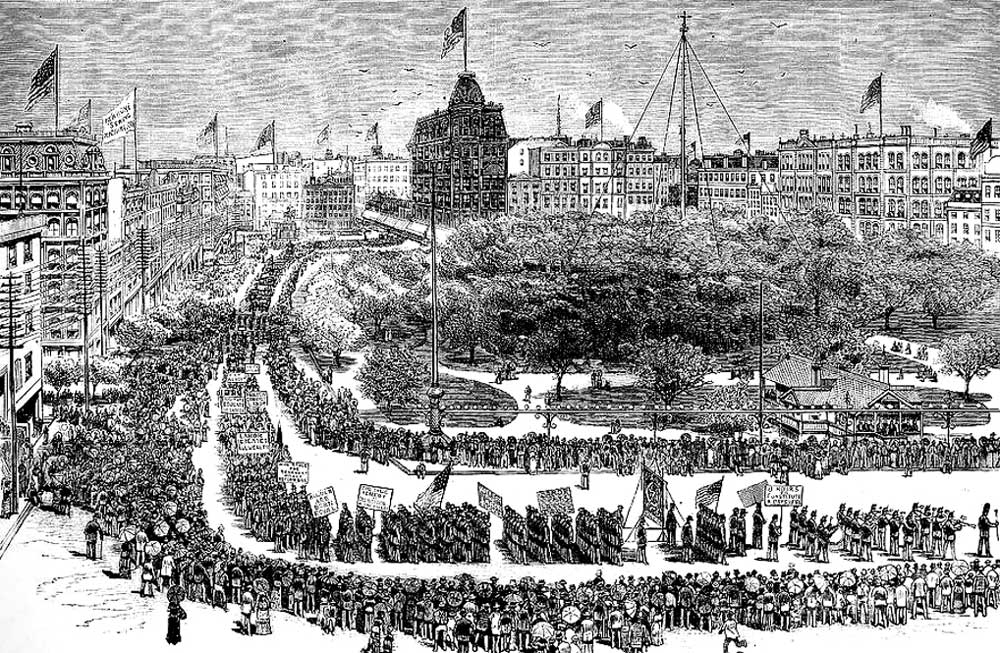
On Tuesday, September 5, 1882, workers in New York City assembled for what the Department of Labor identifies as the first Labor Day celebration. Organized by the Central Labor Union, it was not yet an official federal holiday, and participants made a public statement simply by walking off the job and marching together.
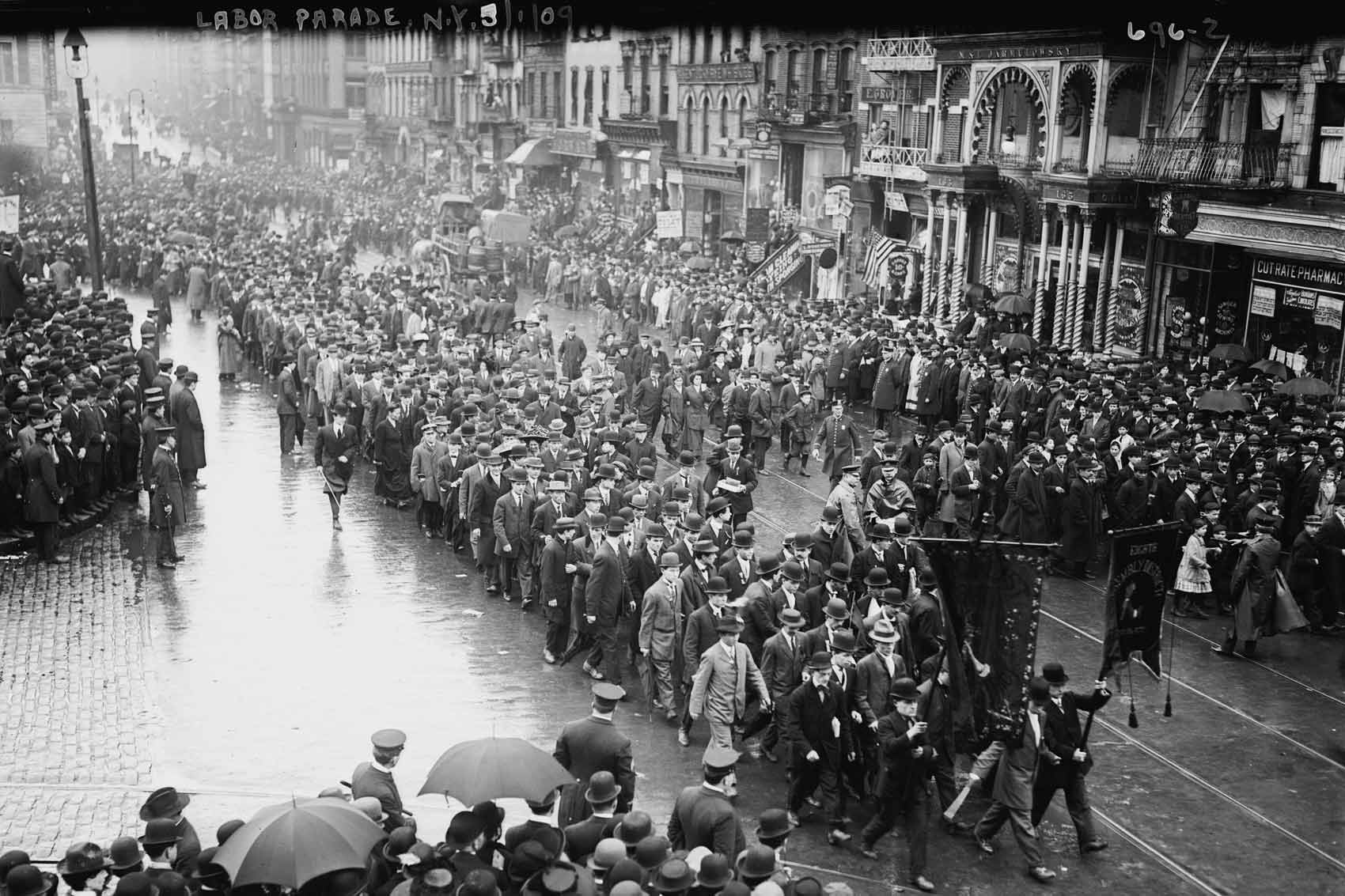
By traditional estimates, about 10,000 workers took part. They carried the presence of organized labor into the streets of the nation’s largest city. The parade showed that working people were not simply employees scattered across individual workshops. They could coalesce into a social and political presence visible to the public.
The day was not intended as a protest. Recreation, speeches, music, food, and family all followed the procession. The proposed order of exercises called for a street parade exhibiting the “strength and esprit de corps” of labor organizations, followed by celebrations for workers and their families. That formula became a standard part of Labor Day.
The parade also enabled organized labor to present itself as a part of American civic life. Labor activism was frequently depicted by its enemies as dangerous, disorderly, or revolutionary. A peaceful march followed by a family festival presented a different image: that of workers as citizens asking the nation to take account of the value of their contribution.
New York’s Central Labor Union scheduled another celebration for September 5, 1883. Labor organizations in other cities soon followed the precedent. What began without presidential proclamation or congressional legislation spread because workers themselves found meaning in it. Labor Day was on its way to becoming a tradition before it became a holiday.
The Eight-Hour Day, Haymarket, and the Rise of May Day
As Labor Day evolved in September, a different date would be linked to the global labor movement. For years, American unions had advocated an eight-hour workday. In the 1880s, labor activists set May 1, 1886, as the target date for a national mobilization. Demonstrations and strikes occurred across the country.
Chicago was the center of the struggle. On May 3, police opened fire on a crowd that included striking workers outside the McCormick Reaper Works, killing and wounding several people. Labor activists called a protest meeting at Haymarket Square for the next evening. The May 4 rally was peaceful, but police showed up as it was breaking up. Someone tossed a bomb into their midst.
The explosion and subsequent gunfire killed police and civilians and wounded many others. The identity of the bomb thrower was never securely determined. Eight anarchists were indicted and tried. Seven were sentenced to death, although two later had their sentences commuted. Louis Lingg committed suicide in prison, and Albert Parsons, August Spies, Adolph Fischer, and George Engel were executed in November 1887. Illinois Governor John Peter Altgeld pardoned the three remaining defendants in 1893.

In the short run, Haymarket hurt the American labor movement. Unions were linked with anarchism and political violence, and immigrant radicals were the objects of deep suspicion. At the same time, internationally, the executed men were martyred as labor heroes. By 1890, May Day had become International Workers’ Day in many regions of the world.
This helps account for why American Labor Day and May Day should not be considered the same holiday. The September celebration had begun in New York four years before Haymarket. Claims that President Grover Cleveland later created September Labor Day to distance the United States from May Day oversimplify a far more complex chronology.
Labor Day Spreads Across America
After its initial New York success, the September celebration spread rapidly. Labor groups in other cities began to sponsor their own parades, picnics, and public demonstrations. The holiday also gave unions something they seldom had: a day that could blend political demands with celebration and pride.
Government recognition of the holiday began at the municipal level. Municipalities passed ordinances in 1885 and 1886. New York was the first state to pass Labor Day legislation, but Oregon became the first to sign a statewide law on February 21, 1887. Colorado, Massachusetts, New Jersey, and New York followed in 1887. Connecticut, Nebraska and Pennsylvania joined them before the end of the decade. By 1894, the observance had become so widespread that federal action was less the invention of a new holiday than the recognition of a movement already well underway.
Annual celebrations also helped change public perceptions of organized labor. Workers marched under union banners and heard speeches on wages, hours, political rights, and the dignity of work. Families participated in picnics and festivals. The holiday could be militant without being violent; political without being a party loyalty oath.
Labor Day’s growing acceptance, however, did not mean that organized labor was winning its larger struggle. In the same years states were recognizing the holiday, employers fought some of the strongest unions in American history. Two confrontations—Homestead and Pullman—would show just how far that resistance could extend.
The Homestead Strike and the Setbacks Facing Labor
One of America’s most well-known labor conflicts began in 1892 at a steelworks outside of Pittsburgh. Carnegie Steel owned the Homestead plant. Andrew Carnegie wrote sympathetically about workers’ rights in some cases, but his company’s officials were determined to break the Amalgamated Association of Iron and Steel Workers at Homestead.

While Carnegie was vacationing in Scotland, the company’s chairman, Henry Clay Frick, took a hard line against the union. Negotiations between the two sides failed, and the workers were locked out. Frick said he would run the plant with nonunion labor. He hired about 300 Pinkerton agents and sent them to secure the plant. The steelworkers nicknamed the heavily fortified mill “Fort Frick.”
On July 6, Pinkerton agents tried to cross the company’s property by barges on the Monongahela River. Workers met them with guns, and a violent battle ensued. The National Park Service’s labor history study says nine steelworkers and seven Pinkertons were killed. The Pinkertons eventually gave up.
The workers’ apparent victory was short-lived. Pennsylvania sent thousands of militia troops to Homestead. With the steelworks under military protection, the company brought in replacement labor, and production began. The strike continued for months before finally collapsing. The union suffered a major loss, and organized labor lost much of its influence in the steel industry.
The Homestead Strike illustrated a fundamental challenge nineteenth-century unions faced. Workers could organize, strike, and even temporarily take over a workplace. However, large corporations had deep financial reserves and political connections. Employers could hire replacements, use private security, obtain injunctions, and ask the government for protection. Labor Day was becoming a legal holiday even as workers were losing some of their most important industrial wars.
The Pullman Strike of 1894
The battle most closely associated with securing federal Labor Day recognition began in Pullman, Illinois, near Chicago. A company town had grown up around George Pullman’s railroad sleeping-car factory. The firm owned all the housing, and it augmented profits by charging workers rent.
The Panic of 1893 hit the railroad industry particularly hard. Pullman cut jobs and wages as orders slumped, but the company refused to lower rents. Workers formed a grievance committee, but Pullman and his managers refused to negotiate. On May 11, 1894, employees quit the Pullman works.
The fight might have ended there as a local dispute, but not for the American Railway Union. The ARU, led by Eugene V. Debs, had become a powerful body that united railroad workers across the industry’s various occupations. The Pullman workers asked for support, and ARU members voted to boycott trains with Pullman cars.
Pullman cars were widely used, and the boycott quickly spread through the national rail system. Rail companies fired workers who refused to handle the cars and hired replacements. The General Managers’ Association of the major railroads serving Chicago coordinated resistance to the boycott. Within days, rail traffic in much of the West had ground to a halt.
The federal government got involved after the boycott disrupted interstate commerce and the movement of U.S. mail. A federal injunction ordered union leaders to cease interfering with rail traffic. President Grover Cleveland then sent federal troops to Chicago, defying Illinois Governor John Peter Altgeld. Violence broke out around Chicago, leaving dozens dead or wounded. Debs and other union leaders were jailed for contempt of court after a judge found them in violation of the injunction. By mid-July, the boycott had effectively ended.
Pullman was a major new defeat for organized labor, but the protest showed workers’ ability to stage an effective national disruption. A strike that began over wages and rents in one company town had brought transportation in much of the country to a standstill. Even as the government moved to crush the strike, Washington was getting ready to give organized labor one of its most enduring symbolic victories.

How Labor Day Became a Federal Holiday
On June 28, 1894, President Grover Cleveland signed a law making the first Monday in September a legal federal holiday. The timing was inescapable. The Pullman crisis was building. American labor, the railroads, and the federal government were headed for a showdown.
This convergence has left a lasting narrative: Cleveland invented Labor Day as a mea culpa or peace offering after his brutal suppression of the Pullman Strike. The federal holiday is not unconnected to the moment’s fraught political drama. Labor warfare certainly resonated politically at the national level in 1894. But the story misleads when it presents Cleveland as the holiday’s sudden or sole author. Labor Day had not been a sudden invention. Nor did Cleveland invent it in the special Pullman context.
By 1894, the holiday had a dozen years of tradition. New York workers had first celebrated it in 1882. By 1887, state governments had begun recognizing it. By the time Congress acted, the Department of Labor tells us, 23 other states had adopted it. Federal legislation therefore completed and recognized an existing movement that workers and states had already created.
The federal measure also did not create a three-day weekend for all American workers by fiat. Federal legislation applied the holiday directly in the federal sphere. States managed their own legal calendars, and employers in private industry were another question. The modern sense of a universal three-day weekend should not be retrojected onto 1894.
A better reading of the whole narrative harmonizes both halves. Labor activists had made it a tradition. Cities and states had spread it. Industrial relations were in crisis, making labor impossible to ignore politically. Congress and Cleveland then gave national recognition to an observance workers had already made their own.

Labor Day After 1894 and the Continuing Fight for Rights
Federal recognition did not change American workplaces overnight. Labor Day parades swelled. Union leaders gave speeches. Politicians came to celebrations in greater numbers. Yet workers still organized over many of the same issues that predated Labor Day itself.
The early twentieth century saw new unions and new confrontations. Conditions were especially poor in industries that still relied on immigrant and female labor. New York’s garment industry would become one of the starkest examples. Despite being in one of the country’s wealthiest cities, low wages, long hours, crowded workshops, and unsafe buildings remained the norm.
Fire would sweep through the Triangle Shirtwaist Factory in Manhattan on March 25, 1911. The resulting disaster killed 146 workers, many of them young immigrant women. Public outrage helped create the New York Factory Investigating Commission and a major expansion of state factory safety regulation. Future Secretary of Labor Frances Perkins became closely involved with the reform movement that resulted.
The federal government would eventually put in much stronger protections. President Franklin D. Roosevelt signed the National Labor Relations Act in 1935. Often called the Wagner Act, it protected many private-sector employees’ right to organize and bargain collectively and created the National Labor Relations Board to enforce those rights.
The Fair Labor Standards Act of 1938 established federal minimum wages, maximum hours, overtime pay, and standards against oppressive child labor for covered workers. Its original reach was limited, and later amendments have expanded its coverage. Arriving more than four decades after Labor Day became a federal holiday, these reforms highlighted how much of the labor struggle remained unfinished in 1894.
What Labor Day Did—and Did Not—Accomplish
The official recognition of Labor Day was still a significant symbolic win. It recognized labor’s right to national celebration and acknowledged workers and their contributions as part of the country’s civic calendar. The recognition mattered for a movement often depicted as unruly, subversive, or dangerous.
But a holiday was not a labor code. Workers could celebrate Labor Day, then head back to work the next morning and face long hours, low pay, dangerous machinery, hostile employers, or jobs where union organizing could have real consequences. Homestead and Pullman had already shown that federal recognition of labor as an idea did not equal federal support for workers during industrial strife.

Nor was protection spread evenly across the workforce. Race, sex, occupation, immigration status, and geography all influenced job and union access. Black workers were regularly excluded from unions or segregated into lower-paid jobs. Women faced unequal pay and employment opportunities. Agricultural and domestic workers were exempted from many key protections in New Deal labor legislation.
The labor movement was also never a single unified entity. Craft unions sometimes excluded unskilled workers. Other unions practiced racial or ethnic discrimination. Leaders could disagree about strikes, socialism, immigration, political parties, and whether unions should pursue broader economic transformation or focus more narrowly on wages and hours.
For these reasons, Labor Day should be understood as a marker of progress, not an ultimate destination. It recognized the growing public significance of American workers, but the rights later associated with modern employment would take decades more of organizing, legislation, court rulings, elections, strikes, and reform to secure.
From Workers’ Parades to the Unofficial End of Summer
The meaning of Labor Day evolved during the twentieth century. Parades and union celebrations remained significant in many cities, but so did public festivities, sporting events, family outings, vacations, and community celebrations. The three-day weekend became familiar, if not always with the history of labor behind it.
Commerce also redefined the holiday. Retailers turned Labor Day weekend into a big shopping season. Tourism developed around the last major summer holiday. In many communities, school calendars made the start of fall routines as much a part of Labor Day’s meaning as its labor history.
The even more familiar rule about not wearing white after Labor Day also became associated with the holiday. Its origin is less clear, as some popular retellings suggest. Fashion historians more strongly link it to seasonal clothing customs and social conventions among more affluent Americans than to any aspect of labor tradition.
The evolution has an irony. A holiday partly designed to show collective worker strength became one of the nation’s biggest shopping weekends. A day with ties to demands for shorter working hours also became a workday for many employees in retail, hospitality, transportation, health care, and other service industries.
Recreation, though, was a part from the start. The very first 1882 celebration included a festival after the parade. Labor Day was never intended to be only a solemn political demonstration. The balance shifted: the picnic and recreation continued to live in popular memory even as banners, speeches, and union demands became easier to forget.
Why Labor Day Still Matters
The gap between the first Labor Day parade and the holiday we know today can make it hard to see the celebration’s history. The first Labor Day parade came in a country without a federal minimum wage, national overtime standards, or the labor laws and worker benefits that would come to define the American workplace in the twentieth century. When the men and women who marched in New York City in September 1882 celebrated, they did so as people who had to fight for recognition.
Some developments that are now ordinary still took decades of struggle to win. The eight-hour movement made an eight-hour workday a serious proposition. Unions pushed for collective bargaining. Reformers pressured governments to regulate unsafe factories and hazardous working conditions. The National Labor Relations Act eventually established organizing rights for many workers; the Fair Labor Standards Act established national wage-and-hour standards for covered employment. None of these were inevitable.
Progress has never been linear. The Great Railroad Strike of 1877 ended in repression. Haymarket both damaged organized labor and became an international symbol. Homestead broke a powerful steel union. Pullman ended in federal intervention and Eugene Debs’s imprisonment. Defeats exposed vulnerabilities that future organizers would try to address.
The problems have also never gone away. Americans still argue over wages, hours, unions, workplace safety, automation, benefits, job security, and the balance of power between workers and employers. Many of the industries that defined nineteenth-century labor have faded. But the basic question that animated those men and women is still recognizable. How much control should working people have over the conditions of their lives?
That is the history behind the first Monday in September. No single president, strike, law, or undisputed founder created Labor Day. It is the product of workers who organized, marched, lost battles, won reforms, and kept demanding to be seen. The barbecues and long weekend are part of that tradition, but they rest on a harder history built in factories, mines, railroad yards, union halls, picket lines, courtrooms, and the streets of American cities.


