
The Reconquista Explained: The Rise of Catholic Iberia
 Reading Time: 24 minutes
 Reconquista is the name often given to the long struggle that reshaped Spain and Portugal over roughly eight centuries. From the first Christian holdouts in the north after 711 to the fall of Granada in 1492, Iberia’s borders shifted again and again through raids, sieges, treaties, and sudden reversals. It was not a single nonstop war, but a frontier world where faith, power, and survival mixed on the ground and in royal courts.
The term “Reconquista” is debated because it suggests a single, clear mission to “take back” a land with a fixed identity, when medieval reality was messier. Christian kingdoms fought each other as often as they fought Muslim rivals, and alliances crossed religious lines when politics demanded it. This article argues that Iberia’s reconquest was a long, uneven process driven by frontier warfare, political ambition, and shifting coalitions, culminating in a Catholic monarchy-centered order that remade Iberia’s institutions and identity.
Iberia After 711: The Starting Point
The Iberian Peninsula shifted at great speed after 711. The Umayyad conquest marked the end of Visigothic political hegemony, and the imposition of a new Muslim-run province, al-Andalus, was embedded in political, religious, and military ties with North Africa and the wider Islamic world. Urban centers and administrative tax districts were reconfigured under new leadership, and the gravity of power shifted south and east, towards the main urban centers. For much of the population, there would have been less difference in quotidian terms and more change in who took revenue, enforced law, and deployed garrisons.
Conquest was not an end to resistance, however, and northern topography allowed room to evade. Mountain belts in the Asturias served as a platform for early Christian survival, a zone in which local leaders could subsist at a remove from easy cavalry raids. Such enclaves were small but significant in that they maintained an alternative claim to legitimacy. Expanding over the longue durée, they became the basis for new kingdoms at the moments when political opportunity allowed for expansion.
The early centuries were shaped by this frontier world, rather than a strict border. Raiding movements flowed across valleys and passes in search of livestock, captives, and prestige. Power ebbed and flowed through seasonal warfare as much as through strict conquest. Frontier leaders gained prestige and influence as much by defending communities or raiding rivals, and strongholds became fixed nodes of power within landscapes of patchy state presence.

Tribute was also key, a dimension of extra-military interaction. Weaker polities might pay to avoid attack, and more powerful ones might be able to turn payments into political debt. Money and grain were both key resources with important military implications: tribute payments could be used to build fortresses and fund armies, which could then be deployed for further expansion. Tribute was a way to close a frontier system around endurance and opportunism.
The later generations able to speak of “reconquest” had a more complicated starting point, therefore. Al-Andalus was not a temporary encampment, but a functioning social space. The Christian north was not a crusading bloc, but a patchwork of local powers surviving on harsh terrain. The space in between was one of shifting borders, negotiated arrangements, and constant testing: it would be these conditions that shaped Iberia’s long path towards the Catholic monarchy-centered order that would emerge.
What the Reconquista Was (and Wasn’t)
The Reconquista was not a single continuous war that stretched unbroken across eight centuries. It was a protracted series of campaigns, interruptions, truces, and resets. In some regions, long periods of peace or minor frontier raiding were far more typical than large-scale invasions. Treaties had real consequences because rulers chose to negotiate when their armies were exhausted or when other rivals were a bigger threat. Intermarriage and hostage exchanges also tied courts together in ways that suggest medieval politics could cut across religious boundaries when survival was at stake.
It also was not a simple “Christians versus Muslims” narrative. Christian kingdoms often fought one another, vying for land, tribute, and legitimacy. On the Muslim side, al-Andalus was not always a single political entity either. Rival taifa rulers, reform movements, and factional infighting could be as decisive as campaigns against the northern kingdoms. Internal conflict was also a factor in timing: when one side fractured, the other often made advances.
Boundaries crossed more often than modern labels imply. Christian rulers sometimes hired Muslim troops, accepted tribute payments from Muslim taifas, or allied with one Muslim faction against another. Muslim leaders used Christian allies and mercenaries, too, when it was convenient. These were not examples of tolerance in the modern sense. They were frontier-world realpolitik where power mattered more than slogans.
“Convivencia” is a real thing, but it needs nuance and context. There were times and places where Muslims, Christians, and Jews lived in close proximity, engaged in trade, and shared aspects of urban life. But coexistence often meant hierarchy—different taxes, legal status, and political constraints depending on which group was in charge. Periods of relative cooperation sat alongside crackdowns, expulsions, and violence, especially during political crises or waves of religious hardening.
So what was the Reconquista? It was an uneven frontier process in which territory changed hands through war and negotiation, and identities hardened over time. It produced both moments of coexistence and moments of cruelty, long truces and sudden offensives. Understanding what it wasn’t—a single holy war with a linear path—helps explain why it took so long and why its legacy is contested.
The Northern Kingdoms Take Shape
Christian power survived in the north, not as a kingdom, but as a set of evolving centers and growing ties. The best-known of the early refuges was Asturias, located in mountainous terrain far enough from the more productive and wealthy Andalusi cities to provide a defensible base. The Asturian heartland slowly expanded in area and complexity, developing into León. This was not just a change of name: it marked the growth of royal authority, settlement, and administration as the kingdom’s rulers moved from eking out an existence in a difficult and remote upland zone to occupying large plains and numerous towns.
The process that led to León’s development required the construction of institutions that could outlive a single campaign or generation. Kings needed nobles, bishops, and local officials to levy taxes and conscripts, and protect local inhabitants. Fortified towns and frontier communities were tools of this expansion, as each new settlement was a political statement and each new church a claim to tie a given territory to the kingdom’s right to rule. Northern monarchies discovered that conquest was not simply seizing territory; it also required holding it and doing so not just by military means but by laws, patronage networks, and local loyalty.
Navarra developed along a somewhat different trajectory, its own political culture shaped by Pyrenean politics and the pressures of living between larger neighbors. Mountainous terrain was more difficult to control directly, but offered opportunities to parry and exert strategic leverage. Navarra could wage war as well as pursue diplomacy, shifting alliances with León, Castile, and Frankish-influenced powers to safeguard its independence. Navarra’s rulers expanded when they could, but also survived by knowing when not to fight battles that they were likely to lose.

Aragon began as a frontier county and eventually developed into a full kingdom. It was also rooted in mountain landscapes, but came to look increasingly southward and eastward, with an expansionary dynamic. Over time, Aragon’s territories extended beyond the uplands into some of the Iberian Peninsula’s most important river valleys and strategic towns. Aragon matured into a power not only in Iberia but, at its greatest, in Mediterranean geopolitics, building on a tradition of military and legal structures that supported this growth.
Northeastern Iberia also saw the development of strong frontier counties with particularly close ties to Frankish power. These Catalan counties’ political development was significantly shaped by the gravitational pull of the Carolingian orbit, with counts who had to work for local autonomy against northern influence.
Frontier location encouraged fortress-building and gradual expansion as well as links to long-distance trade and the coastal connectivity that tied this territory to broader European trends. Over time, these counties would develop their own institutions and political culture, setting the stage for Catalonia’s later rise within the Crown of Aragon.
Portugal’s emergence as a separate kingdom is another example of how the Reconquista produced new states as well as expanded old ones. This process began as a frontier county that developed into a distinct political project, led by local elites, driven by military opportunity, and motivated by the need for stable authority at the western edge of Iberia. In asserting its independence and expanding southward, Portugal showed that the northern kingdoms were not a monolithic bloc advancing in step with one another. They were competing, adapting, and sometimes colliding—while slowly building the Catholic political map that would come to define Iberia.
al-Andalus Fractures and the Taifa Era
The taifa era started when the centralized government in al-Andalus collapsed, and local leaders rushed to fill the void. Instead of a powerful court, setting and guiding policy for Iberia’s Muslim south and east, there were dozens of city-states and regional dynasties. These taifas could be prosperous and cultured, but they were also fragile since they were in competition with each other. Border disputes, prestige, and very survival were at stake. Rivalries that had been suppressed by a single central power were now open contests.
This affected the strategy on both sides. Christian kingdoms in the north faced not a single opponent with pooled resources but many opponents with their own armies and their own fears. That made diplomacy more attractive. A Christian king could threaten one taifa while protecting another. War was turned into a system of bargaining. In this environment, borders were as much reshaped by deals and intimidation as by battlefield victories.
Tribute was the key mechanism. Taifa rulers sometimes paid Christian rulers in gold, goods, or a lump sum or an annual payment to stop them from attacking or to buy an alliance against a rival. This had major effects, as the money paid for growth in the north. Tribute could pay for fortresses, soldiers, and the political rewards that maintained noble loyalty. In effect, southern wealth was helping to pay for northern expansion even in years when no territory changed hands.
The reason for this shift in the balance of power is that fragmentation created a vicious cycle. Paying tribute brought short-term peace, but the payer was weakened, while the receiver grew stronger and could demand more. A taifa that was squeezed too hard might collapse through internal revolt or loss of key towns to rivals, which left it even less able to resist. In this way, negotiation became a slow process of advantage transferring from south to north.
The taifa era also illustrates why the Reconquista cannot be understood as a single religious crusade. Politics, money, and rivalry often counted for more than slogans. Fragmentation did not guarantee Christian victory, but it created opportunities that the northern kingdoms learned to exploit. In the long run, the taifa system remade Iberia by making conquest cheaper for the north and survival more expensive for the south.

The Crusading Turn and International Support
To a growing extent, Iberian fighting was couched in the language of the crusade by the papacy, a development of some significance in and of itself. In such terms, the Reconquista became more than local or national – it was a Christian project. Papal support could provide spiritual rewards (typically couched in terms of indulgences) and legitimize efforts to recruit fighting forces (specifically, knights) from outside Iberia. Papal support did not mean that each new campaign was now a “crusade”, but it did focus resources, manpower, and prestige on the Iberian theatre at key moments when Iberian rulers were seeking to legitimate their campaigns more broadly.
The result was a widening pool of Christian combatants fighting in Iberia. Warriors from all over Europe could fight for spiritual reward, as well as land, reputation, and prize in Iberia. This was useful to Iberian kings, who could use such forces to bolster their armies and demonstrate international support for their cause. The use of such forces also played a role for the Church, as it could be seen as defending the frontiers of Christendom and reclaiming sacred space. This was important in an era when the Church could wield influence and authority over political and military affairs.
The military orders are another group worth highlighting at this point. These were orders with the rule and structure of a monastery, but dedicated to warfare as their mission. They were specifically designed to hold castles and fortresses, patrol borderlands, and provide a long-term defense. The castles they held, like Alcázar de San Juan in La Mancha, often had a dual function: not just military, but also administrative – they became places to which new settlements and political authority could be attached, they became centers of revenue collection, and so on. In short, the military orders helped to consolidate Iberia’s frontier zones.
The interaction between the Reconquista and the Crusades was tangible but also limited. Iberian rulers were still fighting each other, concluding truces, and making alliances that were not consonant with the crusading ideal. Tributes, succession politics, and local rivalry all played a role, and these were, in most cases, more tangible than papal exhortations. Crusading language and incentives could be a factor, but they were not the whole story: medieval Iberia was always a complex political landscape.

Major Turning Points and Campaigns
The conquest of Toledo in 1085 was a seismic strategic event. Toledo, in the near-center of the peninsula, had long acted as a hinge, controlling access routes that tied north to south. Its capture changed more than just a city’s status: it opened corridors for further campaigns, altered psychological equilibria, and offered proof of concept that major urban centers could be lost, and not merely frontier castles. It also offered an attractive symbol for the Christian side: an ancient Visigothic capital in their hands would lend the northern monarchy greater legitimacy.
The loss of Toledo altered the strategic equations of al-Andalus. Taifa kingdoms, already fragmented and often feuding, now confronted a stronger, more ambitious, and more confident neighbor. Some taifas opted for diplomacy and tribute payments; others for armed resistance, but in both cases, the pressure mounted. The crisis was a factor driving another significant development: the emergence of reform empires from North Africa, promising political unity and tighter control. In a fractured political landscape, the advent of a new outside power could appear, at least initially, as salvation.
The Almoravids, who established a presence in the peninsula from 1086, became a vector for renewed resistance. Their armies, with a reputation for discipline and effective cavalry, imposed a more centralized approach. They aimed both to check the advance of the Christian states and to control the excesses and rivalries of the taifa kingdoms. The intervention of this North African power, albeit imperfectly, temporarily slowed the northern expansion and modified the Andalusi political scene by imposing greater oversight over the local taifa rulers. Centralization, however, generated its own frictions, and the effort to maintain control over Iberia consumed significant resources and legitimation across the Strait.
The Almoravids were eventually succeeded by another reformist power, the Almohads, who also crossed from North Africa in the 12th century and had their own project of centralization and religious reform. For a while, the Almohads represented a significant bulwark against the northern kingdoms. The competition was no longer simply between northern armies and divided taifa fragments; it became a clash between two powerful entities. Christian monarchs now faced a single, cohesive, and deeply suspicious polity that was well-organized and capable of mobilizing substantial resources and large forces.
In 1212, Las Navas de Tolosa was the hammer blow that broke Almohad power in Iberia. The battle was significant because it dealt a severe blow to the primary force capable of organizing coordinated resistance. After this, the dynamic altered irreversibly: with the loss of this central force, Christian kingdoms found new opportunities, and Muslim polities saw their territories increasingly fragmented and vulnerable.

The 13th century would see these dramatic advances. The fall of Córdoba in 1236 was a symbolic and strategic triumph that would have been unthinkable a few decades earlier. Seville in 1248 continued this trend: a major river city, with an extensive port network, its capture further bolstered Castile’s strategic position. These conquests are not only military events but also administrative seizures, bringing tax registers, populations, urban structures, and other resources under the victors’ control.
In the east, the capture of Valencia in 1238 would favor the expansion of the Crown of Aragon and would be of particular importance in consolidating a power with Mediterranean ambitions. The eastern advance of the Aragonese and their Catalans thus shows us once again that the Reconquista, far from being the unique project of a single kingdom, is the result of the efforts of a plurality of Christian polities, advancing on their own axis in the space of Iberia according to their own interests, rivalries, and, of course, pressure from their own frontiers. Together, all these conquests would lead to the Muslim-ruled Iberia being reduced to a last stronghold.
By the end of the 13th century, the map had been redrawn. The North African incursions, for all their initial success, had only delayed the long-term disintegration. Setbacks, both territorial and strategic, reopened the possibility of expansion for the northern kingdoms, while division made unified resistance increasingly difficult. The turning points of Toledo, Las Navas de Tolosa, and then the rapid captures of the 13th century were like the stages in which the geography of Iberia is transformed, passing from an equilibrium of powers on a frontier to an order in which the advance of the monarchies becomes the main tendency, crystallizing around a Catholic monarchy.
How the Reconquista Was Fought
The Reconquista was not won in a single march. It was made from castles, sieges, and fortified lines that turned geography into strategy. Stone walls mattered for the simple reason that conquest needed to be made durable. A fortress could dominate a river crossing, protect a garrison, and provide a safe base for raids. Chains of strongholds gradually turned frontier belts into zones in which a ruler could nibble forward, then rest, then nibble again.
Sieges often decided more than field battles. Cities and castles were the real prizes, for they contained the granaries, the tax registers, and the roads. To take them required patience, engineering, and logistics. A successful siege could shift an entire region’s allegiance. A failed siege could bleed an army dry and invite a devastating counterattack. Warfare became as much a contest of logistics as of bravery.
Repoblación—resettlement—made those gains endure. Following territorial changes, rulers welcomed settlers to move into frontier zones, rebuild farms, and establish new communities. Grants of land and privileges lured nobles, soldiers, and towns to take the risk. This was a conquest by population as well as by sword. A frontier that fills with loyal settlers is much harder for a rival power to retake.
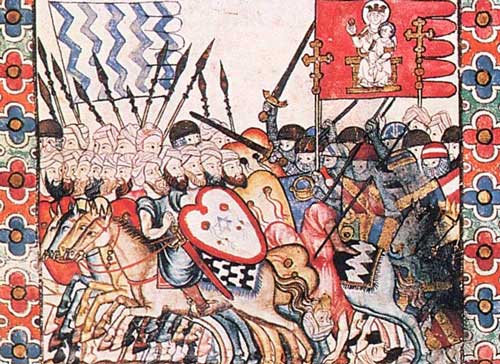
Military orders reinforced this system. These orders were institutions that combined religious identity with permanent duty on the frontier, building and holding castles that ordinary levies could not garrison year-round. The orders’ institutions organized defense, collected resources, and projected power into contested areas. Alongside them were local militias and forces raised in towns, which defended their walls and could react to raids with speed. The frontier was defended not only by kings, but by communities that had learned to fight for their own survival.
Royal armies knit these pieces together. As monarchies centralized and grew stronger, kings could draw on larger, more coordinated forces for large offensives. Royal campaigns often relied on nobles supplying contingents and on towns providing supplies. The most successful rulers over time developed systems that could raise money and men with some reliability, turning seasonal war into sustained pressure. Centralization made conquest more predictable.
Naval power added an additional dimension, particularly for Aragon and its Mediterranean-facing expansionist ambitions. Ports and control of sea lanes mattered for moving troops, for securing trade revenue, and for projecting power along coasts. Mediterranean fronts connected Iberian warfare to broader politics, including rivalries over islands and coastal cities. Aragon’s maritime strength supported its campaigns on land and helped it become a major power beyond the peninsula.
These methods together account for the pace of the Reconquista. Fortresses created lines; sieges took nodes; resettlement filled the ground behind the lines; and military orders helped to hold what was taken. Royal armies and naval power expanded the scale of action when the opportunity arose. The Reconquista was fought as a long frontier system, which slowly turned contested ground into governed territory.
Building Catholic Iberia
The Christian kingdoms needed to turn conquest into something more lasting: government. Royal administration expanded, with the conquered lands producing new taxes, new courts, and new royal officials. Kings turned to bishops, abbots, and local elites to maintain public order, record obligations, and plant the symbols and personnel of authority in towns and countryside. Church institutions grew as the crown did: new dioceses, new monasteries, new parishes embedded conquest in people’s daily lives. The church sanctified the rule, but also organized it.

Law and taxation are the threads that stitch expansion into permanence. Rulers would issue law codes, or charters, that defined rights, duties, and property ownership within the newly conquered territories. Taxes would pay for garrisons and royal courts, but they also required legitimation: “frontier privileges” were awarded to settlers and servants as incentives to settle and defend the conquered lands. Legal protection, land grants, reduced obligations: these privileges could convince entire families to live on a dangerous border and fight when needed.
Frontier privileges helped forge a social landscape that was marked by a new sense of community. Towns acquired collective rights, militias gained status, and local identities were forged around settlement and defense. In the long term, these communities became the infrastructure of expansion, not just the beneficiaries. The crown learned to cement loyalty with more than words: it was easier to maintain allegiance when people had something tangible to defend: land, law, and privileges written into charters.
Catholic Iberia was also built through narration. Saints’ cults, stories of victory, and chronicles were crucial ways of explaining and justifying expansion. Chronicles in particular turned campaigns into exempla, or moral lessons, and the rulers turned public memory into a tool of legitimacy. A victory did not end at the lifting of a siege: it extended into sermons, processions, feasts, and the written record, where it became evidence that God favored a particular dynasty.
Administration, law, and identity-making are the tools by which a shifting frontier becomes a durable order. Castles and armies win territory, but institutions hold it. By building courts, churches, and a shared language of victory, the Christian monarchies laid the foundations of a Catholic political culture that would outlive the medieval wars that made it.
The Endgame: Granada and 1492
By the late fifteenth century, the Nasrid Kingdom of Granada had become the last Muslim polity remaining in Iberia. Nestled in a region backed by mountains, the Nasrids had withstood the pressures from Christian polities for centuries with a combination of diplomacy, tribute, and an intricate web of defensive strongholds. The terrain, as well as the cultured courts and distinct character of Granada’s cities, had frustrated attempts at conquest for much of the Reconquista. Nasrid diplomacy at times exploited the divisions between Christian rivals to their own advantage, and before the marriage of Ferdinand and Isabella, Granada was often in a stronger negotiating position than at any time in generations.
However, the decisive logic of Ferdinand and Isabella’s approach did not require pointless aggression or the slaughter of citizens in pitched battles. The strategic objective was instead to nibble away at Granada’s many strongpoints, cutting supply lines and choking off towns from both urban centers and any aid from abroad. Once their focus had been identified, the resources of the Crown of Castile could be devoted to applying sustained pressure.
Siege warfare was a double-edged sword, of course, and logistics and financial instruments were an important dimension of the Crown’s strategic logic. Even in a time of shifting alliances and Nasrid divisions, the court was diplomatically active in minimizing external aid to Granada and exaggerating fissures in the Nasrid power structure. At the same time, the campaign, once in full swing, settled into the methodical pattern of tightening a vise.
City after city came under siege, and as options for relief and resupply became more limited, the focus and stress of the war sharpened. The final campaign against Granada became a protracted logic of attrition: the final test of Granada’s endurance in a long war. If they could weather the storm of Castilian military and diplomatic pressure and find sufficient relief, then Granada would, in theory, have at least some prospect of survival.
On the other hand, if the resources of Castile and Aragon, the embattled Granadan leadership, and outside influences proved unequal to Granada’s defense over a sustained period, then attrition might overcome. The pressure on Granada, thus, came to focus, and the final resistance would be isolated around Granada’s own capital.
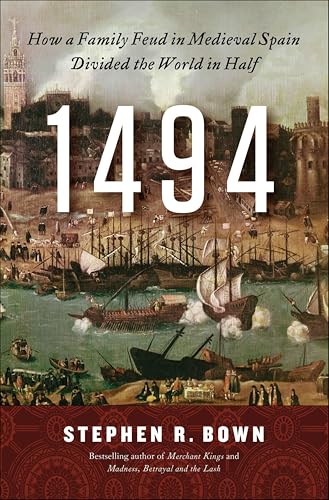
In 1492, Granada fell, its terms of surrender including nominal protections that were, at least in principle, intended to facilitate a smoother transition and avoid a headlong rush into chaos and violence. The consequences of Granada’s fall were nonetheless profound. The symbolic Reconquista was complete, and a new order was defined by the triumph of a Catholic monarchy-centered polity across Iberia. The political and religious unity and confidence that Granada’s fall immediately offered also proved, however, to be the basis for far more pointed religious and social change in the longer run. Granada’s fall was seized as a headline of victory, used to underwrite the royal image and identity, and even to define Iberia’s place in Christendom.
After 1492: Unity, Coercion, and Empire
In that sense, after 1492 is less a cause for celebration and more an account of the concentration of power. The frontier wars had produced many local privileges and empowered regional elites, so the Catholic Monarchs had other objectives besides victory on the battlefield. They wanted to reinforce royal authority with councils, officials, and a more standardized system of government. The project of unity was not just religious and spiritual, but also administrative: to make the crown the unchallenged center of authority over a peninsula as fragmented as the countryside.
Religion was one of their tools of concentration. The Catholic Monarchs had a vision of political unity tied to Catholic identity, in which loyalty and orthodoxy were not merely religious but also political. The practice of faith was more than belief; it was statecraft: a shared religion could be used to demand obedience, discourage competing allegiances, and present internal dissent as both treason and sin.

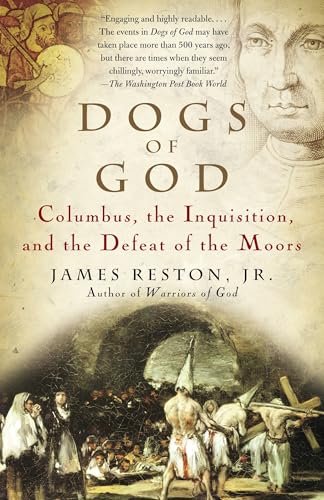
In that light, the waves of coercion that followed make some sense: forced conversions, expulsions, a campaign to align everyone with the ideal political-religious identity. First with the Jews, expelled in 1492, and later with the Muslims of the conquered kingdom of Granada. The objective was not only to quash a threat—real or perceived—but to produce a kingdom that could be described, if not actually as “one faith,” then at least as uniform in its religious practices and institutions. The human and social cost was incalculable: uprooted families, lost property, and centuries-old communities shattered.
The Inquisition functioned as part of this broader trend. As an institution of surveillance and enforcement, it was designed not only to root out heresy but also to police the sincerity of those who converted. It was a mechanism of state-building that extended into all aspects of public and private life. Its influence went beyond trials, for it generated fear, promoted denunciations, and made religion a matter of public monitoring and control. It affected the daily lives of even those who were never accused or targeted by creating a culture in which conformity felt safer than honesty.
Finally, 1492 can be considered a hinge year because Iberia’s gaze turned from the peninsula toward the Atlantic. With the last enemy conquered on home territory, the monarchy could redirect its energy, wealth, and ambition toward overseas enterprise. The same tools of state-building used in conquest could also finance, administer, and ideologically frame exploration, colonization, and the opening of an imperial frontier. The closure of one border opened another.
For those reasons, “after 1492” becomes a new era. The end of the Reconquista and the victory of the Catholic Monarchs strengthened the monarchy. But it also brought an intensification of policy toward minorities and a reshaping of Iberian identity through the use of coercion. At the same time, it prepared the ground for the construction of a global empire. Unity, control, and expansion became connected: elements of medieval conquest remade as early modern imperial power.
Myths, Debates, and Modern Legacy
When you hear the Reconquista spoken about in popular terms, you will often get a heroic story of a “reconquest.” It may sound as if Iberia’s identity was always meant to be fixed and was just patiently reclaimed after 711. That story can be useful and has power, but it can also paper over the lived complexity of medieval life. Frontiers were slow to shift, pauses could last for generations, and an alliance across religious lines could be made when political opportunity required. For a great many people, their experience of these centuries was less the high calling of a religious mission and more the rhythms of a frontier that changed rulers but not the daily effort to survive.
This is why historians often get into arguments about the name. “Reconquest” is a slippery term, one that flattens messy medieval rulers into modern strategists with uninterrupted designs. The polities of Christian and Muslim Iberia fought with and negotiated with each other, and organized when they had a local opportunity. Those patterns also occurred among kingdoms, Muslim polities, and groups of varying sizes and political ambitions in between. The story of the Reconquista is not false or misleading when it ignores those complexities, but it is incomplete when it fails to account for treaties, coexistence, and decades or even centuries in which war was not the normal state.
That is not to say that what changed over these centuries was not real or profound. Political authority did become more consolidated in Christian monarchies, the church did extend its institutional and economic weight, and Arabic-language bureaucracy and Islamic rule did become less prevalent until only one polity remained. But many other things did not change, or did so unevenly or in a patterned way that allowed for negotiation, adaptation, and continuity. New rulers often found local elites to collaborate with, towns continued to exist, and trade and cultural exchange persisted past any given frontier. Even conquest could be a form of continuity, because to govern is to use what already exists.
Benefits were unequally spread, both in time and space. Victorious crowns added territory and revenue, nobles added land and titles, and towns on the frontier could sometimes win privileges that augmented their independence. Displacement and costs were borne by others, including displaced communities, conquered populations subsumed into new legal hierarchies, and minorities who found themselves in a more precarious position, especially in the late fifteenth century. The process of state-building that created more centralized and powerful states also created sharper boundaries around inclusion.
The modern legacy of the Reconquista is contentious because memory can be political. It can be celebrated as an act of national formation, mourned as a loss, or debated as either the origin of conflict or a bygone example of coexistence. Modern politics tend to fasten on one aspect of the Reconquista (heroic victory, religious struggle, multicultural exchange) and present it as the whole story. That selective remembering can weaponize the past rather than learning from it.
Interpreting the Reconquista in the modern day is an exercise in reconciling two truths at once. It was both a centuries-long frontier struggle that left a powerful monarchy-centered Catholic order in its wake and a more textured human landscape with bargaining and negotiation, pockets of mixed communities, and uneven change. Memory of that texture makes it harder to reduce the past to a slogan, and makes it more useful as well. The more that myth substitutes for nuance, the more history stops being used for explanation and starts being used as a tool.


