

The Umayyad Conquest and the Birth of Muslim Iberia
 Reading Time: 29 minutes
 In 711, a small landing initiated the Umayyad Conquest, a process that would change the Iberian Peninsula for centuries. If the arrival had been rapid –a quick crossing, a swift campaign– what would follow was a slow evolution in who had the power in the peninsula, in how its cities were governed, and in the place of Iberia in the Mediterranean world. The rapidity of the process is one reason the tale is so remarkable: in the space of a few years, an ancient kingdom collapsed and a new order was established.
By “Umayyad conquest,” we refer to the Muslim subjugation of large areas of the Iberian Peninsula during the first decades of the eighth century, carried out by commanders on behalf of the Umayyad Caliphate. The social order that subsequently developed is sometimes referred to as Muslim Iberia or, in Arabic, al-Andalus. Iberia was taken by a combination of Visigothic crisis, rapid campaigning, and negotiated rule, a dynamic that established political and cultural conditions that would influence Iberia’s history for centuries after the first armies had landed.
Iberia on the Eve of 711
The Visigothic kingdom was a consolidated political structure, but one that was paper-thin in terms of effective power. The king needed the backing of the elites, local brokers of power, and the vagaries of court culture, where alliances could shift overnight. Royal power had to be continually negotiated, enforced, and renewed at a local level, and this became much harder the further one traveled from the epicenter of politics.
Succession was almost always a great fracture. Visigothic kingship was not hereditary. A new reign was always a gamble. There would be rival noble factions jostling for position, and those who lost out were not necessarily inclined to shut up and fall in line. In those circumstances, a struggle for legitimacy could easily turn into an armed conflict. Political struggle at the court could also easily generate competition and conflict at a regional level.
The nature of the Visigothic kingdom was very much shaped by religion. The Catholic hierarchy was a force to be reckoned with in terms of law, education, and notions of legitimacy. Bishops could be local centers of power. Jewish communities were present in many towns and cities. They were often integrated into mercantile and administrative networks but were also politically vulnerable, scapegoated, and subject to legislative restrictions. There was an overlapping set of local elites: landowners, bureaucrats, and priests that formed the connective tissue of the kingdom. The power of this network of elites was one measure of how much royal writ ran.
The kingdom’s inherent vulnerability stemmed from this blend of factionalism and limited power. A state whose energies are expended by internecine rivalry is not one that can quickly mobilize in the face of an external threat. Nobles who might otherwise be expected to provide troops for royal campaigns could hold back if they thought their king was illegitimate, defect to the other side, or use a national crisis to extract concessions for their local loyalty. A national emergency for the center could be a local opportunity for a regional faction.
This, at least, is the picture that emerges from near-contemporary accounts of the conquest. Collapse comes very fast when political fractures open up. If elites are divided and trust is in short supply, then a single major defeat can set in motion a cascade of surrenders and a realignment of allegiances. Iberia in 711 was not a lost cause, but it was brittle. An ambitious outsider could look for and exploit those fault lines, turning a crisis of succession into a regime change.

North Africa and the Umayyad Frontier
By the early eighth century, North Africa was not a remote periphery of the Islamic world. It was the Umayyads’ western frontier. In the centuries since the first forays beyond the Maghreb, a series of military campaigns had transformed the region into a contested arena of authority. Expansion was uneven and contested, but the frontier left its mark: a new center of political gravity near the Strait of Gibraltar, where decisions could be made rapidly, and armies deployed swiftly.
Ifriqiya, its core built around the city of Kairouan, was the hub of this frontier. It was the place where governors levied revenue, raised troops, and managed competition between local elites. From Ifriqiya, provincial governors could direct energies both inward—to manage and hold the Maghreb—and outward—toward raiding across the strait and securing coastlines. It was the logistical heart that made Western expansion possible.
Berber peoples were central to the operation of this frontier. During the campaign, large numbers of Berber fighters were deployed to the west, and Berber commanders became important in leading forces through challenging terrain. Different communities had different incentives. Some sought new alliances and status within a shifting political order. Others saw a promise of plunder, security, and membership within a wider community. Recruitment often followed local social networks: armies were effective, but dependent on trust and equitable distribution.
The nature of frontier dynamics also encouraged a particular style of war. Campaigning in North Africa privileged mobility, scouting, and strike operations. Armies practiced living off the land and moving through arid and broken country, and when they encountered resistance, they quickly quelled it. These were habits of mind that mattered: they created commanders who were confident in rapid operations, the sort of confidence that made a high-risk crossing into Iberia possible.
Raids simultaneously served many objectives. They tested defenses, distributed spoils, and generated disorder among political rivals. They could also create momentum: a frontier army that raids regularly will develop expectations of gain and action, which can drive leaders toward new objectives when the old ones become costly or unproductive. Iberia lay across a strait, and raid logic seemed ripe for conversion into conquest logic.
Strategically, Umayyad goals were not always a single, monolithic plan to “capture Spain” from the outset. Frontier politics often functioned through opportunity. Umayyad leaders wanted to secure borders, prevent hostile coalitions from emerging on their doorstep, and take advantage of openings that seemed to offer a mix of profit and stability. The instability of Visigothic politics across the strait made Iberia look unusually vulnerable, and in a world that prized rapid advantage, vulnerability was an invitation.
Framed this way, the conquest of Iberia was not a chance event on the periphery, but a consequence of North Africa’s frontier reality. Ifriqiya provided the administrative and logistical base. Berber-dominated forces provided troops and experienced commanders. And the habit of raiding provided the mindset: move quickly, strike decisively, and turn local success into a new order. The Umayyad conquest of Iberia did not begin in Iberia—it began in the frontier conditions that made Iberia look possible.

The Crossing and the Landing in 711: The Umayyad Conquest Begins
In the year 711, a decision was made. It was a decision to venture across a narrow sea and test a kingdom in turmoil. The man most often credited with the first landing is a commander from the North African frontier, Tariq ibn Ziyad. The force he led was not a great imperial fleet. It was a lean army honed to the frontier habits of speed, scouting, and swift advantage. The Umayyad conquest had begun.
The overland route stretched across the Strait of Gibraltar, where Africa and Iberia lie in close sight of each other. The distance across was short, but the risk was high. A force that lands without a secure supply can easily be trapped. So the success of Tariq hinged on early footholds: places to land safely, high ground that could be held, and food and water for men and horses.
The name Gibraltar itself enshrines the memory of this moment. Jabal Tariq, “the mountain of Tariq,” became a landmark associated with the landing and its later retellings. Whether all the details are precise or not, the geography explains why the site was significant: a strong position near the strait meant reinforcement and retreat were possible. It offered a base for forays and scouting deeper into the peninsula.
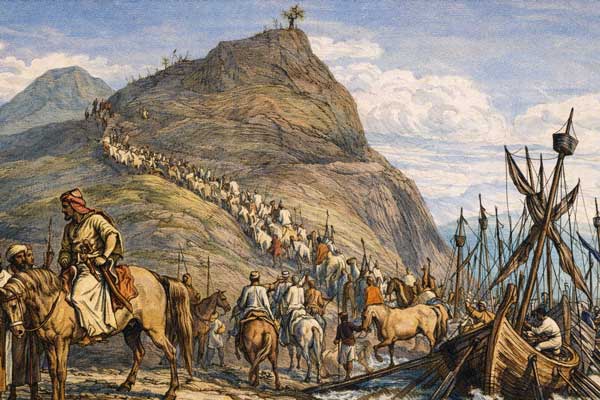
Operations in the first days were probably meant to move fast and to avoid being pinned down. A small invading force cannot afford to be caught in a long siege in the opening stages. It needs momentum—towns that surrender, local allies that offer intelligence, victories that shake the enemy’s confidence. The first days were less about great conquests and more about options: lines of advance inland, places to encamp safely, signs that the Visigothic state was not invincible.
Local politics was also a factor from the beginning. Iberia was not a wall of resistance with a single fixed boundary. Regional elites, rival factions, and communities with long-standing grievances might see opportunity in a new power. Even a small force can seem large if it comes when faith in the old regime is already fraying. In such an atmosphere, a landing is more than a landing: it becomes a sign that the established order is already in question.
Myth can quickly take root in such moments. The best-known legend says Tariq burned his ships to deny his men a way to retreat. He forced them to win or die. A famous line often given to this story sums it up: “Behind you is the sea, before you the enemy.” It is the language of total commitment, and so it is memorable. It sounds like the ideal speech for the moment.
But there is little evidence for the ship-burning story, and what there is comes late. For that reason, many historians treat it as an embellishment added later. For a commander who was still counting on reinforcement from North Africa, the burning of one’s escape route and supply line is an extreme decision. A frontier army could be more fearful of counterattack than of retreat. So the story may say more about the moral lessons people wanted—courage, resolve, destiny—than about the practical choices they actually made.
What can be said with greater confidence is that the landing did what it was intended to do: it opened a door. By landing in safety, then moving inland, Tariq’s force triggered a cascade of battles, defections, and surrenders that the Visigothic kingdom found hard to contain. The conquest began not as an inevitable tidal wave but as a bold crossing that found a brittle adversary on the far shore.

The Decisive Clash and the Visigothic Collapse
The major turning point in the early conquest is commonly associated with the Battle of Guadalete or, rather, a series of engagements now recalled by that name. In 711, King Roderic (Don Rodrigo) confronted the invading army in a battle that decided much more than the fate of a single field. Accounts vary, but the result does not: Roderic’s forces were defeated, and his power disintegrated with them. In a realm already weakened by faction, one such disaster was enough to break the political center.
The significance of this defeat derives from the nature of Visigothic rule itself. The system functioned best when different elites cooperated with the monarchy, and much political business took place at court. The fall of a king, therefore, disrupted the chain of command in a more profound sense than the loss of life. Victory and defeat did not simply transfer automatically to a clearly defined successor. Instead, they created a vacuum in leadership. A political void, in turn, meant that provinces and cities were under pressure to quickly choose who to obey and how to make the new system work.
The resulting vacuum triggered rapid fragmentation. Some local elites opted for resistance, others for negotiation, while many tried to hedge their bets. A crisis also means that there is little time for decision-making. When safety is at stake, communities will often go for the option that most immediately protects their interests. If a town or city judged that the old order could not secure it, surrender might look like an act of prudence rather than betrayal.
Subsequent accounts of this process have long memories for betrayals and flip-flopping allegiances, and some stories, of course, are apocryphal. But the logic is familiar enough. A divided and quarrelsome elite can turn a military defeat into a political earthquake. If rival nobles disliked Roderic personally or had doubts about his legitimacy, they had little incentive to stake everything on his victory. The result might be hesitation, poor coordination, or discreet withdrawal at the worst moment—all small failures that become decisive in a closely fought contest.
Elite panic also contributed to the process. When a king is defeated, rumor travels faster than armies. One battlefield defeat can multiply into ten in the minds of people who imagine punishment for the loss. The desire to avoid this fate in turn leads to rapid surrenders, as each city wants to be the first to reach an agreement with the enemy, not the last to be besieged. The collapse of the old order, therefore, accelerates if everyone assumes that collapse is inevitable.

In this way, the Umayyad advance following Guadalete could sometimes seem to happen in alarmingly short order. The invaders did not need to take every town by force if the political structure in front of them was already in pieces. They benefited as much from a crisis of confidence as from battlefield prowess. The Umayyad conquest, in many instances, became a matter of decisions made by local power brokers under pressure.
Ultimately, what Guadalete is remembered for is not simply a battle, but the moment that the Visigothic kingdom lost its capacity to act as a unified state. Roderic’s defeat removed a central figure from the political stage, exposed latent rivalries and tensions, and turned uncertainty into a race for fragmentation. The Umayyad conquest moved ahead because the old order did not simply lose; it unraveled.
Rapid Expansion Across Iberia 711–720s
The lightning advance that followed the Visigothic defeat continued apace. But the intention was not to control every square mile of territory. It was to control Iberia, in the old sense of the word. To take the levers of power: the major cities, the river fords, the fortified strongpoints that controlled lines of communication, riverine or mountain passes, and even tax districts. When such points fell, their hinterlands often did so as well: local elites would rather live under an alien yoke than suffer interminable uncertainty.
Important cities and administrative or symbolic strongpoints that might serve to anchor a new order were therefore among the early targets. Córdoba, for instance, fell early on: a strategically useful location and an important urban center. Toledo, the former Visigothic capital, had symbolic significance and was thought to be the site of the royal archives. Control of the old state’s heart signified effective control of the entire kingdom. Other towns and fortresses were taken as a matter of course to secure supply lines and prevent any potential counterattacks from finding places to regroup.
Campaigning emphasized mobility as much as possible. High-speed operations allowed forces to show up at locations where the defenders were least expecting them. Individual towns were then forced to choose between expensive resistance and surrender on terms. There was no need to engage in protracted sieges of every target: commanders would isolate a strongpoint, make an example of it, and take terms that stopped short of wholesale destruction. Speed and show of force could do the political work that would otherwise require months of siegecraft.

Cities would often surrender quickly through this process. It suited both sides: an early surrender could save the lives and property of the citizens, as well as preserving a degree of local leadership. For the conquerors, it meant revenue and relative stability without having to throw away manpower. This method also allowed a relatively small force to control a vast expanse of territory: you do not need a garrison in every hamlet if the major towns will open their gates, pay a tax, and obey your orders.
The arrival of Musa ibn Nusayr, therefore, marked the consolidation phase. A senior commander with administrative and political ties to North Africa, Musa’s arrival turned a campaigning army into an organized province. Reinforcements, new appointments, and a clearer chain of command were among the first steps he took, and this was important because a conquest is much easier than an occupation. Holding the major cities required officials to administer them, taxes to fund them, and predictable rules to generate revenue. This was not the same thing as winning battles.
Consolidation also required that the coalition behind the conquest itself be managed and contained. Forces on the ground were heavily Berber, who needed material rewards and status for their part in the campaign. Arab elites also had their own rivalries and would compete with one another for the most prestigious positions. This new order needed to both reward its agents and hold them in check. The first few decades after the conquest were therefore not just a story of military expansion: they were also about who would benefit from that expansion, and how.
By the 720s, the outlines of Muslim Iberia, al-Andalus, were becoming clear. The conquest had been as much a political as a military process: rapid movement and attack, combined with strategic sieges and surrender terms that generally encouraged capitulation. Iberia did not fall only to the sword. It fell because the old state had been fractured, and the new rulers had moved quickly enough to supplant it with a workable system before a rival could reconstruct it.

How Conquest Worked on the Ground
War is not the only, nor even the whole, story of conquest. Treaties were another. At every point in the Iberian Peninsula, some towns and elites faced the choice: fight or surrender, with uncertain prospects, or parley and save their lives and property. Treaties offered a middle ground between capitulation and annihilation. In return for recognition and tribute, a community could often maintain its local leaders, churches, and daily routines. That is one reason the conquest was so rapid—negotiated rule lowered the costs of territorial control.
It was no accident that local cooperation mattered. Rulers are not omniscient or immortal; they need information and continuity. Conquerors cannot immediately replace every administrator, priest, and tax collector. They need local brokers who understand the roads, the harvest, the water sources, and local rivalries. Elites who cooperate in this way protect their own position as brokers, while the new regime is less vulnerable to sabotage and need not rule by force alone. Cooperation was often grudging, but it was rarely irrational.
Taxes were the glue that held this system together. Conquest did not finance itself by sack and plunder, although these features of the early years added to military resources. An army and an administration had to be paid, and thus, the tax revenue needed to be predictable and recurring. Two key ideas structured this financing: the poll tax, often called jizya, and the land tax, called kharaj. These two taxes turned space into governable space by yoking obedience to a continuous flow of money and grain.
Status followed from this. Muslim settlers and soldiers were the new ruling stratum, but much of the local population remained Christian or Jewish in the early generations of conquest. The overall system was designed to maintain order and exact revenue, not to compel immediate cultural homogeneity. Communities could maintain their religious practices under a new political authority, but their legal and fiscal status was subordinate to that of the ruling group. That hierarchy was the intended consequence of early imperial governance.
Governance itself developed in layers. Governors were the visible face of the new order, issuing decrees and overseeing regional policy. Garrisons were established in strategic cities and fortresses, not everywhere. Controlling the right nodes—the capitals, crossroads, and ports—allowed smaller forces to control larger populations. A fort could function as courthouse, treasury, and barracks simultaneously, making rule manifest in stone and steel.
Early Andalusi governance also relied on routine. Taxes had to be assessed and collected, disputes had to be judged, and markets had to be policed. Even when older local systems were left in place, they were increasingly tethered to the new rulers by officials and records. Over time, that created a kind of hybrid landscape, continuity in daily life, but a new political and fiscal canopy over it.
Seen from the ground, conquest was often less a single dramatic moment than a change in who collected revenue and who was responsible for security. Treaties made local cooperation possible, taxes made local rule sustainable, and administration made conquest durable. That is how the Umayyad conquest gave birth to Muslim Iberia, not just through victories, but through a functioning system that could hold what the army had won.
Berbers, Arabs, and the New Society
Al-Andalus as a society was forged first by soldiers and only later by poets. Soldiers needed settlement, and the Arabs and Berbers who had done the conquering were in need of the spoils: land, salaries, and housing. They had to be settled, and those settlements, where they held or built cities, where they farmed or rode along roads, and where they extracted revenue, became colonies by default if not by name: communities that took their identity, their livelihood, and their loyalty from the twin realities of conquest and garrison.
Strategy determined some settlement patterns. Whole groups would settle in dense concentrations where administration and commerce were most concentrated. Others, particularly in frontier regions where military matters carried more weight, would be more dispersed. Allocation of land and revenue became an exercise in politics, as the distribution of good land or strategically important towns translated into wealth and prestige. Settlement, in other words, was not simply a demographic reality. It was also a projection of who would benefit from and therefore lead the new system.
Hierarchy was also determined, from the very beginning, in the relations between Arabs and Berbers. The latter had provided the greater bulk of manpower for the conquest. But Arab lineages sometimes had a superior view of their status and better access to top positions. This caused some resentment, as the effort made in the field did not necessarily lead to a commensurate reward once the fighting was over. In an empire where standing depended on ancestry and where the court was central, Berber troops could feel both necessary and underappreciated.
This was not simply a matter of personal dynamics. It had a political impact. If one community feels that the system is rigged against them, their support becomes contingent. Administrative decisions and actions by officials could therefore be laced with the potential for rivalry and conflict. Appointments, tax privileges, and land grants could be hotly contested. In al-Andalus, the challenge was to bind a conquering coalition together while also governing a largely non-Muslim population. It was not a given that the ruling class would remain united.
Tensions gave rise to unrest. Some of the early revolts and disputes were not over religion but over the inherent strains of conquest: land allocation, authority, and military burdens, which often fell unequally on the Berber communities. The Berbers were now frequently on the periphery, while the Arab cores could claim the more productive heartlands of the conquered territory. When a system starts with inequality, rebellion could appear not as an act of treason but as a corrective to a perceived injustice.
These internal divisions were formative. They left their mark on early Muslim Iberia. The state was required to expend energy not just in holding down others, but in holding itself together. Negotiation, transfers, and repression were all required to manage tensions. The irony, of course, is that the conquest of the Visigoths and Visigothic territory had taken place with breathtaking speed. The conquest of the conquering coalition to bind them into a durable unity was far slower and harder.
Slowly but surely, al-Andalus changed from a camp of soldiers. Intermarriage, local alliances, and urbanization all worked to root it more firmly in place and in the territory’s politics. But the early years, the years following the Umayyad conquest, left a legacy: power was stratified, identity was salient, and the new regime was built with tensions inside it from the start. The rise of Muslim Iberia, therefore, was not just a change of masters. It was the creation of a new society in which the conquerors were both allies and rivals for the fruits of victory.
The Birth of al-Andalus
At first, “al-Andalus” was just a provincial name, a label for newly conquered territory at the westernmost edge of the Umayyad world. But a name can become an identity. As political reality settled, the label began to carry more meaning than simple geography. It marked a new political order: that Iberia was now administratively, fiscally, militarily, and institutionally tied to North Africa and to the wider Islamic Mediterranean world. Over the following generations, the province would also develop into a more cohesive society of its own, with a distinctive balance of power and unique inflections of being both “Muslim” and “Iberian” at the same time.
This process of development from administrative designation into social identity occurred because routine established itself. Once the court system, revenue assessment, and garrison deployments were in place, the sense of conquest as a temporary state of exception began to dissipate. People adjusted. Local elites learned the rules and language of the new system; new settlers put down roots in towns and fields; economic activity adapted to new networks and demands. The result was not immediate cohesion but growing familiarity with a new order that felt increasingly normal.

Córdoba emerged as an important node in this development. Geographically, it had the advantage of a central position on the network of routes linking the main cities of the new province; it also had existing urban infrastructure capable of housing officials, soldiers, markets, and supply chains. But a capital is more than a city: it is a statement of where decisions happen. As Córdoba’s centrality in the system increased, it became the place to which appeals went, from which appointments were made, from which policy and legal decisions were promulgated, and from which tax collection was monitored and enforced. That concentration of functions gave al-Andalus more coherence.
The increasing centrality of Córdoba also promoted cultural development. Cities draw people with certain skills—scholars, scribes, merchants—and urban life, in turn, creates public spaces that are shaped by—and that shape—the performance of identity (language, law, religious life).
Even before the achievements of the later golden age, the early stages were taking shape: political center, economic capital, and the tools to coordinate disparate regions, manage elite competition, and project authority and stability.
This centrality affected religious communities as well. The local population subject to the early Muslim state was religiously diverse, and that diversity would shape the development of society. For much of the first century of Muslim rule, most inhabitants were Christian, with local churches and patronage networks. Jewish communities also existed in many towns and cities, often playing roles in trade, administration, and other social functions. Muslim settlers and soldiers formed a ruling layer, but they governed over a population that was not automatically converted or Arabized. The system that emerged in the early generations was built as much on difference as on imposition.
Difference was managed by a hierarchy of status, but it also made room for local continuity. Many communities were able to retain local leadership and forms of worship, while submitting to taxation and the broader political framework. Over the long term, the balance did change, as conversion to Islam and use of Arabic as a language of administration and high culture increased, especially in urban centers. But the early decades were more about accommodation than about replacement.
In this way, al-Andalus was born through a combination of conquest and accommodation. “The” province became an “us” because people lived under that name long enough to develop habits, administrative and economic as well as cultural. A center in Córdoba provided a symbolic and administrative locus, law created routine, and the diversity of local communities provided the human tapestry from which the society was woven. Muslim Iberia did not appear fully mature at 711 or immediately after the Umayyad conquest; it gradually emerged as the new order became a normal backdrop to the rhythms of daily life.
Europe Responds
The Umayyad conquest did not end at the mountains of Iberia. Pressures continued to build on the Pyrenees as al-Andalus came into being. It is time for Europe to enter the picture. For the Franks, the arrival of new forces in southern Gaul was more than a distant ideological or spiritual threat. It was an empire on their doorstep, and it emerged at a time when Frankish leaders were also coming to terms with a still-developing centralized authority over their own subjects. In response, a frontier zone with intertwined political and military logic emerged.
Resisting local defenses, offering support to borderland elites, and launching campaigns to clear raiders from the area were all part of this Frankish response. Battles were a part of the process, but so too were fortresses, roads, and lines of supply and communication. The best way to avoid problems was often to deny potential targets and the key routes through the mountains. A border is not a line but a network of passes, roads, and towns that could be held or lost.
Raids north of the Pyrenees also tested limits to how far any expansion could go. Quick-moving forces could raid, take plunder, and quickly return to base, but a more permanent occupation was more difficult. The farther a force was from Andalusi bases, the more dependent it was on local cooperation or conquest, and the greater the risk of it being cut off. That reality created some clear limits. Expansion beyond Iberia could happen in short, forceful bursts, but sustained rule required resources and political conditions that were sometimes lacking.

The nature of those limits can also tell us something about priorities. Early al-Andalus required resources and attention to internal affairs. Taxes had to be collected, and rivalries among elites had to be managed. Garrisons had to be supplied, and local leaders had to be persuaded to provide for them. A regime with unfinished business in its own internal development could not easily engage in open-ended campaigns against external rivals without exposing itself to internal competition and fragmentation. In that sense, the Pyrenees frontier became both a place of war and a pressure valve for al-Andalus. Ambition could be expressed, and interests pursued within a zone of contest that also served as a release valve for potential energy.
A more or less “borderlands” relationship developed in subsequent centuries between al-Andalus and the Christian polities on its northern frontiers. Borders became not just a dividing line but a zone of exchange and conflict: raids and counter-raids, raiding and diplomacy, shifting alliances and truces, hostage exchanges and shifting loyalties. Frontier communities often had to live with a degree of uncertainty and sometimes switched sides or sought support from whoever could offer the most protection and stability. The border became not a fixed line of war but a space of ongoing interaction and co-existence.
This longer borderlands period also transformed identities. Christian rulers to the north defined themselves largely by their opposition to al-Andalus, while Andalusi rulers were forced to define their authority in terms of both defense and diplomacy. But this was not a period of total contact or total hostility. Trade, captives, and cultural knowledge continued to cross the boundaries, even if armies did not. The response to conquest thus gave birth not only to effective resistance but also to a centuries-long frontier world whose future was, in many ways, tied to its neighbors.
From Umayyad Empire to Umayyad Iberia
The Islamic world of the mid-700s was rocked by revolution. The Umayyad dynasty, based in Damascus, was replaced by the Abbasids, and power was consolidated in the east. The shift was a takeover and a purge. Umayyad elites and family members were hunted down, with survival often depending on flight to the margins of the empire. In that chaos, al-Andalus transitioned from a western province into a possible refuge.
Iberia was far enough to be beyond Abbasid reach but established enough to matter. The province was an investment: armies, cities, tax revenue, and an emerging political center. It also had local rivalries—Arab elites fighting one another, as well as Berber forces—that made it susceptible to a decisive ruler. A new contender with legitimacy and nerve could exploit those divisions.

Map of Al-Andalus in 732.
That contender was Abd al-Rahman ibn Mu‘awiya, known posthumously as Abd al-Rahman I. As a surviving member of the Umayyad royal family, he had dynastic prestige that others could not match. He escaped, roamed North Africa for years, crossed into Iberia, and then made alliances. He did not conquer al-Andalus from scratch; instead, he insinuated himself into a divided landscape and turned competing factions into support.
Abd al-Rahman I made himself emir at Córdoba by 756, creating the Umayyad Emirate of Córdoba. The move was a decisive pivot: al-Andalus would not be administered as a far-flung border of the Abbasid caliphate. It would be a Umayyad-led state, with its own center in Córdoba. The emirate stabilized the region by centralizing authority in one court, rather than leaving factional militias and provincial elites to compete over policy.
The growth of Córdoba as a political center now had new significance. It was not just a provincial capital but a dynastic seat. Abd al-Rahman combined administration, taxation, and force to create a durable regime, and he backed that with public works and religious patronage. Building a state meant routines and institutions—courts, armies, revenue streams—that could outlive a single leader’s charisma.
Umayyad Iberia became a new center for reasons of convenience and circumstance. The West was far enough from Abbasid armies but well-connected enough to support an independent court. The province carried the administrative practices of conquest, and it occupied a crossroads between the Maghreb, the Mediterranean, and frontier zones with Christian polities. That created both wealth and strategic value.
Over time, “Umayyad Iberia” developed an identity of its own. It was connected to the wider Islamic world but not controlled by it. It had local rivalries, local traditions, and a political culture informed by the frontier. Abd al-Rahman’s success meant that the Umayyads did not disappear with their loss of power in the East. They transferred the dynasty’s story: a former province became a new center of power that would shape Iberian history for centuries.

Legacy and Historical Debate
Historians have long tried to explain the rapidity of the Umayyad conquest of Iberia, with an enduring debate between structural explanations and military factors. Internal crisis is the main theme of one interpretation, which sees disputed succession, rival elites, and brittle political arrangements that could not survive a major military defeat. In this view, the Umayyad conquest of Iberia succeeded because it capitalized on a polity already in pieces and struck at the political heart at just the right time.
The alternative explanation is that of a military and strategic edge, in which mobile frontier forces, veteran commanders, and a strategy of controlling key urban and economic centers provided the advantage. The most credible view is an amalgamation of the two: weak rulers faced rapid pressure.
We care about this debate because it affects how the story is told. On the one hand, if it was an internal collapse that brought the Visigothic kingdom undone, then the conquest was a catalyst for a process that had already begun, an exacerbation of structural weaknesses rather than an autonomous shock. On the other hand, if military factors played a more important role, then the conquest appears as an irresistible wave of military expansion.
The trouble with levers is that history is usually more complex than a single pull. The reality of Iberia’s political collapse is that it was the product of a mix of political vulnerabilities, strategic timing, and battlefield outcomes, further accentuated by local decisions about surrender, negotiation, or defection, which hastened the process.
Myth thrives where historical detail is scarce or in doubt. Simplified narratives of complex campaigns tend to reduce conquest to a single speech, a single betrayal, or a single battle meant to explain everything. There are, therefore, many legends of that sort, memorable because they are simple. A fleet of ships is burned, leaving no retreat possible, or armies converge on a single, climactic battlefield. But conquest was not usually like that: it happened at different speeds in different areas, it often involved negotiation, and when we represent it as the application of naked force, we lose sight of the treaties, taxes, and local cooperation that made it durable.
Accepting a negotiated rule also has a moral dimension. The fact that cities surrendered is not always a sign of love or ideological alignment, nor even of strategic calculation in the longer term. It is also a reflection of the absence or weakness of the old rulers in many areas. Elites made deals to secure property and status. Communities made choices about survival, resistance, and risk. These decisions are not always heroic, but they are recognizably human, and they remind us that processes of political order change all the time, through calculations as much as through swords.
The long-term impact of al-Andalus was very significant. Arabic became a major administrative and high cultural language, and Islamic law and institutions shaped public life in many areas for generations. Visible markers include architecture and urbanism, from new mosque spaces and urban forms to the reuse of Roman and Visigothic materials in Andalusi buildings. This material and visual legacy persisted under later regimes, even as they changed language and religious institutions.
Al-Andalus also made the Mediterranean more of a shared space. Iberia was more closely connected to North Africa, especially in trade, scholarship, and politics. Ideas and goods flowed across the strait, and Iberia’s frontier position meant it was also a conduit as well as a boundary. All of this connectivity helped turn the western Mediterranean into a more shared zone of competition and exchange, rather than a set of more separate worlds.
In the end, the legacy of the Umayyad conquest is two-faced. It built a new society that reshaped Iberia’s politics and culture, and it constructed a debate that still shapes how people understand the past. Was it collapse or conquest? Betrayal or strategy? Sword or treaty? The best answer is that it was all of these: an empire built swiftly, held together by a mix of governance, and remembered through stories that are still contested today.

Conclusion on the Umayyad Conquest
The Umayyad conquest was swift, but not instant, or magical. It established a new political order by a combination of war and negotiation: battles to disrupt Visigothic authority, and treaties to make rule possible and plausible on the ground. Cities capitulated not only because armies appeared in their gates, but because elites recalculated their interests, local communities prioritized security, and the new regime proposed an exchange of taxes, protection, and administration that could swiftly replace the old one.
What resulted – al-Andalus – was more than a territorial conquest. It was a new, enduring center that tied Iberia to North Africa and the wider Islamic world and also served as a magnetic north for the development of Christian polities to the north. Borderlands warfare, diplomacy, and cultural exchange became permanent features of the peninsula that conditioned identities and state-building on both sides of the frontier.
The making of Muslim Iberia matters in European and Islamic history because it created a long-lasting western hub of power, learning, and trade, which both more closely tied the Mediterranean as a shared arena of competition and exchange and left a lasting stamp on language, architecture, and political memory. The Umayyad conquest of Iberia matters not only for the speed with which it occurred, but for the depth of its impact on what Iberia was, and on what Europe and the Islamic world became in response.


