

The Korean War: The Deadly Fight for the 38th Parallel
 Reading Time: 22 minutes
 The Korean War transformed a line on a map into a killing ground. It was the 38th Parallel, which was drawn after World War II to divide the Korean Peninsula into Soviet-backed North Korea and U.S.-backed South Korea. It began as a temporary boundary. But the line quickly hardened into a frontier of rival states, rival armies, and rival futures—and finally exploded into open war in June 1950.
The 38th Parallel mattered because it became the physical edge of the Cold War in Asia. The conflict escalated into a brutal contest of ideology, territory, and survival, drawing in the United Nations, China, and the superpowers behind them. After three years of advances and retreats, the front eventually settled back near the same latitude. As one grim truth emerged, the war proved that “there is no substitute for victory,” yet Korea’s outcome was a stalemate that still shapes the peninsula today.
The 38th Parallel Before the War
In 1945, after decades of Japanese occupation, Korea was liberated by the Allied Powers only to be divided by them as well. The 38th Parallel had been established as a dividing line between the two occupation zones, with Soviet troops entering the Korean peninsula from the north and U.S. troops entering from the south. The provisional military division solidified into a political division, eventually complete with separate security forces and administrations. Distrust and suspicion spread, to a greater extent in the south than in the north.
The two separate states that emerged from that situation were fundamentally rivals in most ways. The Soviet-backed Kim Il-sung took control in the north, and Syngman Rhee, with American support, took control in the south. Each man gathered power around them, making centralized governments while building up opposing militaries. Each man claimed that he represented the Korean people as a whole. That claim was important because it made compromise equivalent to treason, and it made reunification an end to be pursued even by force of arms.
The Korean War was not started by one man or by one moment. Instead, it was the product of a process. By 1948, the division had become official, and the tension had become routine. There was no longer the sense of a shared homeland—each side thought of the other as a foreign, illegitimate regime that was occupying a part of Korea. Propaganda intensified, armies were built up, and political purges increased fear on both sides. The border had stopped being a line between two occupation zones and had started being a line between two separate futures.
Clashes at the border along the 38th Parallel became more frequent between 1948 and 1950. Raids, ambushes, and small battles tested defenses and hardened the resolve of each side. Retaliation followed every attack, and each retaliation made the leaders on both sides more convinced that war was inevitable. By 1950, the 38th Parallel was already a battlefield in slow motion, with the conflict about to tip over into a full-scale invasion.

June 1950: Invasion Across the Line
June 25, 1950, marked the transformation of the Cold War stalemate in Korea into an all-out war when North Korean forces launched a massive invasion across the 38th Parallel. The operation was designed for rapid execution. It sought to overwhelm the South Korean forces before the international community, particularly the United Nations, could mount a response. Advancing along major roads, the attackers aimed to crush the opposition with a combination of armor, heavy, concentrated artillery, and air support. This was no surgical strike or probing action; it was a full-scale invasion with the explicit goal of forcibly reuniting Korea under communist control.
The South Korean response in the first few days of the war was characterized by a swift and disheartening collapse. While South Korean units put up a valiant fight, they were at a disadvantage in terms of heavy weaponry and were generally unprepared to counter the North’s tanks and coordinated offensives. Lines of retreat turned into disorderly retreats as radio silence was imposed and roads became congested with a mix of military personnel and panicked civilians fleeing south. A defensive line that may be sound on a map can evaporate in the face of an enemy that advances with speed and audacity.

Seoul, the South Korean capital, fell within days of the invasion, a stunning development that sent shockwaves throughout the conflict. The fall of the capital was significant not only for its symbolic value but also for its strategic implications. The loss of Seoul was a threat to command and control, supply lines, and it made it logistically easier for North Korean forces to continue their push towards the south. The early confrontations of the war took on the characteristics of a desperate delaying action, aimed at buying time rather than achieving strategic breakthroughs.
The swift invasion also led to an immediate international response that would set the tone for the ensuing conflict. The United Nations Security Council passed resolutions condemning the North Korean aggression and calling for collective military action to repel the invasion.
This UN response, framing the invasion as unprovoked aggression that must not be appeased, provided the subsequent military response with international legitimacy and shaped both the conduct and the legacy of the war. The conflict was no longer just a civil war on the Korean peninsula; it had quickly escalated into a broader confrontation during the Cold War.
The United States was at the forefront of the international mobilization, shifting air and naval power into the region and hastily beginning the process of deploying ground forces. The first American units to arrive found themselves on a battlefield already in motion and often at a disadvantage, contending with challenging terrain and limited resources against a seasoned enemy. The initial objective was to stave off total defeat: to keep the South Korean army from being pushed into the ocean before the weight of a more substantial force could be brought to bear.
By the end of June and into July, the contours of the war had become clear. An incursion designed for speed and surprise had escalated into a growing conflict that would draw in global powers and raise the stakes far beyond the Korean peninsula. The 38th Parallel had ceased to be merely a line on a map, becoming a dynamic and tragic front of conflict and human displacement instead—and the initial pace of the invasion would ensure that the war’s early narrative was one of panic, retreat, and scrambling to mobilize.

The Pusan Perimeter: Holding the South
By late summer 1950, the Korean War had narrowed to a desperate shape: the perimeter of a defensive ring around the port of Pusan. “Pusan Perimeter” sounds like it should be some kind of nickname, but it isn’t: it’s what it says. This area, around the southeastern tip of the Korean peninsula, had tactical significance because it was the last significant position held in the south, after which there was only open countryside. If the South Korean government and the UN-led force there could draw up a defensive line, the next step would be for the Communists to drive them off the peninsula completely.
The remaining weeks of August were a grinding battle with an inverted logic. The war was no longer a simple contest of who could best take and hold positions, but one of who could best avoid losing in the first few months. Pusan was crucial as a supply point. As a deep-water port, it could bring in men and materiel in an enormously higher volume than road or rail transport alone.
Ammunition, food, and the men and vehicles themselves could be shipped into that location before being pushed onward. In any war, but particularly a fast one, logistics is destiny. As long as Pusan was held, the pipeline for reinforcing and resupplying the line would remain intact. Lose Pusan, and that line would be cut off, cutting Korea off from the world at large.

Air and sea power would help solidify the perimeter. Aircraft were able to strike advancing units, disrupt supply columns, and buy time for ground forces, while naval support provided firepower along coastal approach routes and helped secure the port itself. Neither of those factors would have been decisive alone, but they did slow down the North Korean advance and give the defenders time to reorganize and consolidate battered units.
On the ground, it came down to improvisation and holding on. Units were thrown into the line, gaps were closed, and commanders had to quickly identify where they could successfully hold which rivers, ridges, and crossroads. The line would become a series of hard-fought engagements, in which tactical advantages went to the side with more soldiers at a given position, since a breakthrough anywhere along the line would cause the whole defense to unravel. Forces gradually imposed some degree of discipline and coordination as they settled into a more linear, less chaotic front.
Crucially, the situation at Pusan had changed as much psychologically as tactically. The force defending the perimeter had stopped running. For the first time in weeks, supplies were flowing in, and reinforcements were arriving, so rather than reacting to the circumstances, the UN-led force could plan. From then on, the perimeter at Pusan was less a matter of a last stand than a launching pad.
The line was stabilized by the time its defenders could start preparing to use it as such. By that point, the perimeter’s edge had, in many ways, become a training ground for counterattack readiness: the months on the line had bought time to reorganize, concentrate, and prepare a daring operation that could change the direction of the war. Pusan did not win the war on its own, but it prevented defeat—and in war, sometimes that is the first step toward changing everything.
Inchon and the Breakout
In late September 1950, the American general Douglas MacArthur took a huge risk by ordering a massive amphibious landing at Inchon, well behind North Korean lines. Inchon was not an obvious choice for an attack. Its channels were narrow, the tides were extreme, and its landing beaches were small. There was little margin for error. However, the potential prize was also great. Success would threaten enemy supply lines, compel the North Korean army to fight on two fronts, and turn a defensive campaign into an offensive war.
If a breakout from the Pusan Perimeter was an exercise in grinding attrition, Inchon would be a matter of swift surprise. The idea was bold, but the alternatives were not good, and MacArthur decided that a single stroke could do what weeks of pressure might not: change the war’s momentum in a single blow.

NH 96876 Inchon Invasion, September 1950
The Inchon landing was a success. Its effects were immediate. North Korean forces, which had been pouring toward Pusan for weeks, suddenly found their lines of supply and communication threatened from the rear. Pockets of resistance in the Pusan Perimeter snapped, and UN and South Korean troops that had been pinned down in a small perimeter began to turn it into an advancing front. In a matter of days, the war’s geography was completely transformed.
The UN response to Inchon was to target Seoul. Capturing the South Korean capital was difficult, and it involved fierce, street-to-street combat and heavy casualties. But the city’s restoration as the country’s political center was as important as its military position. Recovering Seoul sent a public message that the South had not just survived, but was now in a position to dictate events rather than just endure them.
UN forces then surged to the north. The momentum of the Inchon landing and the Pusan breakout, combined with growing confidence, led to the belief that North Korean units were retreating en masse and would soon be driven from the peninsula. The intoxication of momentum in war is a powerful force. After weeks of retreat, the attitudes of commanders and politicians shifted from seeking ways to avoid defeat to looking for opportunities to win. If the war could be turned, would it end with the peninsula unified under southern control?
The shift in war aims was incremental at first, but the logic was direct. In a war that began with the simple aim of repelling an invasion, that victory created a new temptation: the urge to go on. An attack on North Korean forces across the 38th Parallel became something more: an attack on the North Korean state itself. The logic was simple: if the enemy is destroyed, then it cannot rise again. But the decision to pursue those aims also transformed the war, raising its stakes and opening new dangers. In doing so, UN forces would be advancing not toward the North Korean border, but toward the borders of China and the Soviet Union.
Crossing the 38th Parallel: The Korean War Expands
The liberation of Inchon and Seoul now brought the war to a turning point. Should UN forces stabilize the front at the 38th Parallel and return to the prewar border? Or should they drive all the way to the Yalu, defeating North Korea in an effort to end the conflict? The debate was as much political as military. Those in favor of crossing the Parallel argued that allowing the North to remain as it was would leave the peninsula as ripe for invasion as before. The critics warned that an expanded war would only draw China or the Soviet Union into the fighting.
Making the decision to advance north of the 38th Parallel also changed the nature of the mission. If this was no longer simply collective defense, what was it? In a way, this was the opposite of collective defense. What began as a defense of a nation against external attack had started to look like a war of reunification by force. UN commanders came to believe the North Korean army had been shattered and that a northward advance could end the war quickly, before winter set in. After months of crisis and darkness, momentum now made caution seem timid.
The movement north was quick and aggressive. UN and South Korean forces surged deep into North Korean territory, taking cities and pushing back the still unbroken units. The map, for a time, seemed to validate the optimist’s view. The front continued to move north, and resistance seemed fragmented. This rapid movement, however, created its own peril. Stretching out supply lines and thinning out units are always problems, but this speed also led to the assumption that the enemy had no meaningful reserves left.
Red flags were waving. The Chinese had made it known they were concerned about foreign forces at their border, and there were reports of an uptick in enemy activity in the hills. But most of those who decided to push on treated these signs as a bluff or as limited in scope. In war, what you want to believe often becomes the filter through which you accept intelligence.
The error was strategic in nature. In treating the war as almost won, the UN advance underestimated the threat as it appeared from Beijing. If the Chinese thought their own security was at risk, they had every reason to intervene at great cost. Crossing the 38th Parallel had turned a war in Korea into a regional crisis. The next phase of the war would show that a collapsing enemy can still produce the most dangerous surprise.

China Enters: The Stalemate Begins
As UN forces surged toward the Yalu River, China entered the war, and the conflict’s momentum yanked violently in the other direction. The Chinese arrived in large numbers and struck with devastating surprise, often moving under the cover of night and targeting vulnerable formations along overextended supply lines. What had been a final pursuit had become a desperate struggle for survival. The reversal was not only tactical but also political. It exposed that the war had broadened beyond Korea’s domestic civil war into a regional one in which great-power security dynamics could influence the course of the conflict.
The entry of Chinese forces changed the character of the Korean War. Fixed battles gave way to infiltration, sudden attacks, and pressure along broad fronts. It became clear to the UN that a victory on a map might not translate into dominance on the ground. A retreat that might start as a simple reposition can devolve into a rout if supply lines are choked, temperatures fall, and enemies keep popping up where you least expect them.
Winter worsened the misery. Fighting became raw, and the cold bit soldiers as hard as enemy fire. Frostbite, exhaustion, and a complete loss of morale followed days of long marches and disorderly withdrawals. The violence of war became physical in a different way as steel froze, wounds festered, and survival required constant movement under all but inhuman conditions.
The retreat became a strategic maneuver. UN commanders ordered withdrawals to avoid encirclement and to re-establish coherent lines. Some of the worst moments of the retreat came not when units were encircled or captured, but when formations were forced to give up ground taken at great cost just weeks before. Optimism over the prospects of reunification faded rapidly. War aims narrowed again, this time not so much because of the logistical burden as because the price of a northward offensive now seemed far higher than the political will to pay it.
By early 1951, the front settled into a stalemate near the 38th Parallel once more, almost mocking the original dividing line that had given rise to the conflict in the first place. The front line might lurch back and forth, but neither side had the capability to land a knockout blow. The Korean War settled into a test of endurance—artillery, trenches, hills, and limited offensives. The objective shifted from one of conquering the entire peninsula to one of stalemating the other side and bargaining from a position of strength.
China’s entry gave the war its enduring form: stalemate. It foreclosed the possibility of a rapid reunification and guaranteed Korea’s divided future. The 38th Parallel returned not as a temporary line, but as the fulcrum around which a grinding war of attrition would be fought, one that would end not with a peace, but with an armistice.

The War of Attrition Along the Line
When the front stabilized near the 38th Parallel, the Korean War became a war of attrition. The fighting became static, trench-like, as lines and bunkers were dug in, wire was laid, and patrols probed each other for weaknesses. Korea’s hills and ridgelines made this more deadly than it sounds. Sometimes, a few hundred yards of elevation dominated roads, valleys, and artillery sightlines.
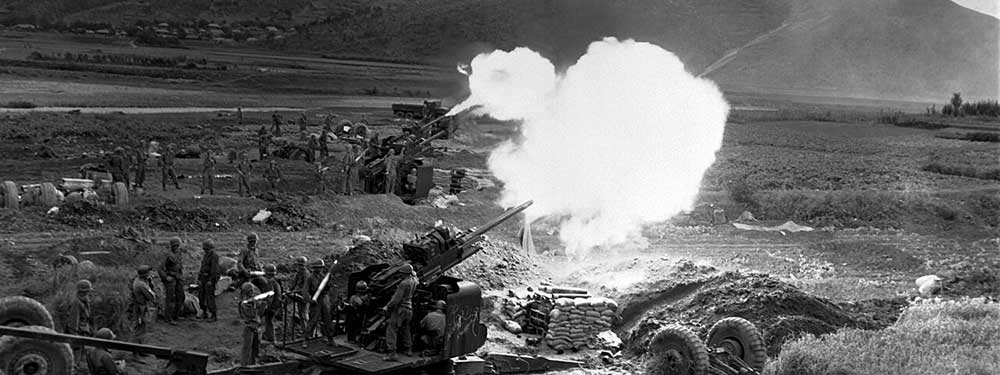
Artillery barrages became the steady beat of this war. Ridgelines, supply routes, and forward positions were shelled almost daily. Infantry assaults were often not part of wider breakthroughs but limited attacks on key hills with good observation and protection. The result was men dying in fierce fighting for names on a map that sounded insignificant, even though the terrain mattered greatly to generals gazing on their battlefield charts.
Bloody Ridge and Heartbreak Ridge were two of the most savage battles of 1951. They highlighted the logic of attrition in its purest form. The Allies launched repeated attacks to push the defenders off key terrain, while the defenders counterattacked to reclaim the same hills. The terrain made every advance uphill while under fire, and every retreat a dangerous retreat down open slopes. Progress was measured in yards and body counts.
In 1953, a hill called Pork Chop became a testament to how costly limited objectives could be. Its tactical significance was much debated, but its political timing was not. As armistice talks began, both sides wanted leverage, and neither wanted to look weak. That made even limited positions seem like symbols of strength. Soldiers paid the price for messaging aimed at negotiators rather than front-line commanders.
The air war overlapped with the ground stalemate. UN aircraft hit supply lines, bridges, and enemy troop concentrations to increase the burden on the enemy’s ability to hold the front. Air campaigns were also meant to signal that time was on the side of the more industrially powerful side. Yet air power could not easily bring about a decisive conclusion when the enemy dug in and no longer cared how many were lost.
Attrition thus created its own stalemate. Neither side could quickly win, and neither could afford to back down. Hill fights, artillery, and air strikes all became means of wearing down the enemy and securing better bargaining positions. The 38th Parallel became a battlefield of attrition and endurance, where mere survival and morale were as important as tactics and strategy.
![[ Set of 2 tapes ] KOREA: WAR AT THE 38TH PARALLEL presented by K...](https://m.media-amazon.com/images/I/416k71Xrp-L._AC_.jpg)
Civilians and the Human Cost
The War was a humanitarian disaster. Caught between the front lines as they shifted and as cities changed hands, civilians packed what they could carry and fled on foot in winter, under air attack, and on clogged roads. Refugee columns of wagons and people on foot became a ubiquitous and permanent feature of the Korean War; whole villages were displaced as people looked in vain for a safety that rarely lasted for long. Advances and retreats were often so rapid that many had to flee more than once.
Mass violence and atrocity were another feature of the War. A conflict driven by ideological ambition and fear, it led to civilians often being seen as potentially guilty of collaboration. When power shifted, reprisals came, and as forces retreated or occupied, there were massacres. The result was social rupture, with neighbors against neighbors, and communities learning that survival often came from silence, flight, or swearing allegiance to whichever side occupied the town that week.
Prisoners of war became another aspect of the war as it became a civil conflict. Captives were symbols as much as they were combatants. Both sides wanted to demonstrate moral legitimacy in the conflict, and POW camps became a site of coercion, factional struggle, and extensive propaganda efforts. “Voluntary repatriation” became a major political struggle of the postwar period as those wishing to return often faced the threat of punishment or death, while those refusing to return were potentially subject to public accusations of being defectors from their own regime.

During the Korean War, many children lost their parents. According to a UN intelligence officer, an orphanage in Seoul was bombed, and more than 40 children were killed or went missing; the roughly 50 children who survived were sent elsewhere. – National Archives of Korea
Propaganda struggles also determined how suffering was framed. Each side in the conflict wanted to demonstrate to its own population that it was truly defending Korea against a foreign aggressor. That interpretation hardened internal divisions in a war that was more accurately a vicious civil conflict, making later reconciliation much more difficult. Violence thus became not only physical but also narrative, teaching people how to remember and whom to blame.
Trauma also outlasted the shooting. Families were separated by a border that soon became fixed, and many never learned the fate of missing relatives. Ruined cities, orphaned children, and unspeakable memories were also the legacy of the war, seeping into daily life in both Koreas.
The war helped to build hardened political cultures in both regimes, one based on anti-communist security in the South, and one based on siege mentality in the North. The human cost was the foundation on which two very different states were built.
Armistice, Not Peace (1953)
By 1951, it was apparent that neither side could outright win without unacceptable cost. Negotiations started, but talks stalled because the most difficult issues weren’t battlefield questions but political ones. Borders were at stake because they would define who could claim victory. Prisoners of war were at stake because they would become political symbols of legitimacy. A war fought in the name of “freedom” or “liberation” could not easily end with an exchange that looked like surrender.
POWs became the most explosive sticking point. Many prisoners did not want to return to their homes, fearing punishment or tests of loyalty. That made the act of repatriation a moral and propaganda struggle. If prisoners refused to return, it was an embarrassing loss for the side they spurned. If they were forcibly sent home, it undercut claims of humane governance. The question of “voluntary” return became a diplomatic minefield that kept the war going even when front lines barely moved.
Borders were the other major obstacle. Fighting continued while negotiators squabbled over maps that could differ by miles but mattered enormously for prestige and security. Each side sought defensible terrain and a line that could be presented as victory. Meanwhile, soldiers died for hills and ridges, often taken not to win the Korean War but to improve bargaining positions.
The armistice of July 27, 1953, created the Korean Demilitarized Zone, a buffer roughly along the ceasefire line near the 38th Parallel. The DMZ is locked in the division of Korea, not as a temporary pause but as a hardened frontier. It created a space intended to make immediate war more difficult while also making the border one of the most militarized places on the planet.
The war never formally ended because an armistice is not a peace treaty. It stops shooting, but it does not resolve claims, recognize final borders as permanent, or settle the political question of the future of Korea. Without a peace agreement signed by the primary parties, the conflict remained legally unfinished even as daily life moved on.
That unresolved ending is the Korean War’s lasting shadow. The armistice froze a battlefield into a border, left families divided, and ensured that future crises would take place under the threat of renewed war. In that sense, the 1953 agreement did not close the story of the Korean War. It suspended it, creating a tense peace that still defines the peninsula.

Legacy of the 38th Parallel
The 38th Parallel became more than a border. It became a Cold War fault line that helped militarize Asia for decades. The Korean War normalized the idea that the superpowers would fight by proxy, with local ground forces bolstered by global logistics, air power, and mobilization on a truly massive scale. For security planning across the region, the post-1953 assumption was permanent confrontation, not a temporary crisis.
In the United States, the Korean War hardened containment into a set of long-term commitments. Troops remained on the peninsula, alliances deepened, and defense spending became a durable feature of Cold War strategy. Korea also set precedents for how Washington would approach later conflicts, especially limited war, coalition politics, and the constant fear of escalation.
In China, intervention in Korea secured a buffer and made it clear that the new regime would fight to defend its borders. The war reinforced Chinese security concerns and shaped Beijing’s view of U.S. power in East Asia. Korea also fed a potent narrative of resistance that would become central to Chinese political memory even as the war’s human and economic costs were immense.
For the United Nations, Korea was a defining test. It showed the UN could authorize collective action to uphold international peace and security. It also revealed limits: that major powers still dictated outcomes, and that political stalemate could freeze a war rather than resolve it. The armistice system and monitoring structures created a model of “managed conflict,” not true peace.
The line remains one of the world’s most dangerous borders because it is heavily armed, politically unresolved, and emotionally charged. The Korean War ended in a ceasefire, not a settlement, so each side still treats the other as a live threat. The DMZ is quiet at times, but it is quiet in the way that a loaded weapon is quiet —because nothing has been truly finalized.

Conclusion
The 38th Parallel was only ever intended as a temporary division. In the end, the world watched a proxy war that pitted ideology, security, and survival against one another. Armies poured back and forth across the border. Superpowers tested each other’s mettle. Civilians bore the cost. In the aftermath, the front line stabilized around the same latitude where it had started, showing how much violence can happen—and still end with a map that looks unchanged.
That front line and the stalemate it represented matter because they were not an ending. The armistice signed in 1953 froze the conflict but did not resolve it. Korea remains divided, the border militarized, and families separated. Politics calcified on both sides, identities shaped by the memory of war. The simple and grim truth of that stalemate is that the conflict stopped but never finished.
Remembering the Korean War matters today because its legacy endures. The DMZ is one of the most militarized borders in the world, and the choices of 1950–1953 still condition alliances, threats, and diplomacy in East Asia. The Korean War is frequently described as “forgotten,” but the peninsula has not forgotten. Understanding how the 38th Parallel became a killing ground helps explain why peace remains so difficult—and so urgent.


![[VIDEO] California: Weird & Interesting State Facts](https://historychronicler.com/wp-content/uploads/2025/03/Screenshot-2025-03-26-at-2.11.20 PM.jpg)
