

The Gunshot That Shattered Europe: How Franz Ferdinand’s Assassination Sparked World War I
 Reading Time: 27 minutes
 On the morning of June 28, 1914, Archduke Franz Ferdinand of Austria rode through the streets of Sarajevo. He had survived an assassination attempt on his way, but just a short distance from the Governor’s office, 19-year-old Gavrilo Princip had another chance. Princip pulled out a revolver and shot the Austro-Hungarian heir and his wife, Duchess Sophie, twice at point-blank range. Eyewitness testimony and official inquiries record that the Archduke spoke to his dying wife, saying, “Sopherl, don’t die. Stay alive for our children.” Both died soon after. Political assassination in Bosnia would become the defining event that unleashed the war to end all wars.
But the killings did not directly cause the First World War. European states had assembled rival alliances, built up armies, competed for overseas empires, and fanned the flames of nationalist movements over decades, leaving the continent tenuous and primed for instability. Scholars such as Christopher Clark have argued the great powers were “sleepwalkers” caught up in a series of political maneuvers, rather than single moments of violence or design.
The assassination was a spark that ignited a powder keg already assembled by decades of choices and circumstances. In a matter of weeks, diplomacy unraveled, declarations of war reverberated across the continent, and a regional crisis turned into a global war that would claim more than 20 million military and civilian lives.
Europe Before the Storm: A Continent Ready to Explode
By the early twentieth century, Europe was home to six great powers, all of which sought to increase their influence through diplomacy, military build-up, and economic development. Germany had recently unified and was seeking a “place in the sun,” which disturbed the century-old balance of power, and Austria-Hungary and the Ottoman Empire were both beset by nationalist divisions. In this environment, many leaders feared that a weak nation would invite aggression, but the drive to show strength only made the continent more prone to conflict.

The same dynamic extended far beyond Europe. Britain, France, and Germany were involved in a global race for colonies in Africa, Asia, and the Pacific, with many convinced that overseas empires were a sign of national greatness. Diplomatic clashes over Morocco in 1905 and 1911 greatly increased tensions between Germany and France, while the British Royal Navy and German High Seas Fleet began an arms race in dreadnought battleships, with British First Lord of the Admiralty Winston Churchill later recalling that each power sought “security through superiority,” but every battleship raised only suspicion in its rival.
Military build-ups became a source of national pride. All the major powers spent huge sums on new weapons, larger armies, modern artillery, and ever more detailed war plans. Most European states had moved to universal conscription, mobilizing millions of men within a few short months.
Two large alliance systems had also developed. Germany, Austria-Hungary, and Italy were the Triple Alliance, while Britain, France, and Russia formed the Triple Entente. Although these pacts were supposed to deter aggression, they meant that every local crisis had the potential to draw in many different nations.
Nationalism also contributed to the crisis. In state after state, people across Europe felt their nation, or ethnic group, deserved greater independence, territory, or prestige. The most explosive area was the Balkans, where Serbia had become an increasingly nationalistic state that challenged Austria-Hungary’s position as the protector of Slavic peoples. As a result, historians sometimes call the region the “Powder Keg of Europe” due to the number of competing ambitions. By 1914, Europe had powerful new militaries, multiple rival alliances, and widespread nationalism across its many nations. It only required a spark to begin the greatest war the world had yet seen.

Who Was Archduke Franz Ferdinand?
Franz Ferdinand was not born with any particular expectations of becoming the emperor of Austro-Hungary. He was born in Graz, Austria, on December 18, 1863, to Archduke Karl Ludwig, the younger brother of Emperor Franz Joseph I. He would not become heir presumptive to one of the largest empires in Europe until the deaths of a string of family members, including the suicide of the emperor’s son and heir, Crown Prince Rudolf, in 1889 and his own father in 1896.
When Franz Ferdinand ascended the Habsburg throne, he inherited a realm rife with ethnic divisions, internal political strife, and growing political tensions that cast a dark shadow over the future of his empire.
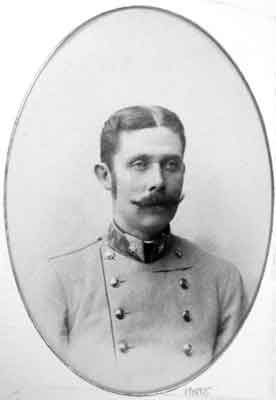
One of the most important events in the Archduke’s personal life was his 1900 marriage to Countess Sophie Chotek. While Franz Ferdinand and Sophie were deeply in love, she was not from one of Europe’s reigning royal families, and, by Habsburg law, their marriage was morganatic. Sophie was granted limited use of royal titles, and their children were not allowed in the line of succession. Franz Ferdinand and his wife were often subjected to deliberate snubs at official ceremonies and events, but their marriage remained devoted. Many historians note that it was one of the happiest marriages among European royal families, despite the imperial court’s restrictions on their relationship.
Franz Ferdinand was a decorated military officer and an active service member, rising to the rank of Inspector General of the Austro-Hungarian Armed Forces. Franz Ferdinand was a frequent traveler, spending time not only across the empire but also in other parts of the world. These travels gave the Archduke a strong sense of both military affairs and international politics.
He believed in a strong army as a necessary and useful instrument of state policy, but not as an instrument of aggression or conquest. His military background and awareness of current affairs convinced Franz Ferdinand that a general European war would prove to be an almost unbearable burden for the Austro-Hungarian Empire.
Franz Ferdinand was, politically speaking, a difficult man to pin down. He favored a strong central government while simultaneously reforming Austria-Hungary into a more properly balanced state that would provide its many ethnic groups with greater representation. Some historians believe that he advocated a form of federalization, also known as the “United States of Greater Austria,” which would have given the empire’s Slavic populations a greater voice in government. This would have been intolerable to Hungarian political leaders, who would likely have lost power under such a scheme, but many Serbian nationalists saw any strengthening of the empire as anathema to their goal of uniting all the South Slavs under Serbian leadership.
Franz Ferdinand has also been described as blunt, impatient, and prickly, and was, by most accounts, a difficult person to work for or work with. He may, however, have been one of the few senior European leaders who were truly trying to avoid a general war. Historian A. J. P. Taylor has argued that the Archduke was one of the few Habsburg leaders who could clearly see the dangers of a conflict with Russia. He repeatedly expressed skepticism about the wisdom of embarking on large-scale military operations, and while he favored a general policy of firmness in foreign affairs, he did not rule out negotiation.
Ironically, the assassination of a man who may have tried to avoid war started a chain of events that caused it to become the most destructive and far-reaching war of his time.
Bosnia: A Powder Keg in the Balkans
The city of Sarajevo mattered because it lay at the heart of one of Europe’s most explosive political fault lines. Bosnia was home to a mixed population of Serbs, Croats, Muslims, and others who had been living under Austro-Hungarian rule since 1878. To the imperial capital of Vienna, the province was a strategic buffer in the Balkans. To many Serbian nationalists, it was a homeland for their fellow South Slavs that should not be part of the Habsburg Empire.
In 1908, Austria-Hungary formally annexed Bosnia and Herzegovina, bringing a long military occupation into direct imperial rule. The Serbian reaction was fierce, as the move was seen as a direct attack on its nationalist dream of uniting South Slavs in a greater Serbian-led state. Russia also protested, but it was too weak, having suffered defeat in the Russo-Japanese War and a revolution in 1905, to fight. The crisis ended without a war, but the resentment and anger would not go away.

Serbian nationalism continued to intensify in the following years. Secret societies, student radicals, and military-linked nationalist networks spread the belief that Serbs and other South Slavs should be independent of Austria-Hungary. This belief was often connected to the broader ideology of Pan-Slavism, which saw all Slavic peoples as culturally and politically related. Russia frequently cast itself as the protector of all Slavs, providing Serbia with the moral and diplomatic backing that only made Vienna more jittery.
Adding to the instability was the ethnic tensions in Bosnia and Herzegovina. Some ethnic groups accepted Habsburg rule, others pushed for reform or autonomy, and still others demanded union with Serbia. The empire feared that Serbian agitation might spread to its own Slavic subjects, destabilizing the whole state. That was one reason why the Balkans were often referred to as “The Powder Keg of Europe”. Rival empires, nationalist ambitions, ethnic grievances, and foreign alliances were all stacked on top of each other like dynamite waiting for one spark.
The Black Hand: Secret Society or Terrorist Organization?
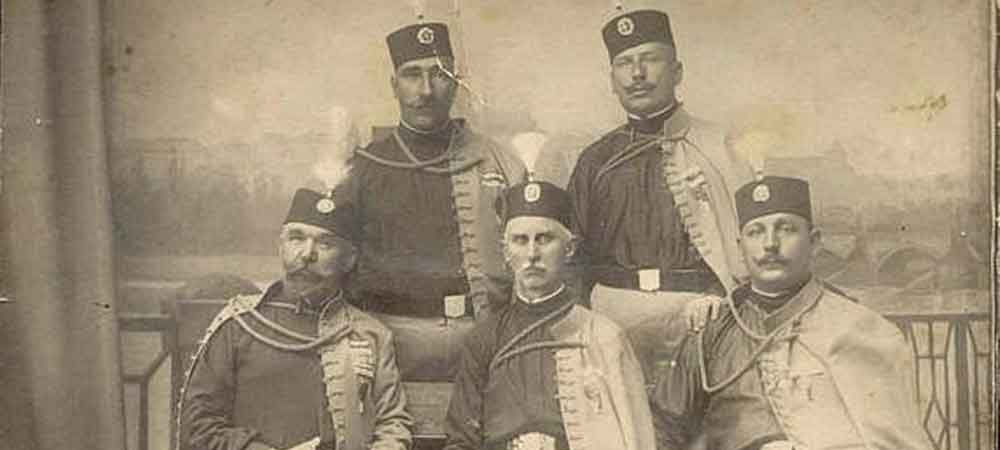
The Black Hand was an organization formed in Serbia in 1911 with the official name of “Unification or Death”. It was established by a group of nationalist army officers as a secret society whose aim was the extension of Serbia and the unification of the lands of the Serbs and other South Slavs. Members swore oaths of secrecy and were committed to the idea that political violence could be justified by the cause of the nation. It has been the target of modern historical debate over whether the Black Hand should be considered a revolutionary nationalist movement, a secret military organization, or an early terrorist organization.
Colonel Dragutin Dimitrijević, who was known by the nickname “Apis”, was the driving force of the Black Hand. Apis was a powerful Serbian military intelligence officer who had already developed a reputation as a master conspirator for his role in the 1903 coup that deposed Serbia’s ruling dynasty. In the years following its founding, the organization grew, but it maintained a strict hierarchy and enforced secrecy among its members. Despite the military backgrounds of many of its members, the Black Hand remained independent from the Serbian government.
One of the organization’s main goals was the unification of South Slavic peoples living under foreign rule, especially within Austria-Hungary. Bosnia and Herzegovina was a particular focus for the Black Hand, as many Serbs saw the province as naturally belonging within a future South Slavic state. The Black Hand disseminated nationalist propaganda through underground networks and established contacts with like-minded individuals outside of Serbia. It gained influence mainly from those who believed that all hope for peaceful diplomacy was lost and that the nation required decisive action to achieve national independence.
One of the greatest historical controversies surrounding the Black Hand is the nature of its connection to the Serbian government. Most historians now agree that the Black Hand had deep and pervasive ties to elements of the Serbian military, particularly because many of its members were active military officers. There is little evidence that the Serbian cabinet ever directly controlled the society’s actions, and historians continue to debate how much civilian leaders knew about the group and if they had the power to rein it in.
The existence of the Black Hand was one symptom of the Balkans’ growing instability in the years before 1914. The nationalist organizations, secret political societies, and competing imperial interests created an environment in which underground groups could thrive. While the Black Hand was never representative of all Serbians, it showed how secretive organizations could influence international affairs. In a part of Europe already pulled in different directions by rival empires and competing national identities, such underground groups were another source of uncertainty.
Gavrilo Princip: The Young Revolutionary
Gavrilo Princip was born on July 25, 1894, in the village of Obljaj, Bosnia, then in Austria-Hungary. He was one of nine children from a poor Serbian family, but only three survived into adulthood. Princip was a quiet, bright, but physically frail child who was a good student. He developed an early interest in literature and politics. As he grew up, he became aware of increasing hostility among many Bosnian Serbs toward Habsburg rule, which influenced his view that Bosnia should be independent of Austria.
Studying in Sarajevo and later in Belgrade, Princip came into contact with nationalist ideas that looked to the unification and liberation of the South Slavic peoples. In Belgrade, he became associated with the ideas of Young Bosnia, a movement or network of students and young intellectuals opposed to Austro-Hungarian rule. It had members from different ethnic and religious groups, but many of them came to the view that no political change would occur without violent revolution. Princip became not just a nationalist, but a man with a cause.
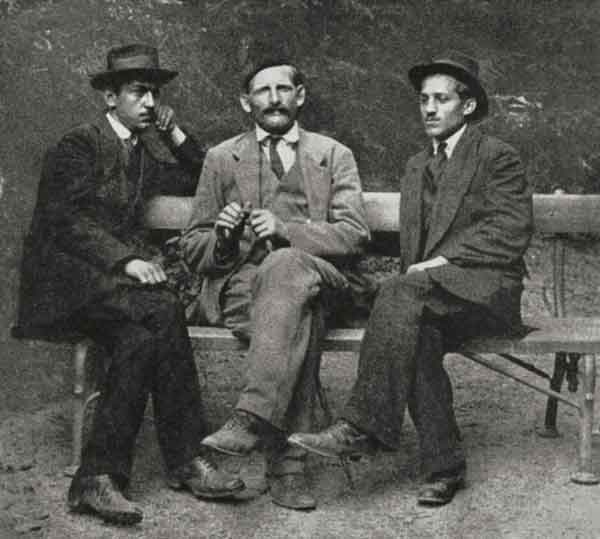
Princip came into contact with agents of the Black Hand and other nationalists while he was in Serbia. He and several companions received rudimentary firearms training and instruction in clandestine travel, then returned to Bosnia. The assassins were each issued a Belgian-made FN Model 1910 pistol, some hand grenades and cyanide capsules, and a small amount of money to finance their mission. The weapons and supplies were acquired by underground networks and had to be smuggled by a number of operatives across the border between Serbia and Bosnia.
Princip later stated that his motivation was political rather than based on personal animosity. Princip testified at his trial: “I am a Yugoslav nationalist, aiming for the unification of all Yugoslavs, and I do not care what form of state, but it must be free from Austria.”
Since he was 19 years old at the time of the assassination of Franz Ferdinand, Austro-Hungarian law precluded the death penalty, so he was sentenced to the maximum 20 years in prison. He also told the court, “I am not a criminal, because I destroyed that which was evil. I think that I am good.”
These words have endured as the center of the continuing debate about whether Princip should be seen as a freedom fighter, a revolutionary, or an assassin whose deed helped unleash the world’s most destructive war to date.
June 28, 1914: The Day Everything Went Wrong
The morning of June 28, 1914, was cold and formal, not frenzied. Archduke Franz Ferdinand and Duchess Sophie entered Sarajevo from their overnight train. The Archduke then joined a motorcade that took him into the heart of the Bosnian capital. He was there to tour a series of Austro-Hungarian military exercises and take part in formal receptions. 28 June was no ordinary day, though. The date was Vidovdan, the Serbian national day commemorating the Battle of Kosovo in 1389.
The Archduke’s presence in Sarajevo on that date outraged Serbian nationalists. He was their ethnic and political enemy, and the visit was inflammatory. Warnings that the trip was dangerous were dismissed, or, if not, security measures were negligible. The motorcade route had been published in the newspapers, and two open-top cars made Franz Ferdinand and Sophie vulnerable.
The Archduke’s procession traveled the Appel Quay along the Miljacka River. Conspirators were present at their designated points on the route, although the first missed his chance. Nedeljko Čabrinović was the next man to see an opportunity. He hurled a hand grenade at the Archduke’s car, but it bounced off the folded convertible roof and exploded beneath the second car. Several officers and civilians were wounded, but none seriously. The assassin swallowed cyanide and jumped into the river, but failed to kill himself, and the water was only ankle-deep. He was soon arrested by police as the motorcade departed. Franz Ferdinand, cool and unscathed, was determined to continue with his visit to Sarajevo.
The next official event took place in the Town Hall. As Franz Ferdinand took the stage, the mayor delivered a welcoming speech. “I come here as your guest, and I am greeted with bombs!” is how a contemporary witness described the Archduke’s interruption. He then continued with the ceremony, before, shaken but still himself, making his way outside again. To the astonishment of his entourage, Franz Ferdinand announced that he now wished to visit the victims of the attack at the Sarajevo hospital. Concern for the injured was one motive, but another was pride. Franz Ferdinand did not want to appear frightened by the attack.
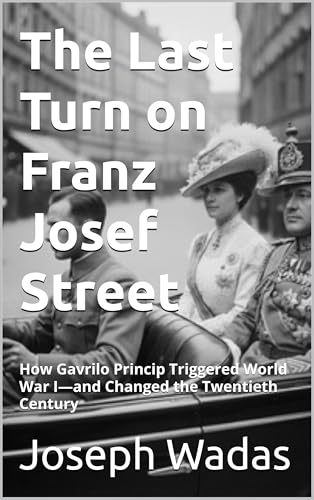
Franz Ferdinand’s unexpected change of plans caused some confusion among his drivers and the security officers. They had agreed that the hospital was the next destination, but one of the drivers turned onto Franz Josef Street and away from the Town Hall. General Oskar Potiorek immediately recognized his mistake and ordered the car to stop and reverse. A wheel blocked its path, forcing the driver to reverse into Franz Ferdinand Square. Fate had one last card to play. The car stopped a few feet from a café, and Gavrilo Princip, who had finished lunch and gone outside believing the assassination attempt had failed, was standing there.

He stepped forward, took out his FN Model 1910 pistol, and fired two shots at close range. One bullet struck the Archduke in the neck, and the other wounded Sophie in the abdomen. The Archduke had cried out to his wife. “Sopherl, don’t die. Stay alive for our children!” witnesses later remembered. Franz Ferdinand and Sophie were rushed towards the governor’s residence, but Sophie died before they arrived. Her husband died a few minutes later. Official medical reports claimed that both victims had bled to death before medical help could save them.
News of the killings sent shock waves through Europe, but very few realized their significance immediately. A number of commentators believed that the assassination, though shocking, would remain a regional event, more a Balkan crisis rather than an international one. They were to be proven wrong, for the consequences of the murders spiraled out of control as diplomatic ultimatums, military mobilizations, and declarations of war began to fill the summer. A failed assassination attempt, a driver’s wrong turn, and a chance encounter combined to make June 28, one of history’s most fateful days.
Shock Across Europe & Immediate Aftermath
News of the assassination spread throughout Europe within hours. It elicited shock, mourning, and anxiety. Newspapers scrambled to publish special editions. Governments struggled to verify the facts that had transpired in Sarajevo. While most people recognized that something terrible had happened, few thought the murders would lead to a general war. Europe had survived the previous Balkan crises, and this one would surely be no different. Diplomats and political leaders assumed that the problem would be contained by negotiation. As historian Christopher Clark has written, few expected a regional assassination to soon redraw the map of the world.
Archduke Franz Ferdinand’s body and that of Duchess Sophie were returned to Austria and interred at Artstetten Castle on July 4, 1914. As a morganatic marriage, Sophie was not afforded many of the traditional trappings of an imperial funeral. Emperor Franz Joseph, who had long had a strained relationship with his nephew, did not even attend the ceremony. Thousands of common citizens lined the path of the funeral procession as a sign of respect to the imperial couple, however.
The initial mourning in Austria-Hungary soon turned to indignation. Government officials assumed Serbia was a source of nationalist agitation and believed it was high time to take decisive action. Germany strongly encouraged its ally and assured Vienna that it would support whatever actions it decided to take. At the same time, German officials hoped that a strong Austrian action would solidify the alliance rather than start a general conflict.
Serbia immediately condemned the assassinations and denied that they were a state-sponsored attack. Serbian leaders knew their nation would be in serious jeopardy if Austria-Hungary held the government responsible for the conspirators. Diplomatic maneuvers started almost immediately, but there was deep distrust on all sides. As Europe mourned the victims of Sarajevo, governments were already appraising military options and alliance obligations. A local Balkan issue was already becoming an international crisis and would lead to the fateful July Crisis.
The July Crisis: Five Weeks That Changed History
The murder in Sarajevo did not immediately trigger war. Instead, the event set off a five-week period known as the July Crisis, during which diplomats, generals, and heads of state made decisions that transformed a local conflict into a world war. The first step was a period of investigation by Austria-Hungary, which sought to establish evidence, identify the culprits, and assess whether Serbian officials were complicit in the plot. The investigation found that the assassins were connected to Serbian nationalist groups, but evidence of official government culpability was inconclusive at best. In the end, most Austrian leaders decided that Serbia must be punished if the empire was to maintain its own credibility.
To do so, Austria-Hungary naturally turned to its most powerful ally, the German Empire. Kaiser Wilhelm II and his government responded to Vienna on July 5, 1914, with a promise of support that would later be called the “Blank Check,” which offered an unequivocal commitment to back its ally even if it meant going to war over Serbia. The offer of a “Blank Check” is now generally considered one of the most consequential events of the July Crisis. Confident that Germany would support it, Vienna did not move immediately; instead, it formulated a diplomatic response in hopes of exerting maximum pressure on Serbia while other European governments continued negotiations.
By July 23, the Austro-Hungarian Empire presented Serbia with an ultimatum containing ten demands that Serbia must agree to within 48 hours. A number of these conditions would have required Austrian officials to participate in investigations and judicial proceedings on Serbian soil, and many interpreted this as an affront to Serbian sovereignty. The Serbians accepted almost all the demands but balked at any suggestion that the Serbian government’s authority be compromised.
Kaiser Wilhelm II was famously reported to have said after reading Serbia’s response, “a capitulation of the most humiliating kind,” but that the response was at least something to build a peace upon. Austrian officials disagreed. While some governments and observers thought the Serbian reply went a long way towards accommodating the Austro-Hungarian demands, the people in Vienna thought otherwise. After giving Serbia an extra 12 hours to reply to their final demands, Austria-Hungary declared war on 28 July, dooming the last realistic chance of a diplomatic solution.
The war declaration, however, was just the start. The conflict that Vienna had intended to keep limited to Serbia soon started to draw in other countries, which were now compelled to consider their treaty commitments, military plans, and geopolitical interests. Over the next few days, the complex system of alliances in Europe would come into effect, turning a war in the Balkans into a general European war. In less than a week, most of the continent’s major powers would find themselves at war, and so was how the process of alliances, rivalries, and military mobilization turned the July Crisis into World War I.
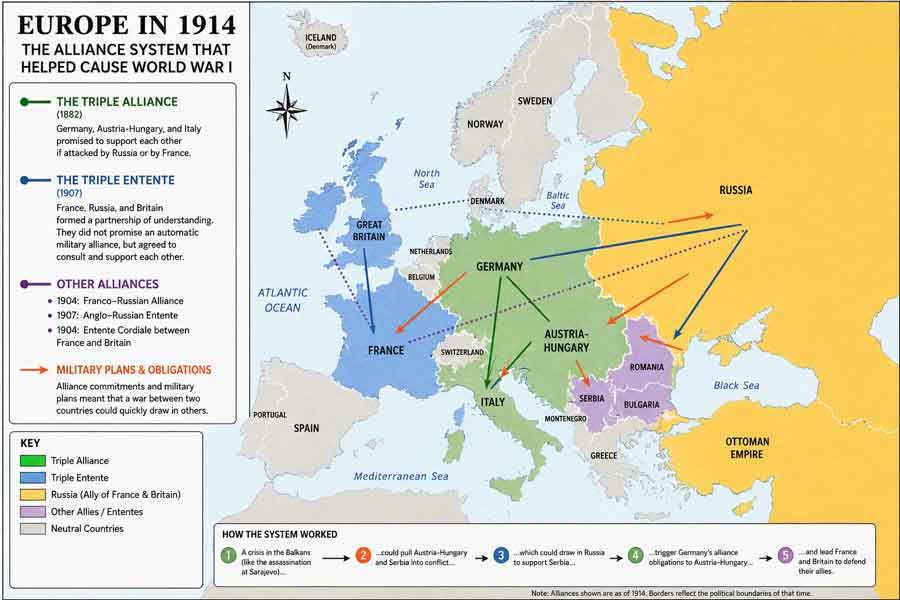
The Dominoes Begin to Fall
On 28 July 1914, Austria-Hungary declared war on Serbia. It expected a short war that would reestablish its influence in the Balkans. However, this set off a chain of alliances that developed over decades. Russia felt it could not idly watch Austria-Hungary’s aggression against Serbia, a Slavic nation. Russia also had a long history of supporting Serbia. On July 30, Tsar Nicholas II ordered a general mobilization of the Russian Army. Although the Russians claimed it was a purely defensive measure, the Germans saw it as preparation for war.
Germany did not waste time. On August 1, 1914, it declared war on Russia. The Germans believed that they could not afford to wait while the Russians mobilized. German war planning had been built around the Schlieffen Plan, which assumed that any war with Russia would also involve France. Rather than fighting a war on two fronts simultaneously. The solution was to knock France out of the war as quickly as possible, using the Schlieffen Plan, before moving east against the slow-mobilizing Russian Army. If this was the German response to Russia, it was no longer possible to limit the war to the Balkans.
Two days later, Germany declared war on France and launched its offensive. Rather than marching on France’s heavily defended eastern border, the German forces marched through neutral Belgium in order to outflank the French defenses. By invading Belgium, Germany violated a treaty signed in 1839: the Treaty of London, which guaranteed Belgium’s neutrality. This opened the eyes of many who had seen the conflict as a limited and regional affair, and created a European-wide crisis.
Britain was under no formal alliance obligation to defend France, but it was under a legal obligation to defend Belgium’s neutrality. On August 4, after Germany refused to withdraw from Belgium, Britain declared war on Germany. Foreign Secretary Sir Edward Grey, when signing the document, is reported to have said: “The lamps are going out all over Europe; we shall not see them lit again in our lifetime.” At the time, his words seemed like an exaggeration, but as the weeks and months passed, more and more people in Europe would come to agree with him.
In the space of a week, an assassination in Sarajevo had become a war in which almost all the major European powers were involved. Austria-Hungary’s attack on Serbia led to Russian mobilization, German declarations of war on Russia and France, the German invasion of Belgium, and the British decision to go to war. The system of alliances, created to keep the peace, had ensured that once one power went to war, all the others would follow. From two shots in Sarajevo, the war quickly became known as the First World War.
Could World War I Have Been Prevented?
The extent to which World War I could have been avoided remains one of the most widely debated questions in modern history, over a century after the conflict began. Some historians view the July Crisis as inevitable, with the single spark of the assassination setting in motion a series of alliance commitments and military mobilization plans that could not be stopped. Others are more skeptical of such inevitabilist interpretations, suggesting the crisis could have been managed without resort to war if cooler heads had prevailed. It is one of the most important and hotly contested questions in modern history because it asks about agency versus determinism in history: Did human decisions or broader historical forces seal Europe’s fate?
One side of the debate argues that Europe was already on a collision course for war well before June 1914. The entire continent was primed for conflict by long-term processes such as militarism, imperial rivalry, nationalism, and diplomatic crises that stretched back for decades. These forces created an increasingly brittle international system where smaller crises such as the Moroccan Crisis and the Balkan Wars had already brought Europe to the brink of war without quite crossing the line. If the assassination in Sarajevo had not happened in June 1914, this interpretation holds, another contingency would have eventually triggered the same underlying forces.
Other historians emphasize the July Crisis itself as the critical turning point that should have, but failed to, avoid war. These historians reject the view of war as inevitable, instead highlighting that at multiple stages during July 1914, European leaders failed to grasp opportunities to de-escalate the crisis and allowed tensions to boil over into war. The decisions that eventually led to the outbreak of war include Austria-Hungary’s confrontational approach, Germany’s “Blank Check,” Russia’s large-scale mobilization, and France and Britain’s adherence to alliance obligations. In this perspective, the calamity was the result not of a single assassination but of a series of decisions that successively reduced the space for a diplomatic resolution of the crisis until none was left.
The debate about responsibility for the outbreak of war has also been fiercely contested. The Allies assigned primary responsibility to Germany through the War Guilt Clause in the Treaty of Versailles in 1919, and for much of the 20th century, this conclusion was accepted by most historians in light of Germany’s early mobilization, willingness to support Austria-Hungary, and complicity in escalating the crisis.
However, in more recent scholarship, the blame has been reassessed. In his book The Sleepwalkers, historian Christopher Clark challenged the prevailing wisdom, arguing that European leaders were not actively pursuing a world war but instead “sleepwalked” into conflict through misjudgments and misunderstandings, fear, and mutual suspicion. Rather than apportioning blame on a single culprit, Clark’s more recent interpretation is that the great powers were equally responsible for the conflict.
This continued debate over the origins of World War I also demonstrates an important lesson about the nature of international politics. The conflict did not begin because a single man was killed, nor because a single country alone wanted war. The multiple, interconnected causes of World War I included rigid alliance structures, aggressive nationalism, military planning, diplomatic missteps, and political misjudgments. The degree to which the First World War was inevitable will remain a subject of debate, but the events of 1914–1915 can still instruct historians that wars often do not begin for a single cause but result from a chain of decisions.
Myths About the Assassination: Separating Fact from Fiction
The Archduke Franz Ferdinand’s assassination has given rise to so many myths that they still obscure the public understanding of World War I’s origins. First, it is useful to ask what exactly Gavrilo Princip was: the heir to the Habsburg throne, and most of Austria-Hungary saw him clearly as a political assassin whose actions helped release a terrible war.
In some segments of former Yugoslavia, however, people have also remembered him as a brave revolutionary who struck against alien rule. Modern historians avoid simplistic labels when they speak of Princip as someone who chose political violence for nationalist ends while at the same time sincerely believing that he was working for liberation. His reputation, like so many of this period, has been in the eye of the beholder.
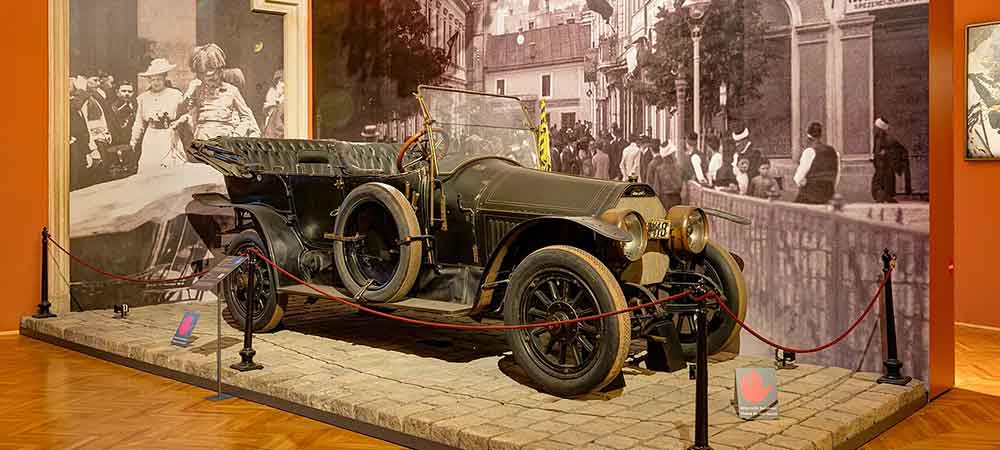
The next story is about the wrong turn made by the Archduke’s driver. Unlike many other popular stories, it can be easily verified by eyewitness accounts and official investigations. After leaving the Sarajevo Town Hall, the driver took the original route instead of turning as he should have to visit the officials wounded in the first attack at the hospital. General Oskar Potiorek ordered the car to stop and back up, which brought it to a halt directly in front of Gavrilo Princip. The wrong turn did not, in itself, make the assassination possible, but it did put the car within reach of Princip after his first target had failed him.
The Archduke was not the universally unpopular royal he is sometimes portrayed to be. Franz Ferdinand was widely disliked by Hungarian politicians, some in the Habsburg court itself, and most nationalist factions that sought to end imperial rule. He also had many supporters, especially among military officers and those convinced that his reforms would help rather than harm the empire. A similar popular misconception is that more security would certainly have prevented the attack. Historians agree that the arrangements made for the Sarajevo visit were astonishingly permissive for such an important occasion, but no one knows for certain if additional guards or a route change would have protected the couple.
Finally, there is the greatest of all myths, the idea that Germany planned a European war from the moment the Archduke was shot. Most historians agree that the German government took a terrible risk by providing an “Blank Check” to Austria-Hungary, but they continue to disagree about how aggressively German leaders sought a continent-wide conflict. Some see Germany as hoping for a limited Balkan war that would solidify its ally, while others see influential German officials as convinced that 1914 was a good time to fight Russia and France.
This ongoing debate over Germany’s role underscores a broader truth about the July Crisis: World War I was not the result of a single cause but of a series of decisions, assumptions, and misperceptions made by several governments amid a rapidly escalating international crisis.
Lasting Consequences: The Two Shots That Changed the World
The assassination of Archduke Franz Ferdinand did not simply spark a war between Austria-Hungary and Serbia. By the time the conflict had drawn to a close in November 1918, the First World War had resulted in more than 20 million military and civilian casualties, millions of wounded and displaced, the destruction of whole swathes of Europe, and the upending of economies and social orders across the continent. A generation of young Europeans would be known as the “Lost Generation” for the terrible losses they had suffered, and their world would never be the same again. The two shots fired in Sarajevo that June had irrevocably transformed the political, social, and economic character of the modern world.
One of the war’s most immediate and startling effects was the downfall of four empires. The German Empire, Austro-Hungarian Empire, Ottoman Empire, and Russian Empire all ceased to exist in the years after the conflict. New states emerged out of their ashes, including Czechoslovakia, Yugoslavia, Finland, and Poland, and the map of Europe was redrawn. At the same time, the Russian Revolution of 1917 led to the creation of the Soviet Union, and, for the first time in modern history, the forces of communism became a major factor in international relations. The world would never look the same again.
In some ways, the peace settlement was almost as significant as the war itself. The Treaty of Versailles in 1919 imposed heavy territorial, military, and financial penalties on Germany. Many Germans felt the terms of the treaty were deeply unfair, and a sense of resentment and grievance built up in German society that was later used as fodder by extremist political movements.
While historians have since debated the justness of the treaty, many would agree that it helped to lay the ground for the emergence of fascism in Germany and Italy and provided the most significant causal factors for the outbreak of World War II two decades later. French Marshal Ferdinand Foch would reportedly say, “This is not peace. It is an armistice for twenty years.” It turned out to be eerily prescient.

Of course, the effects of the war extended far beyond Europe and the Middle East. The breakup of the Ottoman Empire saw Britain and France carve up much of the Middle East as League of Nations-mandated territories. The Sykes-Picot agreement and subsequent mandates established the majority of the modern political boundaries in the Middle East today.
These territorial divisions also sowed the seeds of future conflict in the region, and, in many ways, the League of Nations itself was the first concerted attempt at a permanent international organization committed to maintaining peace through collective security. The League itself ultimately failed to live up to its remit, but the United Nations that succeeded it after World War II was built on its foundations.
The long-term impact of June 28, 1914, therefore runs much deeper than Franz Ferdinand’s assassination itself. The two shots that killed Franz Ferdinand and set the Balkan powder keg off had, in their wake, destroyed empires, redrawn continents, changed the nature of global politics, and had a hand in nearly every major conflict of the twentieth century. It is difficult to imagine a clearer and more potent example of how a single act can unleash forces whose reverberations will echo far beyond the involvement of those who take it.
When One Moment Changed the World
After the failed bomb attack, Gavrilo Princip probably assumed the operation was in tatters. But as he strolled outside Moritz Schiller’s delicatessen, fate handed him one last opportunity: the Archduke’s car stopped almost directly in front of him. In an instant, a local act of political violence became the spark that set off a crisis that Europe’s leaders could not contain.
The gunshots did not cause World War I all by themselves. They released forces that had been building for decades: rival alliances, military plans, imperialist competition, nationalism and fear. Sarajevo was the spark, but Europe had long filled the room with powder.
Few events more clearly show how history can hinge on a single moment. If the car had not stopped, if the route had been corrected earlier, if diplomacy had held firm, the twentieth century might have been very different. Instead, one chance encounter at precisely the wrong time helped change the course of global history.


