30+ Most Important Figures in Greek Mythology
 Reading Time: 32 minutes
 Greek mythology influenced nearly every aspect of life in the ancient Greek world. The Greeks used myths to explain the origin of the natural forces that influenced their lives, to interpret the purpose of religious rituals, and to find allegorical significance in their everyday experiences. Myths provided models for Greek art on vases, temples, statues, and coins, as well as for Greek poetry and drama. Greek cities also used myths to legitimize their political institutions, and the city-state of Athens believed Athena protected the city. Mythical links to gods, heroes, and legendary founders also gave other Greek communities a sense of common ancestry and a shared history.
There was never one fixed or official canon of Greek myths. The traditions preserved in Homer and Hesiod are the earliest surviving examples, and playwrights such as Sophocles and Euripides would rework known myths for their audiences. Later writers, such as Apollodorus, collected and organized the many myths in existence, some of which were told in several versions. These variations and contradictions show that Greek mythology was a long-lived and flexible tradition, subject to the creative power of poets, the local preferences of different regions, and changes over time as it was passed down through generations.
This article provides an overview of the gods, Titans, heroes, mortals, and monsters whose stories had the most influence on Greek culture. Each of these figures represents themes that the ancient storytellers explored again and again, including power and its abuse, fate, war, wisdom, pride, sacrifice, loyalty, and revenge. Their legends also reveal how the Greeks understood the gods’ divine authority and their relationship to both the strengths and the failures of human nature.
The Primordial Powers and Titans
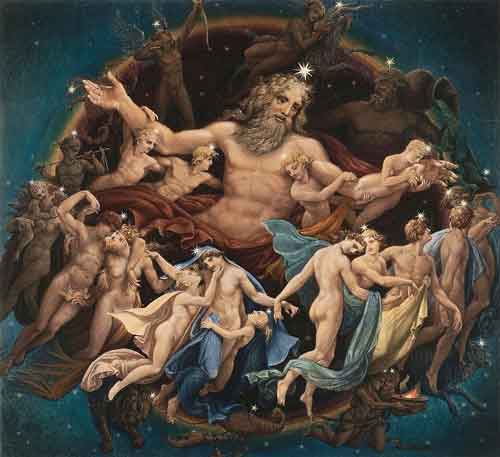
Before Zeus and the Olympians dominated Mount Olympus, Greek mythology told of an earlier world of primordial deities and Titans. These represented fundamental aspects of the world, such as Earth, sky, time, and natural power. The most important surviving source for this primordial family of gods is Hesiod’s Theogony. Theogony’s tales describe how each successive generation of gods usurped power from the previous one.
Gaia
Gaia was the primordial goddess and the personification of the Earth itself. She appeared near the start of creation, and from her emerged Uranus, the sky, whom she later mated with to produce the Titans, the Cyclopes, and the Hundred-Handed Ones. Gaia was both the nurturing mother of all and a terrible and unpredictable cosmic force. She embodied the life-giving soil, but from her sprang gods, monsters, and mortals.
After Uranus imprisoned some of their children, Gaia caused his overthrow by giving Cronus a sickle and urging him to attack Uranus. This ended Uranus’s rule and allowed the Titans to take their place. Gaia was thus at the heart of creation, as well as divine rebellion, for she demonstrated how the Earth could be bountiful while also toppling tyrants who transgressed against the natural order.
Uranus
Uranus was the original god of the sky and one of the first sovereigns of the universe. He sired the first race of great gods with Gaia. However, according to Hesiod, Uranus hated or feared some of his offspring and cast them down into the chasm of Gaia’s darkness. His violent and sadistic acts against his children caused Gaia to long for revenge.
Cronus took Gaia’s sickle and castrated his father Uranus, bringing an end to his rule. Cronus later acted as brutally towards his own children as Uranus had towards his. The idea that tyranny breeds the seeds of its own destruction is introduced with the fall of Uranus.
Cronus
Cronus was the youngest of the Titans and the leader of the Titans’ generation. He became ruler of the world after overthrowing his father, and his reign was the mythological Golden Age, a time when humans lived with minimal hardship as described by Hesiod. However, his benevolent image was complicated by Cronus’s intense fear. Cronus had heard a prophecy that one of his children would overthrow him as he had overthrown his own father.
So he swallowed each child that Rhea bore (including Hestia, Demeter, Hera, Hades, and Poseidon). Rhea saved Zeus; he later tricked Cronus into disgorging his siblings, and the Olympians, under Zeus’s leadership, then defeated the Titans in the Titanomachy. Cronus’s story serves as an archetype of the power-hungry tyrant that one risks becoming if one is excessively fearful of losing control or power.
Rhea
Rhea was a Titan goddess and the mother of the first Olympian gods. She was tormented as Cronus swallowed each of their children in turn. When Zeus was born, Rhea refused to hand over another baby. With assistance from Gaia and Uranus, she hid the newborn in Crete and gave Cronus a stone wrapped in cloth instead.
Cronus swallowed the stone without realizing he had been tricked. Zeus survived and grew to adulthood, eventually freeing his brothers and sisters. Rhea’s bravery and cleverness made the rise of the Olympian gods possible. While she rarely takes center stage in later myths, her choice broke Cronus’s cycle of violence and altered the balance of divine power forever.
Prometheus
Prometheus was a Titan of foresight, intelligence, and the protector of humanity. In one tradition, he had created man from clay, but in others, he was more of a protector of humanity against Zeus. He is best known for stealing divine fire and giving it to mortals, so they could cook food, make proper tools, and build civilization.
Zeus chained Prometheus to a remote rock where an eagle would eat his liver each day, though it would regrow overnight. Later tradition held that Heracles finally managed to free him. Prometheus became a symbol of resistance, knowledge, and progress. The myths also raise the question of whether authority has the right to control knowledge when that knowledge can be used to better human life.
Atlas
Atlas was a Titan who participated in the Titanomachy, the war between Zeus and the Olympians and the older Titans. When the Titans were defeated, Zeus punished Atlas by making him stand at the western edge of the world and hold up the heavens, preventing them from crashing into the Earth. (In the earlier myth, Atlas actually carries the sky itself; the idea that he holds the world is a later conflation with a globe provided in some artistic representations.)
Atlas was later involved in the story of Heracles and the golden apples of the Hesperides; in some versions, Atlas tricks Heracles into holding up the heavens while he fetches the apples for them. Atlas was later depicted by artists as holding up a celestial sphere, and later still, this became a terrestrial sphere as well, representing the Earth. The endurance his labors implied led to his name being used as a metaphor for the “support” of the world and the endurance of extraordinary burdens.

The Olympian Gods
When the Titans were defeated, the Olympian gods became the preeminent divine family in Greek mythology. They each presided over a different aspect of nature and human life. However, the Olympians were by no means perfect. Homer, Hesiod, and other ancient poets described them as powerful but subject to love, jealousy, pride, anger, and ambition. Their struggles gave significance to storms and harvests, war and death, marriage, and the rise and fall of heroes.
Zeus
Zeus was the king of the Olympian gods and ruler of the sky. He escaped his father, Cronus, and led his brothers and sisters to victory over Cronus and the other Titans in the Titanomachy, freeing the six who had been swallowed by Cronus. The new order of gods that Zeus created ruled all of nature and space, and he himself held dominion over thunder and lightning, justice and judgment, hospitality, sacred law, oaths, and rebellious deeds.
Homer’s Iliad and Odyssey often portray Zeus as the high king who metes out justice to both gods and men (though he himself is not all-powerful and must heed fate). His sexual activity produced many gods and heroes, such as Athena, Apollo, Artemis, Hermes, Perseus, and Heracles. It also caused infighting, jealousy, punishments, vengeance, and struggle, most notably with his spouse, Hera.
Zeus is often contrasted as a family father and guardian of law and order with the amoral ruler who is continuously violating familial relationships through his sexual escapades. The tension between Zeus as a ruler who secures order and as a ruler whose lust causes strife allowed Zeus to become a symbol of authority that preserved order but could also produce disorder.
Hera
Hera was the queen of the Olympian gods and the goddess of marriage, women, and the sanctity of queens and kings. As the wife and sister of Zeus, she was the undisputed second-in-command on Olympus. As a goddess, Hera was viewed by Greek communities as the patron and protector of marriage and the lawful family. The most important Hera sanctuaries were at Argos, Samos, and Olympia.
In life, Hera’s marriage to Zeus was repeatedly strained by his infidelities. Hera took out her jealousy on Zeus’s lovers and children far more often than on Zeus himself. She persecuted Heracles both before his birth and for much of his life. On the one hand, the myths present Hera as a majestic and maternal figure; on the other hand, if Hera’s honor was defiled, she could be a terrible deconstruction of the one responsible.
Poseidon
Poseidon was the god of the sea, but also of earthquakes, storms, and horses. He and his brothers divided the cosmos among themselves after overthrowing Cronus, with Zeus taking the sky, Poseidon the sea, and Hades the underworld. Sailors beseeched Poseidon’s favor for calm seas, because he could as easily as not create violent waves or sink a ship.
Poseidon vied with Athena for patronage over Athens, producing a saltwater spring by striking his trident on the ground. Athena countered with the olive tree and gained the city for herself. In Homer’s Odyssey, Poseidon takes offense when Odysseus blinds his son, the Cyclops Polyphemus, and thwarts the hero’s return for years with storms.
Hades
The underworld and the souls of the dead were under the domain of Hades. Hades was of the same generation as Zeus and Poseidon, but often stayed apart from the other gods on Mount Olympus. The name Hades could also be used as a reference to the place he reigned. It was so feared by the Ancient Greeks that they sometimes avoided saying it directly and instead used titles such as “the unseen one” or “the wealthy one”.
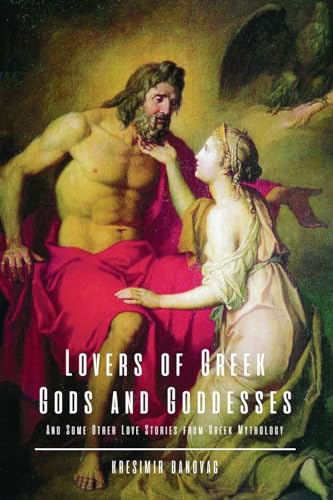
Hades is often incorrectly associated with the Greek counterpart to a devil. While he was stern and to be feared, Hades was not the embodiment of evil. The best-known myth involving Hades was his relationship with Persephone. Hades seized Persephone and brought her to the underworld, where he made her his queen. In some sources, this is described as an abduction, while others treat it as a forced marriage or a union that had the will of the gods from the start, mirroring the different versions told in Greek tradition.
Demeter
Demeter was the goddess of agriculture, grain, fertility, and the cultivated earth. Her influence was a matter of life and death in a society that relied on successful harvests. She was closely associated with Persephone, her daughter by Zeus, in a myth for which the Homeric Hymn to Demeter provides the fullest early version.
When Persephone was abducted into the underworld, Demeter would no longer grant her gifts to the earth. Crops failed, hunger spread, and humanity faced annihilation. Zeus finally intervened and arranged for Persephone to spend part of each year with her mother. The couple’s cyclical absence and reunion came to be seen as an explanation for seasonal growth and decline. Demeter also played a central role in the Eleusinian Mysteries, which offered the initiates a form of hope in death and the afterlife.
Athena
Athena was the goddess of wisdom, crafts, and the arts of strategy and disciplined warfare. After Zeus swallowed her pregnant mother, Metis, according to Hesiod’s report, that her child may be more powerful than he, Athena was born fully armed from Zeus’s head. Her strange birth further established Athena as having a special relationship with her father and as one of the most powerful Olympians.
She became the patron goddess of the city of Athens after gifting the olive tree to its citizens. Unlike Ares, she embodied planning and restraint, as well as martial skill. Athena was also the guardian of many heroes, such as Perseus, Heracles, and Odysseus. The Odyssey features Athena as she protects Odysseus and mentors his son Telemachus, demonstrating that intelligence and patience are just as effective as brawn.
Apollo
Apollo was the god of prophecy, music, healing, archery, and plague. He was the son of Zeus and Leto and the twin brother of Artemis. His sanctuary at Delphi became one of the most influential religious centers in the Greek world. Leaders and ordinary people consulted the Delphic oracle before they undertook wars, journeys, colonies, and major political decisions.
Apollo represented order, beauty, and artistic skill. However, his myths also show that he could be severe. In the Iliad, he sends a plague into the Greek camp because Agamemnon insulted his priest. He also punished those who challenged his talents or who spurned him. Apollo’s character showed that even the divine beauty and reason of the gods did not prevent them from feeling anger, jealousy, or destructive pride.
Artemis
Artemis was the goddess of the hunt, wilderness, childbirth, and young women. She was the twin sister of Apollo and was usually depicted carrying a bow, with animals surrounding her. Artemis remained unmarried, but women invoked her during childbirth. This paradox represented her mastery of perilous rites of passage between childhood and adulthood, and between life and death.
Artemis strongly guarded her independence and sacred space. When the hunter Actaeon saw her bathing, she turned him into a stag, and his own dogs tore him to pieces. She assisted Apollo in slaughtering Niobe after the latter had insulted their mother, Leto. In the myth of Iphigenia, Artemis either demands the maiden’s sacrifice or stops it at the last moment, depending on the version.
Ares
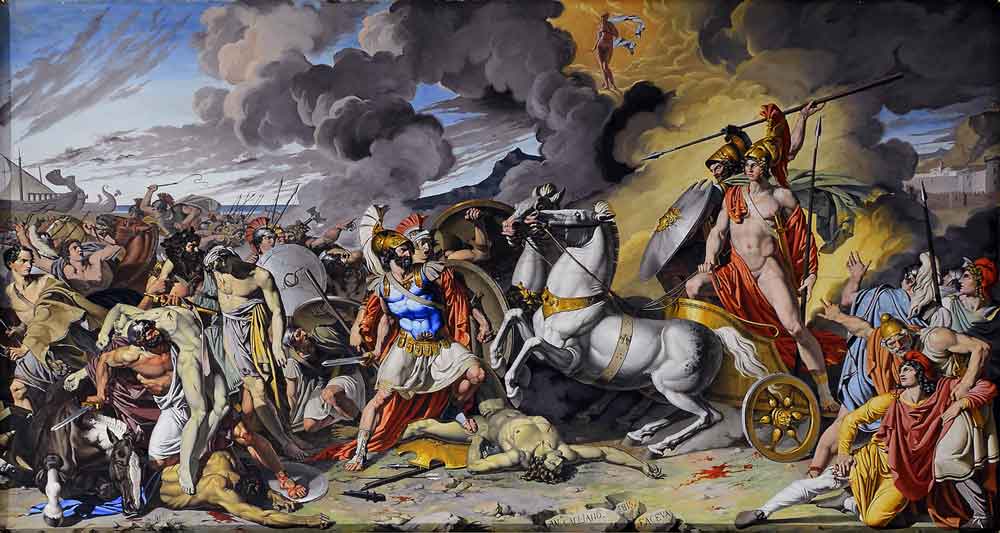
Ares was the god of violent, chaotic, and bloodthirsty warfare. He was more associated with the terror and frenzy of battle than with planning. He was therefore very different from Athena, the goddess of discipline and military strategy. Ares was even described by Zeus as hateful because of his love of strife in Homer’s Iliad.
Ares had a famous love affair with Aphrodite despite her marriage to Hephaestus. Hephaestus caught the lovers in an invisible net, and the other gods made fun of them. Ares was respected and worshipped throughout Greece, but was less loved in the literary tradition than Athena. He was more important in Sparta and Thrace, where military might had a strong cultural significance.
Aphrodite
Aphrodite was the goddess of love, beauty, attraction, and sexual desire. Hesiod says she emerged from sea foam after Uranus’ fall. Homer gives another tradition, naming Zeus and Dione as her parents. These are two competing versions of the same story, displaying the flexibility and regional variety of Greek myths from poet to poet and religious tradition to religious tradition.
She was married to Hephaestus, but she and Ares were lovers. Her influence could draw people together in love and beauty, but it could also create jealousy, destructive conflict, and catastrophe. She promised Paris the most beautiful woman in the world if he chose her as the fairest of the goddesses. Paris chose Aphrodite, and he later abducted Helen, contributing to the cause of the Trojan War.
Hephaestus
Hephaestus was the god of fire, metalworking, craftsmanship, and invention. Ancient sources offer conflicting accounts of his birth and fall from Olympus. According to one version, he was spurned by Hera because he was physically imperfect. In another, Zeus cast him down after Hephaestus sided with Hera during a dispute.
In spite of his rejection, Hephaestus became the artisan of the gods. He crafted armor for Achilles, weapons for divine warriors, palaces on Olympus, and mechanical servants that moved on their own power. He was married to Aphrodite, but their marriage was not happy because of Aphrodite’s affair with Ares. Hephaestus’s mythology suggests a relationship between physical hardship, creativity, intelligence, and unrivaled technical skill.
Hermes
Hermes was the messenger of the gods and the god of travelers, merchants, shepherds, and thieves. The Homeric Hymn to Hermes portrays him as cunning from birth. As an infant, he stole Apollo’s cattle, covered their tracks, and later appeased Apollo by inventing the lyre.
Hermes freely roamed between Olympus, the world of mortals, and the underworld. As a conductor of souls, he guided the dead to the world of Hades. He also assisted heroes by giving advice, using disguises, and providing divine gifts. Hermes embodied speed, communication, commerce, and crafty trickery. Able to cross all borders, he was the natural protector of journeys and chance encounters.
Dionysus
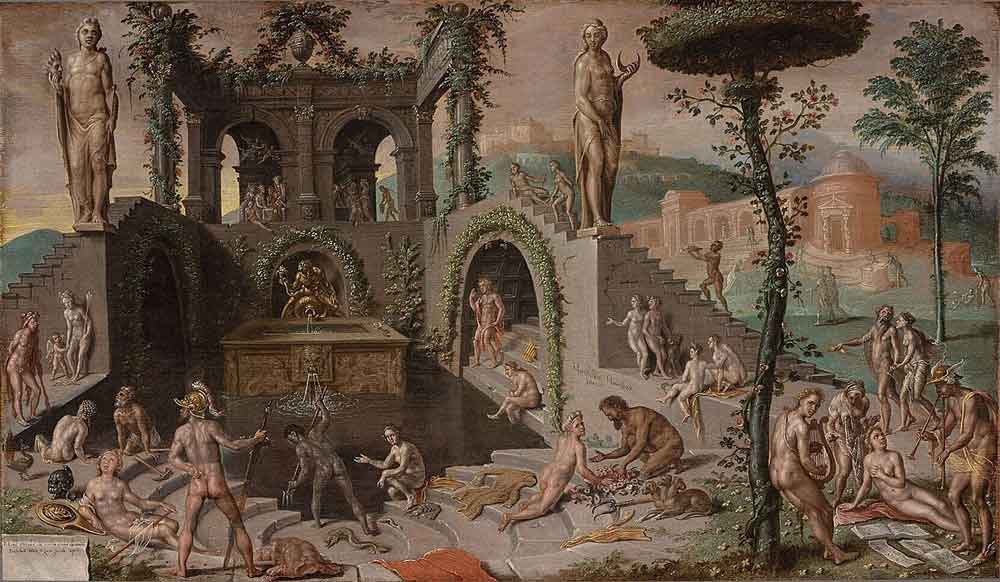
Dionysus was the god of wine, theater, ecstasy, fertility, and altered states of mind and perception. Dionysus was the son of the mortal woman Semele and Zeus. Zeus came to Semele and took her to his palace, where she was seduced by his thunderbolt. She later died of shock when Zeus revealed himself in his divine form to her. Zeus took the unborn child from her body and sewed him into his thigh until he was born.
Dionysus traveled throughout the world and was frequently required to demonstrate his divinity to people who denied his godhood. He had a number of followers, such as maenads, who were women taken into a state of religious ecstasy, and satyrs related to wine and wilderness. Euripides’ The Bacchae depicts both the positive and negative power that Dionysus had over people. On one hand, he could free them from social constraints and expectations. However, rebellion against Dionysus could lead to madness, violence, and death.
Persephone
Persephone was the daughter of Demeter and the queen of the underworld. Hades carried her away while she gathered flowers, causing Demeter to search the earth in grief. When Demeter stopped crops from growing, Zeus intervened. Persephone was allowed to return, but because she had eaten pomegranate seeds below, she had to spend part of each year with Hades.
Her divided life connected her to seasonal change, death, and rebirth. With Demeter, Persephone became central to the Eleusinian Mysteries. Initiates were promised sacred knowledge and hope for a better fate after death. She therefore represented more than an abducted daughter. As queen of the dead, she possessed authority, mystery, and the power to cross between two worlds.

Heroes and Legendary Mortals
Heroes were liminal figures who stood on the thresholds between gods and humans. Although many had divine parentage or were aided by some Olympian, they were nevertheless susceptible to suffering, defeat, and mortality. The legends in which Homer, Sophocles, Euripides, and later mythographers preserved still show that heroic courage was never sufficient on its own. Legendary heroes must also display intelligence, loyalty, self-restraint, or an acceptance of fate.
Heracles
Heracles was Greek mythology’s greatest strongman and a son of Zeus and a mortal woman, Alcmene. From birth, he was under Hera’s hatred for being another of Zeus’s illicit children. Hera drove him to madness, and he killed his wife and children. Heracles entered service to King Eurystheus to be purified of the murders and was given the Twelve Labors to perform.
These labors included slaying the Nemean Lion, the many-headed Hydra, and the Erymanthian Boar, as well as bringing Cerberus from the underworld. Heracles was later killed by wearing a poisoned garment, but the gods saved his immortal half by raising him to Olympus. His legends became a symbol of atonement and of strength tested through suffering.
Achilles
Achilles was the greatest of the Greek warriors at Troy, and the hero of Homer’s Iliad. Later tradition added that his mother, Thetis, had dipped him in the River Styx to make him invulnerable, but that the heel she held when she dipped him was his fatal flaw. That story is not in Homer, but it is the source of the expression “Achilles’ heel” for a single fatal vulnerability.
The Iliad is about Achilles’ anger after Agamemnon seizes his concubine Briseis. He refuses to fight, and the Greeks are at a great disadvantage. He is coaxed back to battle only after Hector kills his beloved friend Patroclus. Achilles’ grief and need for revenge, as well as a visit from King Priam, make him aware of his own mortality and the common suffering he shares with his foes.
Odysseus
Odysseus was the king of Ithaca and the Greek hero most associated with intelligence, persuasion, and deceit. Later tradition attributed the plan for the Trojan Horse, which allowed the Greek warriors to enter Troy, to him. Unlike most heroes who depend on physical force, Odysseus is able to survive by his patience, disguises, and careful use of words.
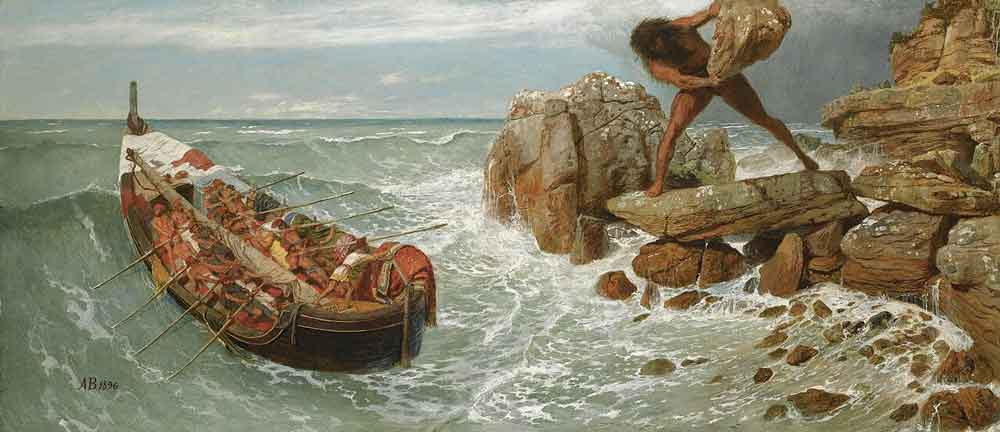
In Homer’s Odyssey, he is the victim of a ten-year battle to return home from the war. He blinds the Cyclops Polyphemus, escapes the witch-goddess Circe, resists the Sirens’ song, and spends years imprisoned by Calypso. His journey demonstrates both the usefulness and the dangers of cleverness. Odysseus’s wits save his life on many occasions, but his pride also earns him punishment and delay.
Perseus
Perseus was the son of Zeus and Danaë, whose father imprisoned her because of a prophecy about her future son. Having survived an attempt on his life, Perseus became a hero and took on the task of fetching the head of Medusa. To gaze upon the Gorgon was to turn to stone.
Athena and Hermes provided Perseus with advice and divine gifts. Armed with them and using a polished shield as a mirror, Perseus advanced without looking directly at Medusa and cut off her head. On his return, he saved the princess Andromeda from a sea-monster. Later traditions associated Perseus with the foundation of Mycenae and with Heracles’ ancestry.
Theseus
Theseus was Athens’s principal hero. He was said to have unified the people of Attica under a single political center. He had many adventures, and his best-known exploit was his role as one of the youths sent to Crete as tribute to King Minos. There, he entered the Labyrinth to slay the Minotaur, half man and half bull.
The daughter of Minos, Ariadne, gave Theseus a thread to help him find his way out after he killed the monster. But his success was followed by a failure. He forgot to change his ship’s black sails to white. His father, Aegeus, thought he had died and threw himself into the sea, which was said to have thereafter been called by his name.
Jason
Jason was the leader of the Argonauts and the rightful king of Iolcus. King Pelias tricked him into setting off on an apparently impossible quest for the Golden Fleece from faraway Colchis. Jason recruited famous heroes for his crew on the ship Argo, and they endured storms, monsters, hostile kings, and dangerous trials.
His survival was largely due to Medea, who used magic to help protect him and aided him in escaping with the Fleece. Jason later abandoned her when he plotted to marry King Creon’s daughter in Corinth. This led to the downfall of his family and reputation. This is a story of how a hero’s success can be built up and then come crashing down when loyalty is replaced by ambition.
Medea
Medea was a princess of Colchis, a sorceress, and the granddaughter of the sun god Helios. When Jason came in search of the Golden Fleece, she fell in love with him and used her knowledge of magic to help him succeed. She saved him from fire-breathing bulls and armed warriors, and arranged their escape from Colchis.
Years into her exile, Jason deserted her to marry a Corinthian princess. Euripides’ Medea answers his betrayal with horrific revenge, killing the new bride and their own children. Earlier versions of her story differ, but Euripides gave it its most famous form. She remains an ambivalent figure of intelligence, exile, wounded pride, and murderous retaliation.
Oedipus
Oedipus was a king of Thebes, the subject of one of the most powerful tales in Greek mythology about fate. An oracle foretold that he would kill his father and marry his mother. His parents, and then the adult Oedipus, tried to outrun the prophecy but only managed to make it come true.
Oedipus killed his real father in a roadside brawl and married his widowed mother, Jocasta, without knowing either of their identities. In Sophocles’ Oedipus Rex, Oedipus investigates a plague in the city and discovers that he is the source of the pollution. His fall explores fate, identity, pride, and the terrible cost of finding the truth.
Monsters and Forces of Destruction
Greek monsters were not just arbitrary challenges set before a hero. Chaos, unbridled violence, divine retribution, or the perils of the wild all had physical form in Greek mythology. Poets like Hesiod and Homer put their creatures at the boundaries of the earth, deep underground, or in carefully guarded interiors. Overcoming them was as much about demonstrating one’s might as it was about cleansing an area where fear and uncertainty reigned.
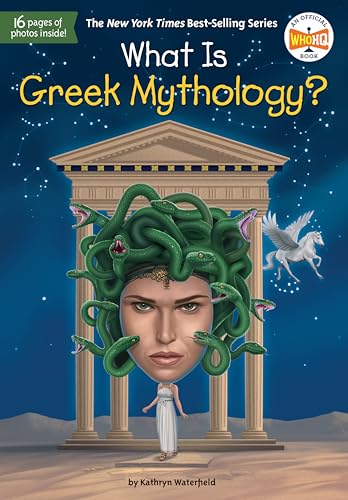
Medusa
Medusa was the most feared of the three Gorgons, and the only mortal of the three. A hideous face was her most distinctive feature, and she was so dreadful to behold that the mere sight of her would turn onlookers to stone. In early Greek literature, such as Hesiod’s works, Medusa was described as a dragon-like monster, the daughter of the sea gods Phorcys and Ceto. She had two immortal sisters: Stheno and Euryale.
The Roman poet Ovid offered a variant tradition in which Medusa was originally a beautiful maiden whom Minerva punished by transforming her into a Gorgon. Neptune had made advances to Medusa, and Athena, offended by the thought of her shrine being violated, permitted Neptune’s advances but punished Medusa for the seduction. Perseus beheaded Medusa while looking at her reflected image in a polished shield given to him by Athena. Athena later placed the Gorgon’s head on her shield or breastplate. The vanquished monster became a protector of Athena’s divinity.
The Minotaur
The Minotaur had the body of a man and the head of a bull. It was born after King Minos failed to sacrifice a magnificent bull that Poseidon sent him. The god punished him by making his wife, Pasiphaë, lust after the animal. She slept with the bull, and the Minotaur was their offspring. The creature was associated with the failure to keep a promise and the ensuing divine punishment.
Minos commanded the inventor Daedalus to build the Labyrinth to keep the beast from escaping. Athens was forced to provide victims for the Minotaur, who were sent to Crete to be placed in the maze. Theseus entered the Labyrinth and killed the Minotaur. Ariadne prevented him from getting lost by giving him a thread to trace the route back.
Typhon
Typhon was among the most fearsome entities in Greek mythology. Hesiod first described him as a giant fire-breathing monster born of Gaia and Tartarus. Subsequent tradition increased his serpent heads, added wings, and said his voice combined that of gods, beasts, and the roaring forces of nature. He embodied a final resistance to Zeus’ ordered rule.
Typhon raged against Olympus and battled Zeus for control of the universe. According to later stories, he temporarily overcame the chief god and took the tendons from Zeus’ hands and feet. Recovering, Zeus clubbed Typhon with thunderbolts and buried him beneath Mount Etna or another volcanic area. Ancient authors used his imprisonment to explain earthquakes, eruptions, and destructive storms.
The Lernaean Hydra
The Hydra was a multi-headed serpent. It lived in a swamp near Lerna. Hesiod made it one of the children of Typhon and Echidna, and part of a family of deadly monsters. It breathed and bled poison. If one of its heads was cut off, two more would grow in its place. It is said that the central head was immortal.
Killing the Hydra was the second of the Twelve Labors of Heracles. He hit it with a sword or a club while his nephew, Iolaus, burned the neck after it was cut off. This stopped new heads from growing. Heracles buried the immortal head under a large rock. He dipped his arrows in the Hydra’s poison, making them deathly for years to come.
Cerberus
Cerberus was the monstrous watchdog of the underworld. He guarded the entrance to the kingdom of Hades and let all the dead enter, but none to leave. Hesiod called him fifty-headed, but later artists generally gave him three. He was also depicted with a serpent tail and snakes coiling around his body.
Heracles had to confront Cerberus as the final and most hazardous of his Twelve Labors. Hades agreed to let him bring the beast up into the world of the living, on the condition that he was to use no weapons. Heracles wrestled him in the old man’s kingdom and brought Cerberus to Argos. He showed the monster to King Eurystheus and then returned him safely to the underworld.
Other Important Figures in Greek Mythology
In addition to the main gods, heroes, and monsters described above, there are many other influential figures in Greek mythology. Some of these influenced the Trojan War, and others became immortal symbols of love, loyalty, punishment, prophecy, or pride. Their stories are preserved in the works of Homer, Sophocles, Euripides, Ovid, and other ancient writers. Each one offers a different perspective on how the Greeks interpreted fate, human frailty, and divine power.
Orpheus
Orpheus was a great mythical musician whose voice could charm humans, animals, trees, and stones. When his wife Eurydice died of a snake bite, he descended to the underworld and charmed Hades and Persephone with his singing. Moved, they agreed to let Eurydice return with him to life if he did not look back to see if she followed until they reached daylight. Orpheus looked too soon, and she disappeared forever. The story has become an enduring symbol of love, loss and the human temptation to mistrust.
Helen of Troy
Helen is known as the most beautiful woman in Greek mythology, and the wife of Menelaus, king of Sparta. Her leaving with the Trojan prince Paris (in some stories a result of abduction, in others of escape) was one of the main causes of the Trojan War. In Homer’s Iliad, her character is both respected and wracked with guilt. Helen’s myth asks the questions: how much do we have to answer for our desires? Can women ever transcend their roles as icons of men’s will and power?
Paris
Paris was a Trojan prince whose decisions ultimately caused the Trojan War. He was asked to judge which of the three goddesses was fairest. He awarded Aphrodite the golden apple after she promised to bring him Helen. Hera offered power and riches, and Athena offered wisdom and success in war. Paris’s actions placed his personal happiness over his responsibilities, and he incurred the wrath of the goddesses he offended. While he was an accomplished archer, Paris was often contrasted with more aggressive warriors, and his slaying of Achilles was often attributed to divine intervention.
Agamemnon
Agamemnon was a king of Mycenae and the leader of the Greek forces in the Trojan War. In Homer’s Iliad, his taking of Briseis makes him so hated by Achilles that he pulls away from the fighting, damaging the Greek army’s morale. Other traditions say he sacrificed his daughter Iphigenia to ensure his fleet’s departure for Troy. When Agamemnon returned home, he was murdered by his wife, Clytemnestra, and her lover, events which were the basis of a cycle of revenge treated by Aeschylus in the Oresteia.
Cassandra
Cassandra was a Trojan princess granted the gift of prophecy by Apollo. After she spurned him, he cursed her so that her prophecies, though true, would be disbelieved. She prophesied the doom of Troy, the peril of the Trojan Horse, and her own death, but was powerless to stop any of them. Poets like Aeschylus used Cassandra to explore the anguish of knowing the truth in a world that prefers self-delusion, comfort, or pride.
Penelope
Penelope was the wife of Odysseus and queen of Ithaca. She remained faithful to her husband during his twenty-year absence and warded off suitors who tried to take over his home and kingdom. Penelope avoided choosing a new husband by weaving a burial shroud in the day, and unraveling it at night. Homer’s Odyssey characterizes her as smart, prudent, and emotionally resilient. Her artful way of testing the returned Odysseus suggests that she was not simply waiting passively, but was also proactively guarding her family and authority.
Sisyphus
Sisyphus was a wily king, a trickster who was arrogant and twice tried to cheat death by outsmarting the gods. In one myth, Sisyphus chained up Death and thus made it impossible for anyone to die for a time. As punishment for his crimes, Sisyphus was made to roll an enormous boulder up a hill in the underworld. Each time Sisyphus neared the top, the boulder would roll back down to the bottom. His unending, failed labor became a metaphor for pointless toil and repeated failure. It is also the punishment for those who defy the gods and the natural order.
Tantalus
King Tantalus had special access to the gods but was guilty of betraying them. Ancient tradition varies about the exact nature of his transgression, but one account had him killing his son, Pelops, and offering him to the gods at a banquet. His punishment was to stand in water beneath branches bearing fruit. When he bent to drink, the water would recede, and when he reached for fruit, the branches would rise. His experience became the basis of the term “tantalize,” or to torment someone with something always just out of reach.
Narcissus
Narcissus was a handsome youth who spurned everyone who loved him. In one of Ovid’s Metamorphoses, a nymph named Echo falls in love with him, only to be rebuffed. Narcissus is punished by becoming hopelessly in love with his own reflection in a pool of water. Unable to have the image before him, he wastes away and dies, leaving the flower that carries his name. His story is a warning against vanity, emotional hardness of heart, and the dangers of loving an image instead of another person.
Pan
Pan was the god of shepherds, flocks, wilderness, and rustic music. Depicted with the legs and horns of a goat, he roamed the wild places that lay beyond the order of civilization. His sudden, unprovoked shouting caused unexplained, paralyzing fear, from which the word “panic” was derived. According to the Homeric Hymn to Pan, the gods rejoiced in his coming and reveled in the sight of him and his music. Pan symbolized the inherent beauty of the countryside, but also the unexpected perils and dangers that lurked in its uncharted places.


Themes Connecting the Figures of Greek Mythology
Characters from Greek mythology are connected by shared, recurrent questions about power, choice, suffering, and responsibility. The narratives of Zeus and Athena, Achilles, Medea, and Oedipus pose challenges to divine command and human desire. Ancient authors, including Homer, Hesiod, Sophocles, and Euripides, revisit these questions in their work because the stories helped them and their audiences better understand the gods and the inherent unpredictability of human life
The Struggle Between Fate and Free Will
Greek myths explore whether anyone can outmaneuver a destiny already prophesied. Oedipus tries to prevent killing his father and marrying his mother, but all his decisions only lead him to that future. Achilles also knows that if he stays at Troy, he will be famous forever but die young.
These tales do not render human decisions inconsequential. They portray individuals making choices about how to react to constraints they cannot eliminate. Odysseus lives because he is flexible; Oedipus is (in part) miserable because he is headstrong and acts without the full facts. Fate may set the endpoint, but character frequently decides the route.
The Dangers of Pride and Hubris
Hubris is excessive pride that makes a mortal overstep due limits or rebel against the gods. Niobe, Arachne, and King Minos pay the price for boasting, breaking sacred pledges, or thinking they are superior to the gods. Their stories make it clear that talent, beauty, or power never justify arrogance.
Heroes are destroyed by pride, as well. Achilles’ wrath damages the Greek army, and Jason’s ambition makes him betray Medea and his household. Greek myths present pride rarely as healthy confidence. It becomes dangerous when self-belief turns into scorn for others, for holy customs, or for limits placed by fate.
Conflict Between Divine Power and Human Ambition
Throughout Greek mythology, mortals struggle to make their lives great in a world ruled by arbitrary gods. Prometheus defies Zeus by providing fire to humans. Heroes like Heracles and Perseus can only perform superhuman deeds with the help of the gods. Success is often achieved with courage, but also with respect for forces stronger than man.|
The gods do not always behave justly or consistently. Devotion might be rewarded, resistance punished, or mortals dragged into divine rivalries. The Trojan War develops from a competition between Hera, Athena, and Aphrodite. These stories expressed an ancient idea that human designs can be thwarted, redirected, or accelerated by divine whim, favor, anger, or fortune.
Family Rivalry Across Generations
Family conflict is the central dynamic of the earliest Greek cosmogonic myths. Cronus deposes his father Uranus, and then attempts to keep his own children from deposing him in turn. Zeus overthrows Cronus and brings a new order, continuing the cycle of fear and violence passed down from one generation to the next.
The same pattern of fraternal rivalry is found in the mortal sphere. Oedipus unwittingly destroys his family. Agamemnon’s household is consumed by murder and revenge. In Greek myth, the family is often treated as a source of identity and safety, but also a place of danger. Inherited guilt, ancient prophecies, and unsettled crimes can impact the lives of descendants who had no hand in the original quarrel.
Justice, Punishment, and Revenge
Greek mythology makes a fine distinction between justice and revenge. Zeus punishes those who break oaths or fail in hospitality. In the underworld, the punishments of Sisyphus and Tantalus are tailored to their offenses. All such deeds against divine or social law require a response.
But revenge often produces a cycle of one’s own injustice. Medea repays betrayal with murder. The family of Agamemnon is caught up in a cycle of bloodletting. Aeschylus’s Oresteia dramatizes how personal vengeance might be supplanted by public justice. The myths ask not just whether a punishment is deserved, but who has the authority to impose it.
The Thin Boundary Between Heroism and Destruction
Heroes could benefit a community, and tear it down, in the same tale. Heracles slays monsters and performs superhuman labors, but his strength does not stop his own family from suffering. Achilles is the greatest Greek hero at Troy, but his fury inflicts pain on friends as well as foes.
Heroism was therefore not the same as moral perfection. Courage, strength, and intelligence could bring glory, but also pose a threat when combined with anger or hubris. Odysseus’s cunning saves his life, but his bragging to Polyphemus brings only more trouble. Greek mythology presents greatness as powerful, volatile, and often very costly.
Mythology as an Explanation of Nature, Politics, War, and Death
Greek myths explained the divine significance of the natural world. Poseidon explained earthquakes and treacherous seas, Demeter and Persephone embodied the cycle of growth and decay, and Zeus commanded storms and lightning. Monsters such as Typhon were associated with volcanic eruptions and other destructive forces of nature.
Myth also reinforced political identity and social hierarchy. Athens associated itself with Athena and Theseus. Rulers claimed heroic or divine descent. Epic tales offered Greeks a way to consider war, leadership, loyalty, and death. In these figures, the ancient world was made a little less puzzling, even when it remained frightening, violent, or ultimately beyond human control.
Myths and Misconceptions of Greek Mythology
There was never a single, official version of Greek mythology that all cities or storytellers agreed upon. Homer, Hesiod, Sophocles, Euripides and later mythographers frequently preserved different genealogies, motives, and conclusions. A myth might be altered as it traveled between regions or was imported into a new poem, play, or religious context. The contradictions are not errors, but indications that mythology was a traditional, developing body of stories, not a sacred book of doctrine.
It should also be noted that Hades is not always confused with the Christian devil. The ancient Greeks often treated him as a stern ruler of the dead, who was not the cause of all evil. The Titans were also gods, and not just giant monsters. In Hesiod, they are an older generation of divine figures, including Cronus, Rhea, Oceanus, and Themis. Their defeat and overthrow by Zeus and the Olympians marks the ascendancy of a new order of gods.
Details of Medusa’s story varied over time. Hesiod treats her as a Gorgon, born monstrous, while the Roman poet Ovid later described her as a beautiful woman transformed into a monster by Minerva. Achilles’ famous weak heel was also a later invention. In Homer’s Iliad, there is never any mention that Achilles was dipped into the River Styx as a baby or that his heel was the only part of his body that could be harmed. He is instead portrayed as a mortal warrior aware that he will die.
Many details that are now treated as standard elements of Greek mythology are drawn from Roman writers or much later sources. The most famous versions of Medusa, Narcissus, and many other characters were shaped by Ovid. Later authors invented details that their Greek sources either told differently or barely mentioned at all. Readers should therefore remember not only to ask what a given myth is about, but who recorded it, and when. Those layers can help enrich Greek mythology and prevent later retellings from being treated as the only ancient version.
Why Greek Mythology Still Matters
Greek mythology was integral to ancient religion and civic life. It bound together different communities by associating them with specific gods, heroes, and customs. Athens was the sacred home of Athena; many other cities claimed ties to gods, heroes, and ancient rituals that explained local practices, festivals, and political power. In this way, mythology was not confined to Greece. Roman authors and readers adapted the same myths in their own ways, and later Europeans have turned to the same characters to reflect on loyalty and betrayal, power and corruption, ambition and tragedy.
Contemporary artists, playwrights, novelists, and filmmakers return to the myths because they are flexible and have powerful conflicts. Medea might be portrayed as a victim or a villain—or both at once. Achilles can represent courage, anger, fame, and mourning. Each new telling changes the setting or the focus, but the underlying question remains plain: What is the price of power? Is it possible to defy fate? When does justice turn into vengeance?
Names of Greek figures also persist in the names of fields and common vocabulary. Psychology is full of terms such as narcissism and the Oedipus complex, while Achilles tendon and atlas are terms in medicine. Names such as Atlas, Europa, and Andromeda survive in astronomy. Panic, tantalize, and herculean all derive from mythic figures whose stories became part of common parlance.
Most of all, these myths still feel human. Their characters fear death, love, envy rivals, betray friends, and face choices they cannot take back. Gods and monsters may render the stories epic, but the emotions are recognizable. Greek mythology matters because it gives memorable expression to moral dilemmas that humans continue to face, from the corrupting influence of power to the conflict between desire and duty.


