The Dreyfus Affair and the Ruthless Politics of Blame
 Reading Time: 18 minutes
 The Dreyfus Affair began with a charge that became a national crisis: a Jewish officer in the French Army had betrayed his country. The treason case, leveled at Captain Alfred Dreyfus, expanded beyond the bounds of a routine military investigation because it touched down in a society already crackling with the sparks of nationalism, press sensationalism, and anxieties about internal enemies. The charge quickly became more than just a legal accusation against one man. It became a litmus test of how fragile a republic can be when suspicion replaces evidence.
The Dreyfus Affair became a political battleground where assigning blame, fearmongering, and self-identity were as important as the weight of evidence. Institutions had strong incentives to safeguard their prestige, newspapers had incentives to fan the flames of outrage, and politicians had incentives to take a stand for political gain. As the case grew in scope, it became less about the guilt or innocence of one man and more about a referendum on justice itself, on whether the French Republic would be a government of law or the ruthless expediency of scapegoating.
France in the 1890s
France had begun the 1890s in the shadow of the Prussian victory of 1870–71. The loss of Alsace-Lorraine and the bloodletting of the Paris Commune had made the Third Republic legitimate in form, but not necessarily in essence. Most French citizens were reconciled to republican institutions, but a significant minority were not, and often regarded the new regime as weak, corrupt, or morally lost. That insecurity bred a hypersensitivity to scandal and a hair-trigger panic when faced with threats, real or imagined.
In that environment, the army was not just a fighting force, but a symbol of national honor that must be defended after such humiliation. Officers and nationalist politicians were intolerant of criticism of the army, which was treated as an attack on France. That environment discouraged accountability. It was tempting to imagine spies at large, a “traitor within the gates”. It was reassuring to find a single culprit who could be blamed for exposing the nation to all those spies and for restoring the honor of an otherwise competent military.
Antisemitism supplied the necessary pre-existing conspiracy theory. Jews were seen as a “dangerous” minority who could not be fully trusted, even when they were French citizens. The prejudice was blended with nationalist anger and a desire for a simple explanation. In the late nineteenth century, all of those impulses combined to make the idea of a Jewish traitor more plausible to people who needed to believe it.
French newspapers also amplified the tension. Editors competed for sales with a mixture of blood-curdling headlines, leaked “evidence,” and inflammatory political editorializing that muddied the line between reporting and campaigning. Repetition became a kind of proof, and outrage became a form of identity. By the time the Dreyfus Affair erupted, France was already a powder keg primed and ready to explode: a fragile republic, a prestige-hungry army, a riven public, and a media ecosystem that thrived on converting fear into certainty.
Who Alfred Dreyfus Was and Why He Became a Target
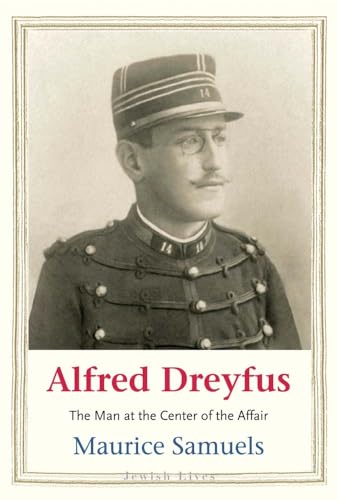
Alfred Dreyfus was a French army officer and a steadfast believer in the Republic’s promise that talent could trump background. He was from an Alsatian Jewish family, but also a professional soldier in a country still scarred by defeat in 1870–71 and preoccupied with loyalty. The officer corps was status-conscious, socially closed, and highly sensitive about its honor. In that environment, Dreyfus stood out. Not because he lacked the required credentials, but because he did not match the unspoken image many people had of what a “true” French officer should look and be like.

The fact of his outsider identity made suspicion linger. Antisemitic stereotypes accused Jewish citizens of being cosmopolitan, selfish, or secretly disloyal, and such prejudices made ordinary social differences. Accent, manners, and education became “signs” of treachery. Once the possibility of Dreyfus as a traitor entered public conversation, the idea felt emotionally plausible to a population already primed to suspect enemies within. The accusation had to be watertight to convince people; it only had to correspond with what the public had already been conditioned to fear.
Dreyfus’s military record also made him appear to be a suspect on paper. He was an artillery officer, a technically oriented branch of the army that valued math skills, precision, and staff work. By the early 1890s, he had moved into the professional officer career path that fed into France’s General Staff, a role that involved writing reports and planning rather than leading troops in combat.
France was not at war on a major scale at the time, but the army was still living in the shadow of 1870–71, a period when it was obsessed with how to rebuild and keep its plans secret. Dreyfus’s staff work meant he had access to classified documents, and that was all the investigators needed to argue that he had the opportunity to provide information, making his competence and access a part of the case against him.
The army also needed a convenient culprit after a security breach. Espionage cases panic the public because they signal that the state is vulnerable and incompetent. Catching a single guilty officer had a simple solution: punish the traitor, pronounce the system sound, and reassure the nation. A prolonged, uncertain investigation would have broadcast vulnerability. A swift conviction, by contrast, could be presented as a restoration of authority.
That is why Dreyfus became more than a suspect. He became a solution. By pinning the problem on a single man, the institution could insulate itself from deeper questions, and politicians and newspapers could mobilize audiences around a clear villain. The tragedy is that, once blame became a political asset, evidence became negotiable. Dreyfus’s identity helped make him plausible as the culprit, and the Republic’s fear helped make belief stronger than proof.
The Initial Accusation and Trial
The case itself opened with a scrap of paper. It listed military information that a French citizen had offered to sell to a foreign power. The bordereau, as the memo was known, was treated as a fingerprint from which a “matching” hand and a suspect to match the mood of fear could be found. Instead of careful case-building, the pressure to show that the army had not been compromised encouraged haste. A swift arrest would show control. A public accusation could reassure the nation that treason had been located and contained.
Dreyfus was selected because he was a convenient suspect. He was one of the few officers who handled sensitive information, and he was a staff officer in an environment where paperwork circulated and secrets counted. More important still, he was an “outsider” in a status-conscious corps, making the judgment seem instinctive to those predisposed by antisemitic bias. In that atmosphere, uncertainty could be construed as disloyalty, and a swift culprit could shield the institution from further examination.
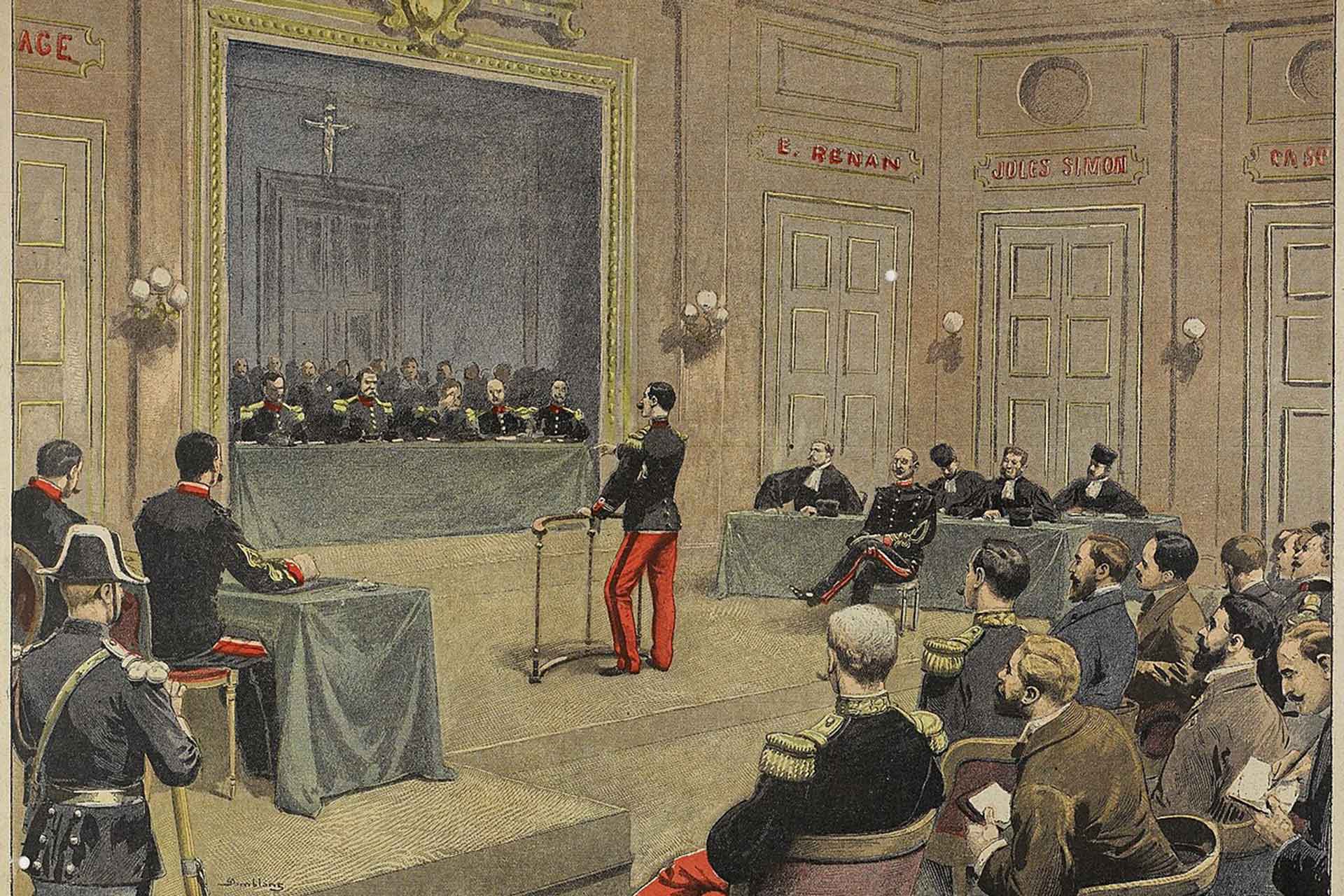
The arrest was a manufactured affair to create the sense of guilt before guilt was established. Dreyfus was lured into a meeting for what he thought was innocuous business and then surprised under controlled conditions. Questioners pushed him to write to compare his handwriting with the bordereau, and they scrutinized his manner as if jitteriness were an indicator. He denied the charge, but that did not pause the process. He was detained and cut off, and treated as if the case were already closed. The intent was to fix the narrative in place before doubt had time to take root.
The rush to judgment set the trial’s course. Hearings were closed. Defenses were constructed to make an effective challenge hard. The most controversial move was the use of secret evidence presented to the judges but not to Dreyfus or his lawyers. The principle is clear even without the full details: secrecy changed the balance. When a court demands that you accept the guilt of a defendant without full access to the evidence against him, “security” is no longer a practical concern, but an institutional one.
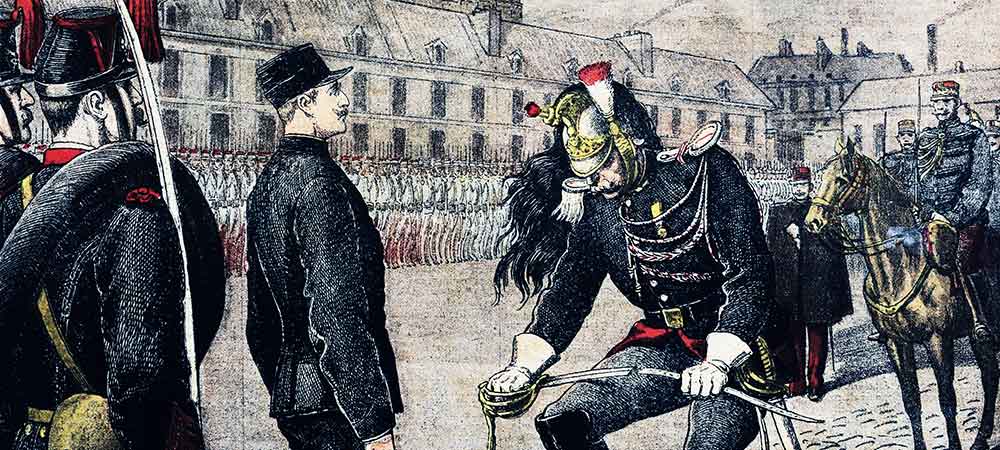
Conviction was followed by a ceremony of degradation. Dreyfus had his rank taken from him in a public event designed to restore the army’s honor by defiling the traitor. The performance mattered because it taught the public what to believe: not only was guilt settled in court, it was on display for ritual. Exile to Devil’s Island removed the accused man from public view, transforming a voice into a symbol.
Here, blame politics becomes visible. By making punishment both dramatic and irreversible, the institution had raised the cost of admitting error. If the army had orchestrated a national ritual of shame, then reopening the case meant acknowledging that the ritual had been built on a lie—or, worse, on prejudice. The Dreyfus Affair’s first phase was not only a legal process. It was the production of a scapegoat, whose construction was sealed by secrecy and broadcast by public shame.
The Politics of Blame in Action
Blaming one man was effective because it deflected attention from the institutions that really needed shielding in 1890s France. If only one officer had turned traitor, then it could be said that the problem was localized, not structural. That narrative reassured the public that the intelligence system still worked, that the officer corps remained faithful, and that the Republic was not leaky. The alternatives, such as uncertainty or institutional failure, would have been an admission of weakness to both France’s foreign rivals and its own fractious political movements.
Army leaders had a second motive: infallibility. After the defeat of 1870–71, the army’s honor became something of a civic religion. Its critics could be tagged unpatriotic, and the notion of internal error could be stigmatized as a threat to national unity. Once the army had declared Dreyfus guilty, admitting otherwise would have been to publicize, in a humiliating way, the failure of senior officers and investigators. In an institution driven by prestige, the mere prospect of that kind of admission feels like surrender. It became easier to defend the verdict than to defend the truth.
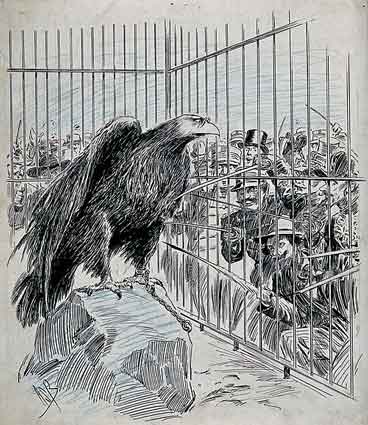
Scapegoating has a third effect: restoring confidence through emotional closure. Espionage is scary because it’s invisible. We want a face, a name, and a punishment. Dreyfus was made to be that symbol, especially since antisemitic stereotypes had already made the accusation “plausible” to many observers. When that prejudice already exists, the threshold for belief is lower. Suspicion can become “proof” by mood, and the scapegoat can become a solution before the evidence is even settled.
That’s why Dreyfus became the target he did, even given the facts of the case. He provided the army with an easy way to end a crisis, the press with a lucrative way to report on a sensational story, and politicians with a way to rally voters behind a simple enemy. Once usefully blamed, his defense could be painted as an attack on the army, and that attack could be painted as an attack on France. The Affair is a lesson in how scapegoating becomes a kind of political technology, one that can stabilize institutions in the short run even as it corrodes justice from within.
The Press and the Manufacturing of Public Opinion
In the 1890s, the press was anything but a neutral or impartial observer. Newspapers operated as partisan machines of political factions, ideological movements, and business interests. Editors did not just report the news. They shaped it, created villains and victims, and told their readers what the story was and why it mattered. This way of presenting the news mattered as much as any document in the Dreyfus Affair, because for most citizens, access to the case was not through the courtroom, but through the headlines, leaks, and editorializing.
Gossip and rumor, then as now, were a kind of currency. “Secret files” and anonymous whispers could be quoted as near-certainties, particularly when they confirmed readers’ pre-existing suspicions. Then caricatures added fuel to the fire by reducing complex questions to simple stereotypes so they could be instantly recognized. Then, over time, came proof by repetition: the notion that if a story is told often enough, in different words, it becomes common knowledge, regardless of the underlying evidence.
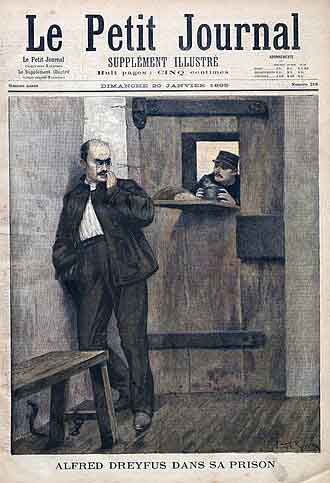
Outrage was its own political capital. Papers vied with each other for attention and the public, and nothing sold papers quite like the scandal that confirmed a reader’s pre-existing fears. Anger could be directed at a scapegoat, an institution, or a political camp. Politicians learned to harness that anger, rather than dissipate it. The Affair coalesced into identity tribes, not just over opinion about Dreyfus, but using the case as a marker for who France was and what France should be.
This is the way the press contributed to turning a legal case into a national fracture. The process is incentivized for each newspaper to cut public patience for nuance and incentivize certainty over caution. Once the media environment had made indignation its own kind of patriotism, changing one’s mind became a costly social exercise.
The Dreyfus Affair teaches a cruel lesson in public opinion: newspapers are more likely to operate as political engines of reaction when they create a reality that evidence can hardly catch up with.
The Case Cracks Open
The Dreyfus conviction seemed, for a while, “settled.” To doubt was to be disloyal, and the army pushed that line hard. But doubts persisted. Handwriting was a “strain” to make, timetables didn’t quite align, and the logic of the bordereau, the document used to accuse Dreyfus, was less airtight under scrutiny. The more fundamental questions were asked, like who had access to the information in the bordereau, who gained from Dreyfus’s conviction, exactly what had been proved—the more the case looked like a tapestry with gaping holes that confidence could not conceal.
The crisis was cracked open, not by outside pressure, but by questions asked from within. Lieutenant Colonel Georges Picquart was stationed in military intelligence. He found evidence that both suggested the real author of the memo was not Dreyfus but a fellow army officer named Ferdinand Walsin Esterhazy, and indicated Dreyfus was likely innocent. The problem was that Esterhazy’s likely guilt made the army’s institutional credibility a casualty of Dreyfus’s conviction. It was an inconvenient truth, which helps explain why it was not embraced.
Instead of welcoming the truth, the army resisted. For the army to have been wrong meant it had relied on secret evidence, organized public shaming rituals, and driven a man into the wilderness based on the whispers of a file. That was a reputational catastrophe, especially in France, where the army’s honor had become intertwined with the nation’s identity. Instead of correcting the mistake, the forces that helped create it suppressed evidence that contradicted it, embraced the wrong verdict, and treated dissent as an irritant or an existential threat.
It was then that the miscarriage of justice metastasized into a national crisis. When the facts pointed away from Dreyfus, the question was not simply, “Who wrote the memo?” It became, “Will the institution protect the truth, or protect itself?” The Dreyfus Affair tore France in two because, in cracking open, the case forced everyone to choose between loyalty to authority and loyalty to evidence. The two did not always align.
J’Accuse… and the National Split
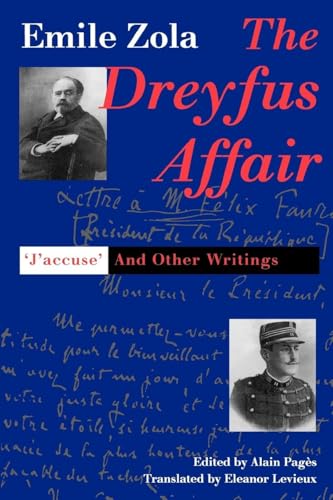
Zola’s intervention mattered because it dragged the Affair out of the corridors of the military into the center of public life. In January 1898, Zola published his open letter J’Accuse…!, naming names and accusing high officials of protecting an injustice. It was not meant to be a polite debate. It was to force a reckoning in broad daylight where the Republic could not hide behind secrecy or uniforms.
Zola’s letter changed the tempo as well. It made the case urgent again, and it dared the state to respond. By putting specific accusations into print, Zola made it difficult for authorities to pretend the controversy was only a rumor. It became a kind of legal and moral challenge in newspaper form, ensuring that the next steps would take place under the white-hot glare of public scrutiny.

The state’s response turned the letter into an even bigger event. Zola was prosecuted for libel. This made the writer a martyr and symbol for the fight over free speech and the power of the state. The courtroom became another place where facts and institutional pride would collide, and whether readers agreed with him or not, they could see that the Republic was punishing a writer for daring to question the army’s word.
As the fight widened, two camps hardened around competing identities. Dreyfusards rallied around the evidence, legal fairness, and the idea that citizenship should not depend on religion or class. Anti-Dreyfusards presented themselves as defenders of the army, tradition, and national honor, often treating any doubt as a betrayal. People were no longer just arguing about one officer. They were picking a side and choosing what they believed France was and who counted as truly French.
Street politics reflected the split. Newspapers inflamed tempers. Public meetings could turn into shouting matches, and demonstrations could slide into violence. Riots and intimidation were not accidents. They were pressure tactics to make certain outcomes feel dangerous.
In that atmosphere, calm and reasoned consideration of evidence became difficult because the price of “the wrong opinion” could be social isolation or physical threat.
At the center of the fight was the Republic’s soul. If the state could condemn a man through secrecy and prejudice, what did justice mean? If the army could not be questioned, what did republican government mean? J’Accuse… did not just defend Dreyfus. It challenged the idea that authority should be believed simply because it is authority. That challenge is why the Affair split France so deeply, and why it remains a warning about how quickly a democracy can fracture when blame becomes more useful than truth.
Retrials, Pardons, and Partial Justice
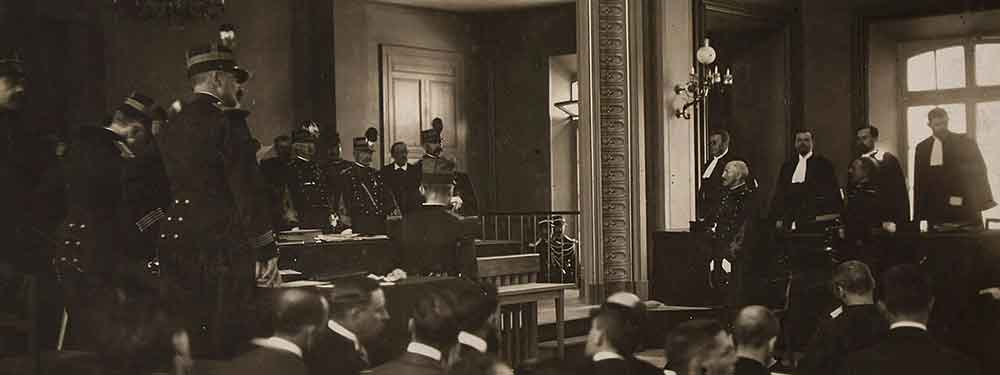
The same logic of blame had a life when the case was finally brought back to court in Rennes in 1899. The doubts about the original conviction were widespread by then. The army and its supporters, however, feared the consequences of a clean acquittal. A full reversal would not just free Dreyfus. It would also turn the institution’s earlier certainty into a record of error and document just how far officials had gone to protect it. In that atmosphere, the retrial was less about the search for truth than a struggle over reputation.
Rennes delivered the verdict that pressure could produce. Dreyfus was convicted, again, but this time with “extenuating circumstances,” a compromise that managed to say both that the evidence was inconclusive and that Dreyfus was guilty. It preserved the army’s face while keeping the scapegoat in place. It also made the public conflict worse, since many observers could see the contradiction: if the evidence was strong, why soften the judgment?
A presidential pardon followed. That’s the point where the phrase “partial justice” becomes so clear. A pardon ends punishment, but it does not declare innocence. It restores freedom without restoring honor. For Dreyfus and his supporters, that difference was crucial. Accepting a pardon could look like accepting guilt in exchange for mercy, which left the stigma intact and allowed the politics of blame to survive.
Full exoneration had to come later, when the Court of Cassation annulled the conviction in 1906 and cleared Dreyfus, and when he was finally reinstated in the army. Even then, however, the victory had its limits. Years of propaganda had scarred the public trust, and antisemitism did not fade with a court ruling. The Affair ended on paper, but the damage of its story lingered in institutions, in politics, and in the lesson it left behind: correcting injustice is always harder than committing it, because pride and fear fight the truth at every step.
What the Affair Changed
The Dreyfus Affair redrew the boundaries of civil–military relations. The scandal showed the army could not be treated as a state within the state. In the Affair’s early years, military leaders behaved as if their judgments could not be challenged and their critics were the enemies of France. The long unraveling of the case made that position increasingly difficult to defend. The Affair also, over time, strengthened the principle that civilian institutions could and should challenge military authority when justice and citizenship were at stake.
The Affair also put republican values on public trial- not in theory, but in practice. The Republic professed to stand for the rule of law and equal rights. But Dreyfus was sentenced in secret proceedings and on secret evidence. The scandal forced France to ask if legality meant anything when national honor felt at stake. The reversal mattered because it reasserted that courts and evidence should outrank rumor, hierarchy, and crowd pressure—even when institutions find that humiliating.
Citizenship itself became a weapon in the fight. The Affair showed how easily some French people could be treated as “less French” because of identity, religion, or stereotype. Dreyfus’s Jewishness did not cause the injustice. But it made the injustice easier to sell. As the case came to divide the country, it also revealed how fragile equality is when fear becomes politics and belonging becomes conditional.
Antisemitism was both exposed and politicized. It emerged from the background to become an active organizing tool—used by newspapers, street movements, and factions that gained energy by naming an internal enemy. The Affair did not end antisemitism. It revealed the power of antisemitism and the reach of antisemitism. It showed that prejudice can be institutional, not only personal, and that public passion can pressure systems to protect themselves rather than the truth.
Finally, the Affair changed France’s political culture by creating a model for modern “identity camps.” Dreyfusards and anti-Dreyfusards learned how to mobilize through media, petitions, rallies, and the language of moral claims. The case left a warning that outlasted its verdicts: when institutions choose blame over proof, they may win a short-term sense of unity, but they weaken the Republic’s core promise—justice that applies to everyone.
Myths and Misconceptions
One myth is that the Dreyfus Affair was a “one bad apple” story: one biased investigator, one unlucky defendant, one regrettable mistake. In fact, the Affair was a systemic breakdown. Multiple levels of the state were implicated in sustaining the wrongful conviction: intelligence officials who protected secrets, commanders who protected prestige, and courts that accepted various restrictions that should have sounded alarms. The case dragged on because institutions saw reversal as an affront to authority rather than a restoration of justice.
A second myth is that secrecy was a neutral necessity. Secret evidence and closed procedures can seem attractive in security cases, but the Dreyfus Affair shows the peril: secrecy shifts the burden of trust from evidence to institution. Once “national security” becomes an excuse to hide evidence from the defense, it becomes easier for officials to protect themselves instead of the truth. Institutional self-protection then becomes indistinguishable from patriotism, and dissent becomes indistinguishable from betrayal.
A third myth is that the Affair ended cleanly once Dreyfus was exonerated. Even after exoneration, the forces behind the injustice did not disappear overnight. Antisemitism had been mobilized, factions had solidified, and public trust had been frayed. The case’s legacy was not only legal but also social and political, leaving behind new habits of media warfare and identity-based polarization.
That is why the Affair remains a cautionary tale. It warns that democracies can fail quietly, not only by coups but by procedures that feel “normal” while they warp fairness. It also shows how blame becomes a tool: once a scapegoat restores confidence, institutions may double down on the scapegoat even when evidence unravels. The Dreyfus Affair matters because it teaches a hard lesson—that justice is not only about finding guilt, but about building systems that can admit error without breaking.