the Erfurt Latrine Disaster of 1184 and the Nobles Who Drowned in Sewage
 Reading Time: 12 minutes
The Erfurt Latrine Disaster of 1184 is one of the strangest accidents in medieval European history. On July 26th, 1184, dozens of some of the most powerful nobles from across Germany suddenly found themselves plunging from the second story of a building where they were meeting.
The collapse caused them to plunge into a cesspit filled with human waste below. Dozens more rushed to help as those who fell began screaming and crying out that they were being drowned by filth. While many were able to scramble out of the cesspit, many others died at the scene that day, including multiple members of some of the most powerful noble houses within the Holy Roman Empire.
The nobles had gathered in the city of Erfurt not for some kind of social event, but instead to attempt to quell a raging political conflict between the Landgrave of Thuringia and the Archbishop of Mainz. The King of Germany, Henry VI, son of Holy Roman Emperor Frederick Barbarossa himself, was also in attendance and was meant to settle the conflict with his presence.
The Erfurt Latrine Disaster is well documented throughout medieval history. However, like many details from the medieval period, exactly how many men died and the specific series of events that led to the collapse of the floor are debated among historians. What isn’t up for debate are the circumstances that led to some of Europe’s most powerful men falling into a pool of human waste.
The Holy Roman Empire Under Frederick Barbarossa
In 1184, the majority of Central Europe was part of the Holy Roman Empire. This immense political entity covered territory that today includes much of Germany, Austria, northern Italy, and lands beyond. The emperor of this realm was Frederick I, known to posterity as Frederick Barbarossa. Frederick had ascended to the imperial throne in 1155 and spent the next nearly thirty years working to increase imperial power throughout the domain.
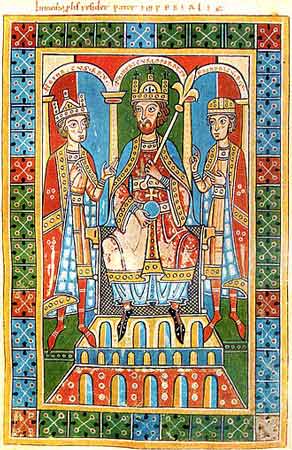
The Holy Roman Empire was not a nation-state in the modern sense. Political authority was shared between the emperor and a number of dukes, counts, bishops, archbishops, and other rulers of large territories. Most had considerable autonomy from the emperor, ruling their own lands, raising taxes and collecting fees, administering justice and maintaining armies. They owed their allegiance to the emperor, but relations between them were often dictated by personal relationships, political interests, and privileges agreed through negotiation.
Disputes amongst these powerful lords were common. Questions of landownership, taxation, justice, and authority over towns were all possible causes for conflict. The emperor was responsible for keeping the peace between his most important subjects, but he could not always demand their compliance. Local rulers might be determined to manage such conflicts without interference from the emperor.
Frederick Barbarossa had experienced these nuanced situations throughout his reign. Conflict with the cities and the pope in Italy, as well as disputes between princes in Germany, required constant attention. The Holy Roman Empire could not be held together by military strength alone, and alliances and negotiations were just as important.
Frederick Barbarossa’s son, Henry VI, was already taking on many responsibilities of imperial rule. In 1169, Henry had been elected King of the Romans. This gave him recognition as Frederick’s successor and, although not yet emperor himself (he would not become emperor until 1191), Henry exercised royal authority during his father’s lifetime.
Young Henry, the future Holy Roman Emperor, became involved in the dispute that drew so many nobles to Erfurt.
A Political Dispute Between Two Powerful Rulers
The meeting at Erfurt resulted from a conflict between Ludwig III, Landgrave of Thuringia, and Conrad of Wittelsbach, Archbishop of Mainz. Both were powerful figures in the Holy Roman Empire, but their power was derived from very different places.
Ludwig III was a member of the Ludowingian dynasty who ruled over substantial holdings in Thuringia. As Landgrave, he ruled secularly over the lands, strongholds, and towns in his domain. As such, he was one of the greater territorial rulers in medieval Germany.
Conrad of Wittelsbach was one of the most powerful ecclesiastics in the Empire. As archbishop of Mainz, he held one of the great ecclesiastical offices. However, his role was not limited to religious affairs. The archbishop ruled lands, held extensive rights, and was involved directly in the politics of the empire.
We tend to think of religious and secular authority as distinct spheres, but that was not quite true in medieval Germany. Bishops and archbishops were often territorial lords. Counts and lords often had sway over churches. Conflict could arise over boundaries, incomes, and political rights that would pit ambitious churchmen against their princely neighbors.
Erfurt was significant both for its ties to Mainz and its situation in Thuringia. The archbishops of Mainz held ancient rights in the town. The landgraves of Thuringia were influential in much of the surrounding region.
Medieval chronicles do not record the specific details of the contention between Ludwig and Conrad. What is clear is that their disagreement was grave enough to warrant the attention of the king. Henry VI worked to keep the peace between two powerful individuals whose conflict threatened the region’s stability.
Nobles from across Germany traveled to Erfurt to discuss matters of authority and power. None of them expected what would disrupt their convention.
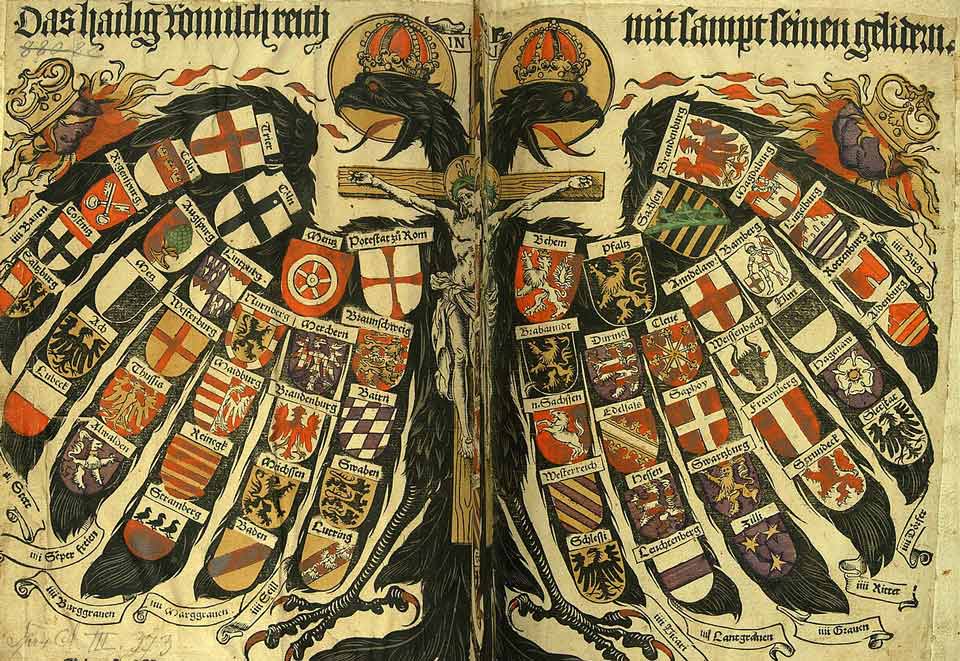
The Holy Roman Empire including its members, depicted as a stylized, structured coat of arms – Jost de Negker circa 1510
Why Erfurt Became the Meeting Place
Erfurt had long been a significant settlement within medieval Germany by the time of the twelfth century. Situated along long-distance trade routes, Erfurt’s prosperity came from trade, agriculture, and ecclesiastical connections. Thuringia itself was host to nobility, church leaders, and agents of centralized power who would naturally congregate in Erfurt due to its location.
In addition to being a site of civic leadership, Erfurt was connected to the Archbishopric of Mainz. Officials from Mainz would have had jurisdiction over key buildings in Erfurt, including the cathedral. The church complex itself served as another area where visiting nobles and other dignitaries could meet.
It was within what has been described as the residence of the cathedral provost that guests convened to meet. This provost was essentially an administrative official who oversaw areas related to the cathedral or perhaps even an order of monks.
Provosts would not be required to live in humble dwellings. In fact, buildings that served as residences for ecclesiastical officials were often sizeable enough to entertain guests and accommodate the work that needed to be completed. The rooms inside these buildings could be quite large, requiring timber beams to help support the roof above. Maintenance facilities and latrines were typically found on the ground floor.
We cannot know for certain how this building was laid out. While chroniclers of the period record the events leading to the collapse and subsequent deaths, they leave no blueprint for modern-day scholars to follow.
One thing is certain. A large group of people had converged over an area full of human waste. The weight of those gathered and structural limits would soon lead to tragedy.
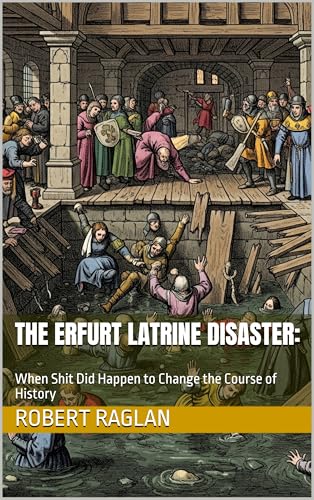

Erfurt Latrine Disaster Unfolds: The Moment the Floor Collapsed
The noble and royal gathering in Erfurt was convened on July 26, 1184. As the attendees met to resolve their disagreement, disaster struck. The floor supporting the men suddenly collapsed, dropping many through the surface they had been standing on.
According to medieval sources, the area above the cesspit in the room’s latrine collapsed. One account mentions multiple floors collapsing during the incident, but the details are not clear. Regardless, those standing above the cesspit would have had little time to react to the structural failure.
The most obvious cause of the Erfurt Latrine Disaster was excess weight applied to the flooring. Medieval structures sometimes used wooden beams to support floors above ground level, and their strength would have varied. Many factors can affect the structural integrity of building materials, including how weight is distributed across support beams. While typical activity in the room might have been safe, sizable crowds could have created this dangerous circumstance.
Numerous other factors could have affected the Erfurt latrine floor. Wooden beams may weaken due to water damage, age, or lack of upkeep. Remodeling or other architectural changes can also remove support from vulnerable areas of a building. Modern investigative techniques have not uncovered any reports on the condition of the Erfurt latrine, so it cannot be confirmed if any of these factors were at play. While too much weight is the likeliest explanation for the disaster, the exact cause remains unconfirmed.
Plunging through the floor was deadly enough, and in this case it was even more so with the cesspit lying directly underneath. Medieval bathrooms took many forms, but larger structures were sometimes equipped with shafts or holes that could drop waste into rooms below a building. These lower rooms had to be periodically cleaned out, creating their own hazard if they were not sufficiently separated from areas frequented by people.
People dying in the Erfurt latrine would have encountered several immediate threats. Injuries from falling through the floor would have been catastrophic on their own. Falling debris could hit or crush someone standing below when the floor failed. Victims who landed in the cesspit would also need to avoid drowning. Medieval writers were particularly horrified by drowning in a chamber full of human waste.
Perhaps what makes the Erfurt Latrine Disaster so remarkable is who died during the collapse. Nobles were no strangers to violence or intrigue, leading armies or debating important political issues. Although death was common in medieval Europe due to war, disease, and tragedy, men of importance dying during a floor collapse would not be unforeseen. Members of the nobility, people who were used to exercising authority over others, were killed in one of the least dignified aspects of daily medieval life.
The disaster shows one weakness in medieval building construction. Despite creating impressive castles, churches, and homes that have lasted for centuries, individual buildings could still fall prey to dry rot, lack sufficient support, or be overloaded. Without further archaeological evidence, it may never be possible to pinpoint which conditions caused the floor to fail at Erfurt.
Historians can say with certainty that what began as a meeting to settle a disagreement became one of the most gruesome accidents in medieval Europe. The incident came to be known as the Erfurt Latrine Accident, though medieval records would not have described it by such a contemporary name.
Dozens of Nobles Die in the Cesspit
Historical accounts state that around 60 people died in the Erfurt Latrine Disaster. It remains a significantly deadly accident to befall those inside a single building. Medieval sources conflict on the number of victims, and historians have no access to a definitive roster of the deceased.
Prominent noblemen were among the dead. Chroniclers were especially interested in reporting on deaths among the upper class, as medieval accounts typically omitted commoners who happened to perish in the same incident.
Medieval society afforded nobles significant power. Deaths could disrupt inheritance claims, create confusion over property titles, and shift the balance of political power. An accident that swept away dozens of noblemen was therefore noteworthy in a way that disasters today may not be.
Death by latrine also differentiated this incident from other tragedies. It was expected that noblemen might face danger in military campaigns, political conflicts, or difficult journeys. Deaths came with hazards that were accepted as part of life. Drowning in a cesspit during a royal gathering was clearly out of the ordinary.
Not all of those who died perished by drowning, of course. Many victims could have been crushed to death as the floor gave way, or been immobilized by debris. Medieval accounts do not make it possible to attribute specific causes of death to every attendee.
As such, the number of deaths should be viewed as approximate. However, there is general agreement on the incident’s key details: esteemed individuals died in large numbers after the floor collapsed beneath them, and they fell into a latrine.
The Chronicle of Saint Peter’s in Erfurt lists noblemen who died in the Erfurt Latrine Disaster of 1184: Count Friedrich I of Abenberg, Count Heinrich I of Schwarzburg, Count Gozmar III of Ziegenhain, Gozmar’s brother-in-law Burgrave Friedrich I of Kirchberg, Count Burchard of Wartburg, Behringer von Wellingen, and “other lesser names” that remain unrecorded.
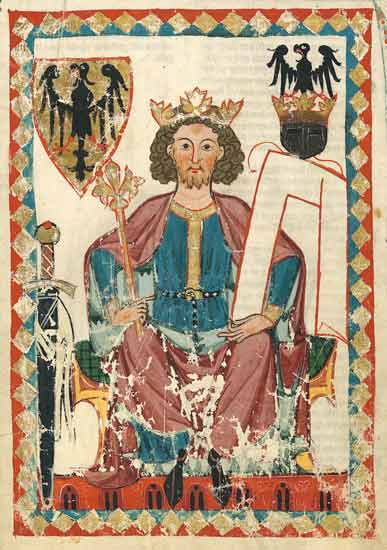
How King Henry VI Survived the Disaster
The single most important detail about the Erfurt Latrine Disaster involves the survival of King Henry VI. While he attended the gathering, King Henry avoided the collapse that caused the nobles behind him to fall through the floor.
According to the narrative, Henry VI and Archbishop Conrad were sitting in a stone window alcove. They avoided the collapse, and the surrounding masonry apparently held, leaving him safe from falling through like so many others. This is part of the legend surrounding the disaster, and readers should not expect it to hold up as confirmed architectural history.
Henry’s survival mattered politically as well. The son and successor of Frederick Barbarossa was still a young man at the time of the Erfurt latrine disaster. Barbarossa was one of Europe’s most powerful men, and his empire would not have survived intact if Henry had died at Erfurt. Frederick Barbarossa and his advisors worked hard to ensure the succession, and Henry’ death would have complicated matters considerably. Thankfully for the aging emperor, Henry lived and went on to rule.
Henry became Holy Roman Emperor in his own right in 1191, a position he held until his death in 1197. Henry’s miraculous survival when so many around him died is one of the enduring images of the Erfurt latrine disaster.
The Aftermath of the Erfurt Latrine Disaster
The accident’s immediate aftermath would have been terrible for the survivors. People lay dying in a small ditch covered in sewage and filth, while the surrounding half-collapsed building created its own hazards.
Very little description of rescue efforts survives from the time.
Quickly retrieving the victims would have been challenging because of these factors. Workers cleaning out the building dealt with an unstable structure surrounded by sewage and human remains. Chroniclers wrote about who died, but they did not take the time to describe the recovery effort in detail.
The dignity of the families and regions these nobles represented also mattered. During the Middle Ages, politics were more personal than they are now. Laws about who inherited land often depended on who held title to it. When a nobleman died unexpectedly, his land was at risk of changing hands.
Even immediate family was not guaranteed to inherit. If the land had no direct heir, it might have been claimed by the king. Regardless of who inherited from the fallen nobles, vassals had to renegotiate their local relationship and allegiances. Their deaths caused immediate local political implications.
It would be a stretch, however, to say that the Erfurt Latrine Disaster irrevocably altered the political landscape of the Holy Roman Empire. The source material does not describe the accident as politically transformative, nor did it have any permanent effect on policy that we know of.
The conflict between the nobility had been put on hold because of the disaster, but the empire’s politics continued as usual. Henry VI still wielded royal power, and Frederick Barbarossa remained emperor.
People remembered the Erfurt Latrine Disaster for its extraordinary circumstances and all of the notable lives lost, not for any dramatic shift in imperial politics.