The Boston Tea Party and the Punishment That United the Colonies
 Reading Time: 17 minutes
 Most everyone knows about the Boston Tea Party. Colonists dressed like Native Americans stormed into Boston Harbor and threw crates of tea overboard. But the night of December 16, 1773 was just one part of a larger conflict that had been going on for years. Parliament and the colonies argued about taxes, representation in government, trade, and Parliamentary authority over the colonies.
Fast forward to December 1773. The fight now hinged on three merchant ships called the Dartmouth, Eleanor, and Beaver. All three ships were loaded with tea. Britain had recently passed a law that allowed them to ship tea directly to the colonies instead of through England. Protesters felt that this law violated their rights and took aim at the ships. Boston went back and forth for weeks trying to figure out some way to send the ships back without breaking British laws.
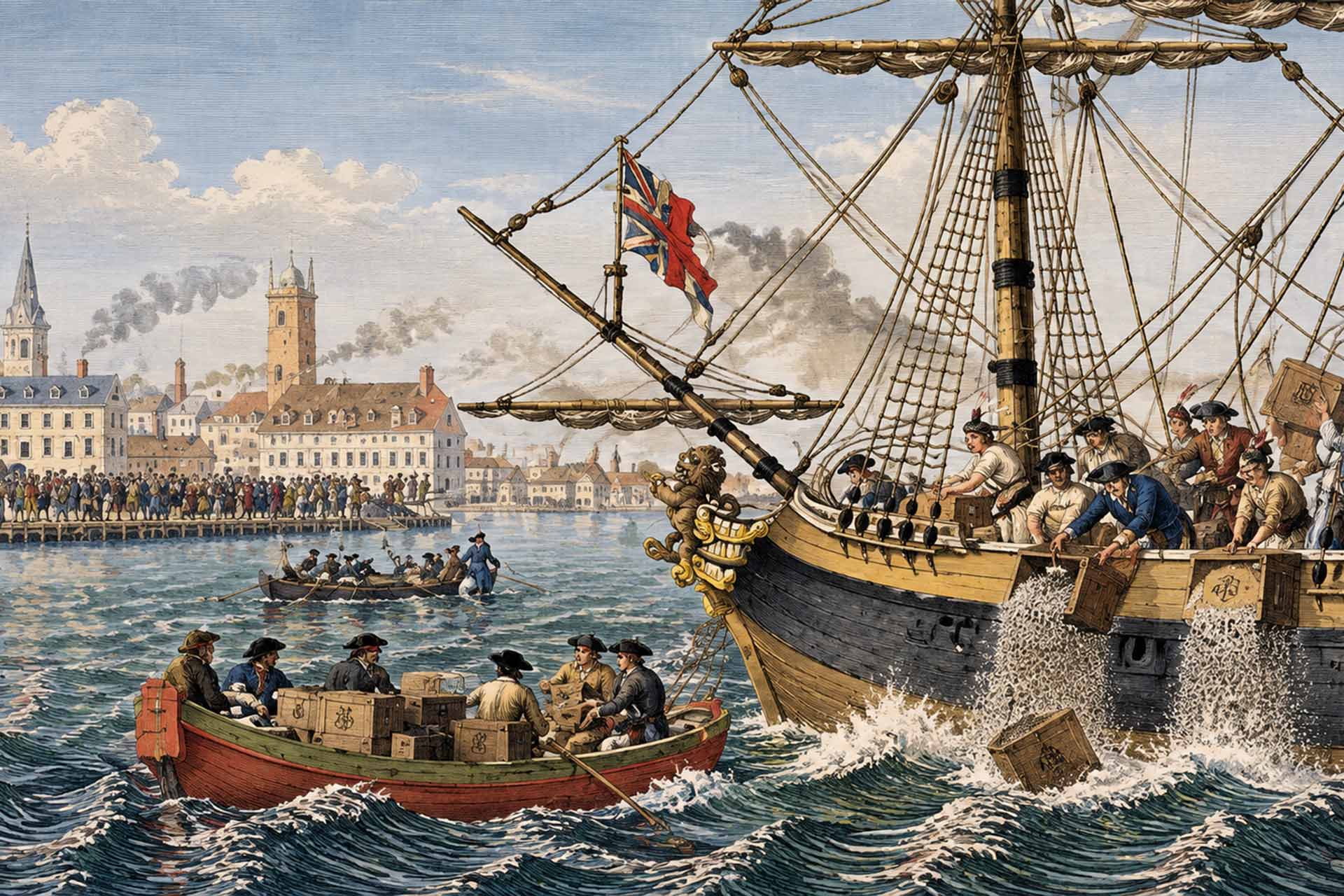
Ultimately, they could not find a solution, and men took matters into their own hands. Men boarded each ship and destroyed 342 chests of tea. The British decided to punish Boston by closing down Massachusetts Harbor and revoking parts of its government charter. Britain hoped this would crush Massachusetts’ rebellion, but instead it ignited colonial outrage from New England to the Carolinas. Less than a year and a half later, the first shots of the American Revolution were fired at Lexington and Concord.
The Argument That Began Years Before the Tea Party
By some measures, the origins of the crisis stretched back to Britain’s victory in the Seven Years’ War (known as the French and Indian War in North America). The war concluded in 1763 with Britain in control of a significantly larger empire. However, the British government was bogged down with war debts and expenses associated with maintaining its North American territory.
Parliament looked to the colonies to ease the fiscal burden. The Stamp Act of 1765 taxed just about any printed material used in the colonies. Colonial backlash was immediate and vehement. Opponents said Parliamentary taxes were unlawful because colonists didn’t elect representatives to Parliament.
The Stamp Act was repealed in 1766, but that was not an admission of defeat. The Townshend Acts placed duties on glass, paper, paint, lead, and tea imported into the colonies. Protestors resorted to boycotting goods and renewing cries of “taxation without representation.”
Boston remained especially unruly. British troops had been stationed there since 1768, and tensions grew fierce. On March 5, 1770, troops were confronted by an angry mob. The soldiers opened fire and killed several civilians. It became known as the Boston Massacre.
Parliament repealed the Townshend duties that same year except for one. The tax on tea remained.
It didn’t raise a significant amount of revenue, but politically it was more valuable than money could measure. If the British eliminated all Townshend duties, it could be seen as an admission that Parliament couldn’t tax the colonies. The tax on tea allowed Britain to maintain its perceived authority.
It would take three more years and a healthy dose of tea for the colonial controversy to return to Boston Harbor. According to the Library of Congress’ summary of the colonial rebellion, the continued taxation on tea was already a point of contention among colonists leading up to passage of the Tea Act.


Why Tea Became So Important
Tea drinkers in eighteenth-century British America did not get all of their tea through legally sanctioned British channels. Illegal Dutch smugglers had long supplied North American colonists with tea as well.
Because smuggled tea faced neither the import duties charged by the British nor the costs associated with the long voyage from Britain to America, smuggled Dutch tea could be sold more cheaply than legally sanctioned British tea.
For some colonists, buying legally imported British tea was more significant than the decision to buy one product over another. British tea was taxed by the British Parliament. Using tea on which the British had collected a duty became, to its opponents, a tacit acknowledgment of Parliament’s right to tax the colonies.
British politicians did not see the issue in the same way. They generally did not accept the idea that Parliament was only meant to represent the colonists’ interests when it elected officials directly. To these politicians, Parliament provided “virtual representation” to all British citizens.
The argument over the tax was not about whether colonists would pay a few extra pennies for their tea.
It was about who had the right to tax them, who spoke for the colonists, and how much power the British Parliament should have over colonial America.
This made the tax on tea a powerful symbol. Parliament could not repeal it without losing face. American patriots could not willingly pay it without essentially giving up years of protest.
This situation came to a head when the British East India Company further encountered financial instability.
The Tea Act of 1773
Parliament approved the Tea Act on May 17, 1773, in part to allow the East India Company to sell off a large surplus of tea and put its business on solid financial footing.
The greatest misconception about the Boston Tea Party starts here. The Tea Act did not impose a new colonial tax on tea. The Townshend duty stayed in place. The act changed only how East India Company tea would be sold in the colonies.
The company got several commercial advantages that let it ship tea to America with fewer middlemen and at lower cost. Its tea could therefore undercut smuggled tea, making legally imported British tea cheaper even with the existing duty.
The British government did not become the sole retailer of tea to the colonies. It did so through the East India Company and the colonial consignees it appointed. But opponents decried the company’s exclusive status as a monopoly. They feared colonial merchants would suffer if the company was allowed to work its way into every colonial port.
The political issue was even worse.
If colonists began buying cheaper tea, they would also be paying the tax Parliament had imposed. Britain would collect taxes and prove, by the colonists’ actions, that they accepted Parliament’s right to tax them.
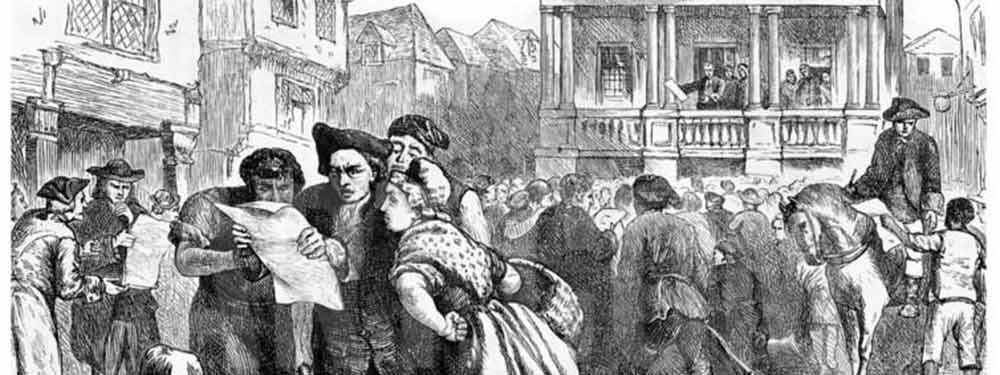
Opponents of the act saw the issue clearly at the time. An anonymous December 1773 broadside from Philadelphia complained that East India Company tea was arriving “subject to a Duty.” Philadelphia had passed resolutions earlier in the year condemning any plan that would lead to monopoly, linking the economic threat to constitutional concerns.
Cheap tea, in short, didn’t fix the problem. It exacerbated it.
The Sons of Liberty Mobilize
Resistance began even before the tea ships arrived in America. Merchants, newspapers, committees of correspondence, and political organizers called upon the colonists to boycott East India Company tea.
Organized resistance was led in large part by groups called the Sons of Liberty. The name had come into use during the Stamp Act crisis, but it didn’t refer to any modern national organization. There was no single headquarters and no formal membership requirements. There were local organizations and networks in various colonies. Committees often relied on the power of public meetings, newspapers, demonstrations, and economic coercion.
Boston had an especially active community organizing and resistance network. Samuel Adams was pivotal in tying local struggles to the broader political conflict. Boston’s Committee of Correspondence worked to spread the ideas and muster support from other towns throughout Massachusetts.
Resistance began in other ports as well. Colonists in Philadelphia and New York took action to resist the tea. In some ports pressure was applied to consignees and merchants to prevent East India Company cargoes from being landed according to Parliament’s plan.
Things would be different in Boston because the tea made it into Boston harbor—and then became trapped there.
It was no longer just a political dispute. It became a legal crisis with a ticking clock.
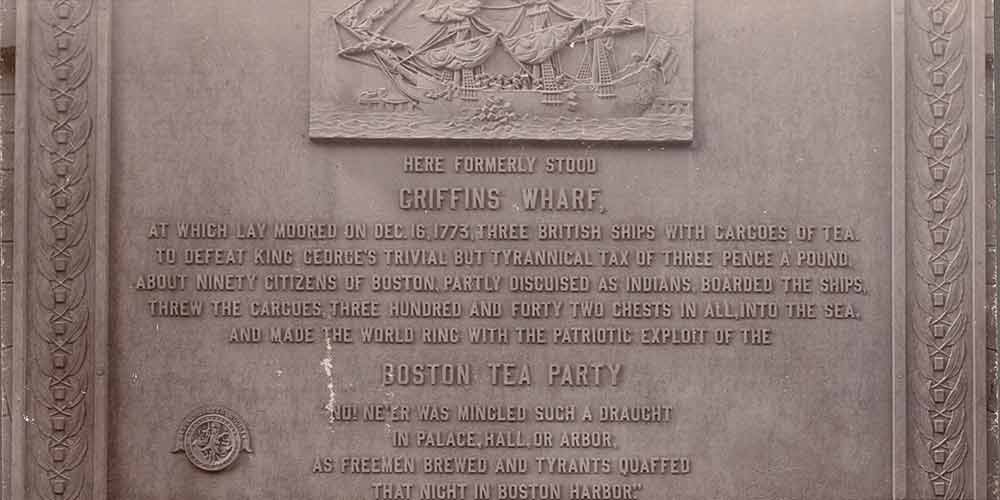
The Dartmouth Arrives in Boston
The Dartmouth arrived in Boston Harbor loaded with tea from the East India Company on November 28, 1773.
The ship was owned by merchant Francis Rotch and captained by James Hall. Rotch soon discovered that he was being pulled in two directions by conflicting demands.
On one side, Boston’s Sons of Liberty demanded that the tea not be unloaded. They insisted that Dartmouth take the tea back to Britain, leaving its cargo and its duty unpaid.
Rotch faced a problem with British customs law.
By docking at Boston Harbor, Rotch had started a legal timer. He had twenty days to unload and pay duty on his cargo according to the regulations of British law. If the tea remained on board after that time, customs officials could begin seizing it from him. December 16 was the day Dartmouth’s cargo would’ve been seized by the Crown.
Boston’s rebels wanted to avoid destruction if at all possible.
On November 29 and November 30, Rotch and an enlarged public meeting debated their options. They agreed that the tea should neither be unloaded nor taxed. Participants also declared that the cargo should be returned to Britain.
An extant broadside details the group’s pledge to prevent “the landing and sale” of any units of tea “and the payment of any duty thereon.” This document also makes clear that watches would be kept on any ships that delivered tea to Boston. This 1773 broadside, which is held by the Library of Congress, is strikingly clear about the demands of protesters before the Tea Party.
Don’t land the tea. Send it back.
The Eleanor and Beaver Join the Standoff
The Dartmouth would not remain the only tea-laden ship at Griffin’s Wharf for long.
Shortly thereafter, the Eleanor, led by Captain James Bruce, arrived bearing more East India Company tea. The Beaver also arrived in Boston under Captain Hezekiah Coffin, though she didn’t reach Griffin’s Wharf until she had aired out long enough in quarantine.
All three ships sat at Griffin’s Wharf with their illicit cargoes intact.
A fourth ship, William, had also been sailing to Boston with a load of tea on board but was wrecked near Cape Cod. That left the Dartmouth, Eleanor, and Beaver at the center of the standoff that reached its peak on December 16.
With more ships constantly arriving in Boston harbor, the pressure was mounting. Armed guards kept watch to ensure that the tea wouldn’t be silently unloaded. According to the National Park Service, smaller groups of the Sons of Liberty met as the deadline for the Dartmouth’s arrival drew near.
It was no longer a question of whether colonists would buy the East India Company’s tea.
That tea was already in Boston Harbor.
Now someone had to decide what would happen next.
Governor Hutchinson Refuses to Back Down
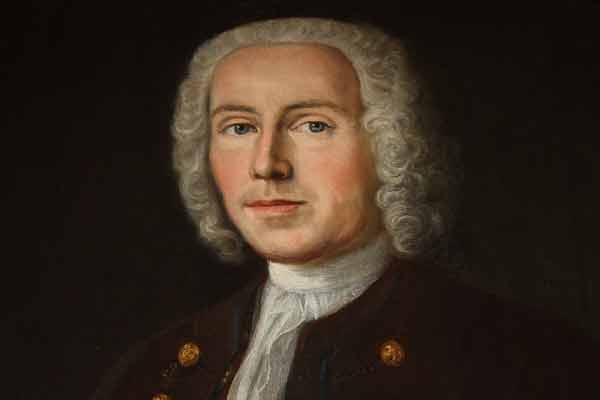
On one side of the standoff was Royal Governor Thomas Hutchinson.
Hutchinson has been portrayed in many patriotic accounts as nothing more than the official who wouldn’t let the tea leave the harbor. He had good reason not to. Letting one ship violate customs regulations because of mob coercion would have signaled a crushing defeat for the Crown’s authority.
The protesters viewed it from the opposite perspective. If the tea was unloaded and taxed, Parliament would be scoring a huge victory against the policies they had fought for years.
Neither side wanted to risk setting a precedent by backing down.
Francis Rotch was caught in the middle. He couldn’t just turn the Dartmouth around and sail home. The ship still needed customs clearance, and the royals controlled the harbor.
The protesters still pushed for some legal means of departure. On December 14, the day before Rotch’s ultimatum expired, a large meeting told him to try to ask customs for clearance. He did, and was denied.
By December 16, legal methods were nearly used up.
The people of Boston would decide what to do next.
The Dartmouth’s Final Day
On December 16, the people of Boston met at Old South Meeting House in the morning. The building was Boston’s largest public meeting space, but it was still packed to capacity.
The National Park Service estimates that almost 5,000 people attended what would become the meeting that decided their course of action. That was an extraordinary turnout, as Boston’s total population was just 15,000 people. Citizens from other towns nearby had also come to attend the meeting.
Simply returning the Dartmouth to Britain without authorization was now a dangerous option. Governor Hutchinson had given orders to Admiral John Montagu to blockade the harbor entrances with the Royal Navy, and Lieutenant Colonel Alexander Leslie had received orders at Castle William that he was not to “permit any Vessel not Cleared” to pass. The cannons at Castle William were loaded. Hutchinson also ordered the Royal Navy to fire upon the Dartmouth should she attempt to leave without clearing. Francis Rotch was no longer risking merely his cargo or a fine for disregarding customs regulations. Escalating to the protesters’ level now endangered his ship, his crew, and his business.
Francis Rotch had one more opportunity to find a way around the issue without breaking the law. When Boston customs officials would not clear the Dartmouth, Rotch rode about ten miles to Governor Hutchinson’s country home in Milton. The crowd waited patiently for his return at Old South Meeting House.
Time dragged on.
Rotch returned that night. Hutchinson would not allow the Dartmouth to leave port without following the law. He later wrote to Lord Dartmouth that he even offered to speak to Admiral Montagu on the ship’s behalf for protection, but Rotch was too afraid of local retribution should he not leave, and what Hutchinson called the “resentment & rage of the people should he attempt to” leave without complying with the protesters.
Much of that answer’s importance is lost when historians condense the Tea Party into a quaint tale about unruly colonists impulsively choosing to dump some tea in the water. For over two weeks, Boston’s patriots had insisted that the ships’ cargo be sent back to Britain. On December 16, the Dartmouth’s deadline had passed without the desired legal resolution taking hold. The ship was legally unable to unload the tea without paying the contested tax, but sailing away without consent would subject it to capture, or possibly even worse, by either the Royal Navy or Castle William.
What occurred next altered the trajectory of the controversy.
The Destruction of the Tea
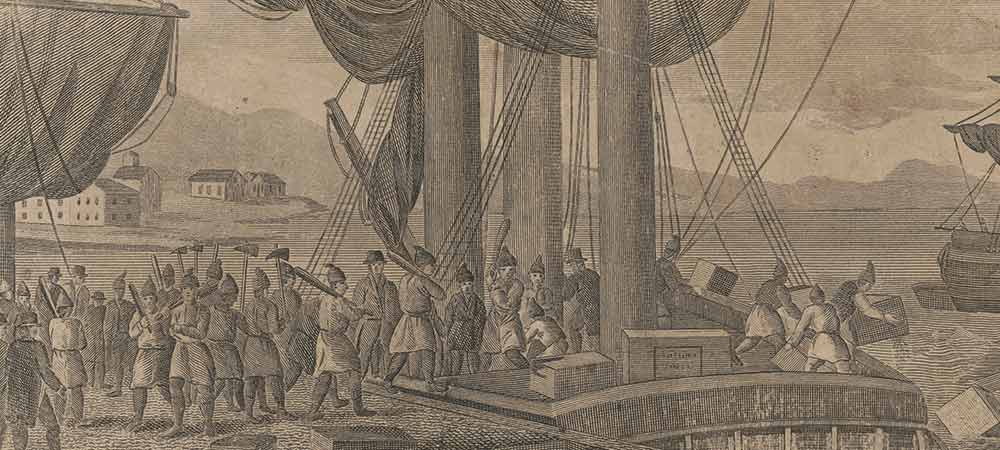
After the meetings had broken down, groups of men marched towards Griffin’ s Wharf.
Some disguised themselves. Accounts later described them as Mohawk Indians. But images of colonists dressed up as Indians are largely apocryphal. Accounts from the time and soon after describe a mix of smeared soot, blankets, rough clothes, and men pulling together whatever disguises they could. According to the National Park Service Museum, about 150 men wore “ashes or soot on their faces and appeared dressed in a variety of ways including: sewed work clothes, leather aprons, hunting shirts, and some with Indian attire.”
These men boarded the Dartmouth, Eleanor, and Beaver.
Over the course of about three hours, participants broke open 342 chests and poured over 90,000 pounds of East India Company tea into Boston Harbor. It was coordinated, not chaotic. They left property unrelated to the shipment alone, and there is no evidence the ships were damaged on purpose.
Peter Edes remembered men coming to his father Benjamin Edes’ house the afternoon before they destroyed the tea. He wrote that they’d kept him in another room a while, fashioning punch for the “party.” The Massachusetts Historical Society holds Peter Edes’ later account as well as the Edes family’s punch bowl.
It was not originally called the Boston Tea Party.
“Destruction of the tea” was a common contemporary description for what happened. The phrase “Boston Tea Party” would not become synonymous with the events of the evening until much later.
However, one thing remained true: Britain still had a problem to deal with.
Britain‘s Response to the Boston Tea Party
News of the destruction soon crossed the Atlantic, causing widespread outrage in Britain as well.
From Parliament’s perspective, privately owned property had been wantonly destroyed, and officials in the colonies had either been unable or unwilling to stop it. If colonial resistance like this were allowed to stand, British rule over Massachusetts–or maybe even the entire empire–might seem totally ineffective.
British leaders decided that Boston needed to be punished.
Parliament passed what were known in Britain as the Coercive Acts in 1774. Americans who opposed them referred to them as the “Intolerable Acts.”
The Boston Port Act shut down most trade in Boston Harbor starting June 1, 1774, until restitution for the destroyed tea was made and other conditions were met. The Massachusetts Government Act restricted aspects of the colony’s longstanding system of self-government. The Administration of Justice Act allowed some trials to be relocated to Britain if they involved royal officials or soldiers. The Quartering Act allowed for colonial households to be used to quarter troops in specific circumstances.
Colonists also commonly called the Quebec Act one of the Intolerable Acts, though Parliament had not passed it in response to the Tea Party. That fact can be important, since the phrase “Intolerable Acts” technically describes the colonial political reaction to multiple British laws passed around the same time.
The British intended for Massachusetts to fall in line after being punished.
Instead, nearly every colony joined Massachusetts in opposition.

The Punishment That United the Colonies
Closing Boston’’s port went straight at Boston’’s livelihood. Everyone from merchants to laborers, sailors to craftsmen, and nearly every family would be affected.
The British hoped that increased pressure would isolate radicals in Massachusetts. Maybe other colonists would realize that Boston had overstepped its bounds and simply let the town suffer for destroying the king’s tea.
Instead, what happened was that colonists around America sympathized with Boston.
Communities far from Massachusetts raised aid to send to Boston. Newspapers printed letters describing the new legislation. Committees of correspondence worked to turn what had begun as a local crisis into a colonial political matter.
Suddenly the issue wasn’t just whether or not Boston was right to destroy the tea. Colonial residents began wondering what was preventing Parliament from punishing their own cities and towns.
If Parliament could shut down Boston’’s port and change the way Massachusetts was governed, they wanted to know, what stopped Britain from doing the same thing to another colony tomorrow?
As the National Archives describe, a colonial Common Cause emerged. Intended to punish Boston, the measures taken by Britain helped unite colonial resistance and contributed directly to calls for a Continental Congress to be formed.
This was the huge political mistake made in response to the Tea Party.
Britain punished a single colony and rallied twelve more against it.
The First Continental Congress
Delegates representing twelve of the colonies met in Philadelphia at Carpenters’ Hall beginning on September 5, 17 74. Georgia was the only colony not to send representatives.
Taken as a whole, the delegates to the First Continental Congress disagreed on many issues. Some were less radical than others. But nearly all were alarmed by Britain’s recent policies and the need for colonial action.
They had not gathered to write a new Constitution for an independent United States.
“The delegates to the Congress did not advocate independence,” records The National Archives in Britain. “They wanted to organize pressure on the British government in the hope that it would mend the broken relationship with the colonies, while allowing colonists to keep what they believed were their rights as British subjects.”
On October 20, the Congress adopted the Articles of Association. This created the Continental Association and started a wide program of economic resistance against Great Britain.
Tea was still part of the controversy. Under the agreement, individuals signed to “use no tea imported by the East India Company” nor tea that had had the controversial duty paid on it.
The colonies had now moved to coordinate resistance on a much larger level than previously. The possibility of war was not inevitable yet.
This would change in the winter and spring of 1775.
Massachusetts Moves Toward Armed Resistance
The political power struggle intensified dramatically in Massachusetts. The Massachusetts Provincial Congress was beginning to carry out activities that royal officials viewed as illegal. Communities were forming militia companies and stockpiling arms, ammunition, provisions, and other military supplies.
General Thomas Gage was both commander of the British forces in North America and royal governor of Massachusetts. He sat in Boston and watched an illegal political and military organization spring up around him.
By early 1775, the colonists were storing considerable military supplies at Concord, about eighteen miles northwest of Boston.
Gage decided to do something about it.
Late on the night of April 18, he dispatched British regulars to Concord with orders to capture and destroy the military supplies. In written orders to Lieutenant Colonel Francis Smith, he listed artillery, ammunition, provisions, tents, small arms, and “all such supplies” for seizure and destruction.
secrecy was required.
Secrecy was soon lost.
Messengers were sent into the countryside to warn farmers as militia companies began organizing to confront the regulars.
What had started as a crisis over taxes and legislation was about to turn into armed rebellion.
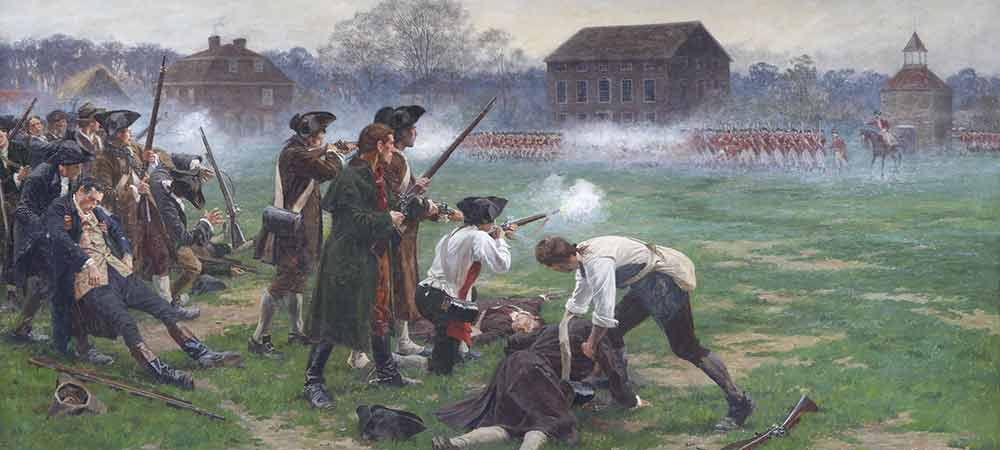
Lexington Battle Green, Battles of Lexington and Concord, 19 April 1775- William Barnes Wollen 1910
Lexington and Concord
Just before sunrise on April 19, 1775, British regulars entered Lexington. Captain John Parker’ militia was waiting on Lexington’s town common.
Disputes remain about who fired the first shot. Warring accounts appeared almost immediately, and the controversy became entrenched. To this day, nobody knows for certain who fired that first shot.
What happened next is not disputed.
The British advanced and fired. Several members of the Lexington militia were killed. The regulars marched on Concord. Once there, they searched the town for military supplies.
Colonial militia met them at Concord’s North Bridge. It was here that militia officers commanded their men to fire at the regulars. British soldiers died in the volley. The National Park Service marks the North Bridge as the site where colonial forces first fired upon the orders of their commander.
The British column headed back to Boston. Militia from around the countryside attacked them on the way. By the evening of April 19, fighting had spread for miles throughout Massachusetts.
The American Revolution had begun.
To say that the Boston Tea Party “started” Lexington and Concord would be misleading.
There was no one single cause of the American Revolution. Taxation. Representation. Trade. Military authority. Colonial government. Parliamentary sovereignty. Years of disputes had poisoned the relationship between Britain and its 13 colonies. The Boston Tea Party pushed things closer to war by forcing a British reaction that further altered the political landscape.

![[Video] Women of the American Revolution](https://historychronicler.com/wp-content/uploads/2025/03/Screenshot-2025-03-29-at-3.53.33)


