
The Münster Rebellion and the Brutal End of John of Leiden
 Reading Time: 17 minutes
 Few events from the Protestant Reformation left behind a more unusual monument to religious violence than the Münster Rebellion of 1534–1535. Three iron cages still hang high above Germany’s Prinzipalmarkt in the city of Münster, attached to the outside of St. Lambert’s Church tower. Five hundred years ago they held the bodies of three men whose followers attempted to construct a new religious order inside the city walls.
John of Leiden (Jan Van Leiden) was the most notorious. Within a year he had transformed himself from an obscure Dutch Anabaptist missionary into king over what his followers believed was a New Jerusalem. His regime instigated communal property, plural marriage, draconian blasphemy laws, and a royal court worthy of Tudor England, while supporters gathered outside the city gates into an army.
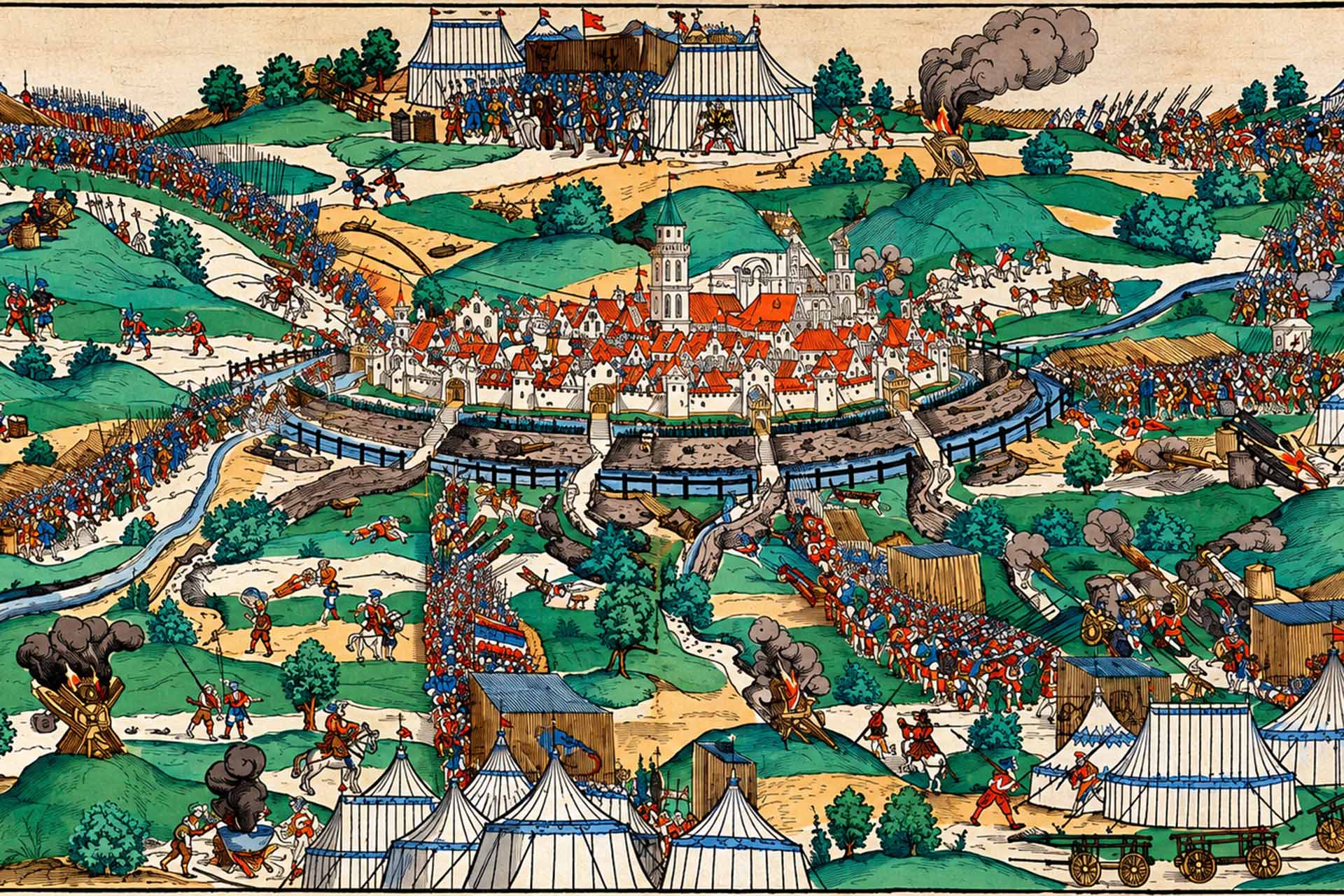
The Dutch kingdom ended in June 1535, when the besieging forces finally breached the city walls. Three of its leaders, including John of Leiden, were tortured at the marketplace before being executed and mutilated. Their bodies were publicly displayed in iron cages hanging from the tower of St. Lambert’s cathedral as a warning to others who would seek to emulate their rule. The cages still hang on the tower today.
Yet the story behind them is more than simple religious fanaticism. Münster was already a bitterly divided city long before the Anabaptists entered the scene. A mixture of war, prophecies, political ambition, hunger, and fear drove the citizens of Münster down a radical path. To understand the arrival of the Anabaptists, we have to go back to a religious upheaval that was already tearing Europe apart.
A Reformation That Escaped Its Founders
When Martin Luther made his objections to Catholicism public in 1517, he started a movement that quickly spiraled beyond his own intentions. Reformers protested church practices, challenged papal authority, translated Scripture, and fought over Christian doctrine and organization.
Germany became a primary location for this conflict. Unlike today’s nation-state, the Holy Roman Empire consisted of hundreds of territories, cities, bishoprics, and principalities. Its rulers enjoyed significant autonomy, which tied faith reform to local politics.
Some reformers took Luther’s ideas even further.
Among them were movements which would later be known collectively as Anabaptists, from the charge that they baptized people twice. They opposed infant baptism and instead argued that baptism was to follow a believer’s confession of faith. As nearly everyone in Christian Europe had received an infant baptism, this critique extended beyond church ceremony. Baptism defined whether someone was part of the religious and political community.
The perceived threat that denied infant baptism posed to the religious and political order was met with severe punishments. The Diet of Speyer in 1529 condemned Anabaptists to death. Both Catholic and Protestant governments prosecuted Anabaptists. But Anabaptism wasn’t a centralized movement. Many different groups shared the belief that baptism should happen after an individual confession of faith. They differed on theology, political aims, violence, and the role of Christians in secular government.
This is an important distinction to remember. The Münsterite effort was just one manifestation of a broader movement and a precursor to the violence that followed in the Thirty Years’ War.

Prophets and the Coming End of the World
A man who helped pave the way for the Münster Rebellion was Melchior Hoffman. He was a fiery preacher who mixed Anabaptist teachings with a passionate apocalypticism.
Hoffman looked to God to dramatically alter the course of human events. Ultimately, he saw Strasbourg as playing a unique role in the end times. He was arrested and imprisoned there in 1533. The new world he had anticipated did not arrive.
However, Hoffman’s imprisonment did not stifle the movement he had begun.
A Dutch baker named Jan Matthys rose to become a more radical prophetic leader of Hoffman’s followers. Matthys restarted the baptisms Hoffman had put on hold and announced a new timetable for God’s intervention. Word of his message spread through the Netherlands and into northern Germany.
Among the converts was a young man from around Leiden. His name was Jan Beukelszoon, but he would become known to history as John of Leiden.
John of Leiden was 24 or 25. He had learned the trade of tailoring and supported himself as a merchant. He also appears to have been involved in amateur theater troupes in Leiden. This may have given him a knack for the dramatic public persona he would later project as the leader of Münster. In November 1533, Jan Matthys baptized him.
Not long after, the two men would find themselves in a city that was already embroiled in conflict.
Why Münster Was Ready for Revolution
Münster was a thriving walled city in Westphalia with about 10,000 citizens. It was a self-administered city enjoying considerable civic freedom, though the prince-bishop was its ultimate sovereign.
Reformation sentiments had arrived in Münster well before the Anabaptists gained strength.
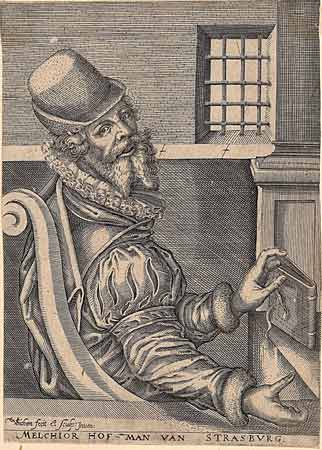
Melchior Hoffman became the people’s spokesman for reform beginning about 1530. His congregation grew as conflict divided the city council, the guilds, local clergy and Prince-Bishop Franz von Waldeck. By 1533, the bishop was compelled to concede key Protestant advances. Most parish churches had been converted to Protestantism while the cathedral and some monasteries remained Catholic. Rothmann continued to advance past Luther’s teachings and later took to Anabaptism.
The city found itself made up of three religious groups: Catholics, moderate Protestants and radicals.
Anabaptist missionaries who followed Jan Matthys soon arrived in town.
Adult baptism became quite common in January of 1534. According to the University of Münster’s Institute for Comparative Urban History, about 1,400 people embraced baptism by the new doctrine. John of Leiden was also present at this time and quickly rose to power in the movement.
The conflict in Münster was no longer a simple Catholic vs. Protestant situation. This burgeoning sect also believed that the city had a role in God’s soon-to-come new order of the world.
The Anabaptists Take Münster
The turning point was the city council election of February 23, 1534. Supporters and sympathizers of the Anabaptists took power in Münster.
Jan Matthys entered the city soon afterwards.
Münster was constructed ever more openly as the New Jerusalem, the home of God’s elect prior to the imminent end times. Dutch Anabaptists and others from the region made their way to the city. At the same time, locals unwilling to submit to the new rule were expelled.
The radical reform of society was violently imposed. Catholics and Protestant non-Anabaptists were given the choice of baptism or expulsion. Vacated homes and goods of exiles could be claimed by others. Churches and monasteries were attacked, and statues, altars, and other church fittings were destroyed.
By March, the sect had implemented something approaching common ownership. The group rationed food, established common meals, and turned over money and jewelry to the group leaders. Ideology was important, but siege psychology and the practical demands of absorbing refugees also played their part.
We should be careful, though, not to think of the Anabaptist takeover of Münster as simply the revolt of destitute newcomers. Studies of who lived in the city show that members of the movement could be found at all strata of urban society. Rich citizens and former civic officials were included among the leadership.
The Münster Rebellion had begun, and outside the city walls, the prince-bishop began making preparations to retake the city.
The Siege Begins
Prince-Bishop Franz von Waldeck would not stand for the loss of Muenster. It was his political capital and the seat of his bishopric.
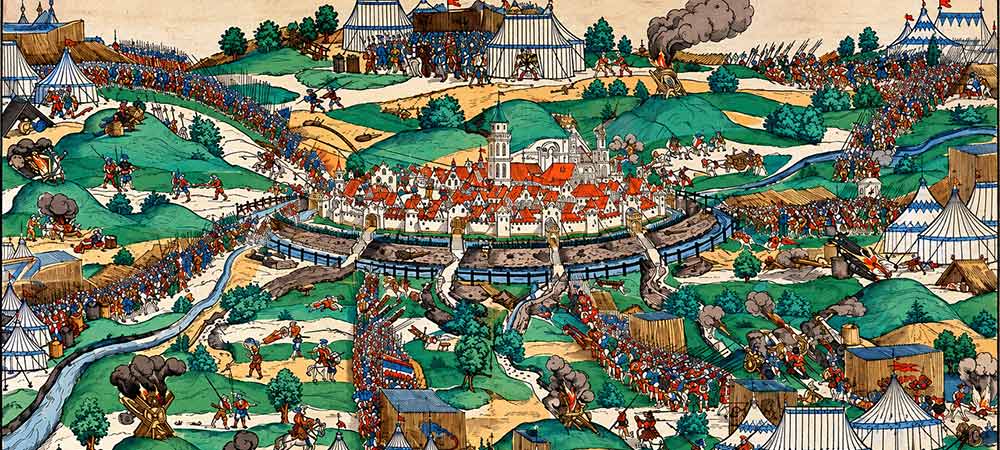
By the end of March 1534, troops under his command were closing in on the city.
What was happening at Münster was unlike anything that had occurred during the Reformation up to this point. A prince-bishop was trying to take back his walled city from revolutionaries who thought they were establishing God’s Kingdom on Earth.
Münster’s walls gave those inside a huge advantage. They could be surrounded by mercenaries and other troops, but it would be hard to storm the city. The Bishop called in thousands of Landsknechte. These were professional soldiers often used in European warfare during the 16th century. Many neighboring princes helped as well. The Münster Rebellion became a matter of concern throughout the Holy Roman Empire.
Those inside Münster felt that the siege only proved their beliefs correct. They could look out over the walls and see an army of evil trying to destroy their New Jerusalem.
Their prophet then did something unexpected.
Jan Matthys Walks Out to Meet the Enemy
Jan Matthys was prophesying divine intervention around Easter 1534.
When this failed to materialize, Matthys didn’t quietly amend the timetable or alter his prediction. On Easter Sunday, April 5, Matthys rode out of Münster at the head of a small group of followers, aiming for the bishop’s army’s encampment.
He believed that God would provide victory.
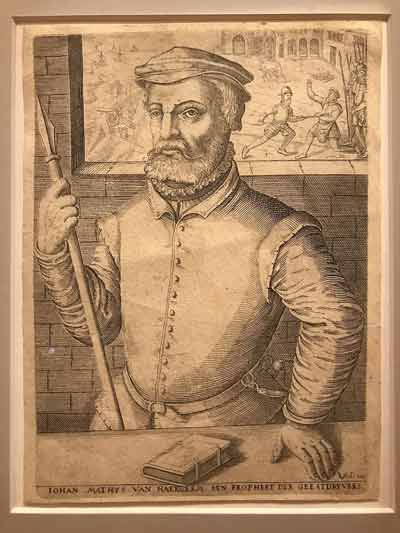
The professional soldiers outside the city quickly overwhelmed the group.
Matthys was killed before the city walls. Reports say that his corpse was mutilated, and that his decapitated head was held up for display. The broad strokes—his failed attack and his death—are reliable, but the grisliest details are preserved in documents created in the heat of battle against Narrative enemies and should be taken with a grain of salt.
The Münster Rebellion was built around prophecy, so this should have been disastrous. Followers had waited for God’s deliverance, and it hadn’t come. Their prophet had charged against the enemy and been killed.
John of Leiden turned that defeat into a rallying cry, turning a possible catastrophe into an opportunity.
Instead of waiting for God to bring down their enemies, he claimed the city’s believers needed to take charge and transform Münster into God’s kingdom.
John of Leiden Builds the New Jerusalem
Following Matthys’ death, John of Leiden became Münster’s unrivaled prophet.
Münster’s government was quickly remade. Officials installed a group of twelve elders to rule the city, replacing the elected council. This hierarchy was designed to resemble the biblical precedent. Van Leiden himself remained at the top as prophet.
Daily life was now subject to biblical law. Matters which might once have been managed with simple civic justice were now matters of obedience to God. Anything from disturbing the peace to dissenting against the religious hierarchy could be punishable by death.
This transformation illustrates the growing absolutism of the movement. The Münster Rebellion began as an experiment in collective brotherhood and shared property. But the movement was forced into cult-like paranoia by the encroaching threat, with power centralized.
Van Leiden also began making moves to export the revolution.
Münster began sending missionaries into the world to announce the new hierarchy and drum up support. They had little success. According to the University of Münster’s historical project, they sent 27 apostles out. Missionaries were quickly arrested by the local authorities in the towns they tried to visit, and almost all were eventually executed.
Münster had cut itself off from the world. But within the city walls, another radical experiment was starting.
Polygamy Comes to Münster
Plural marriage was announced that summer of 1534.
The institution became one of the most infamous aspects of the Münster Rebellion. Those who supported polygamy cited Old Testament examples, like patriarchs and kings with several wives.
Conditions within the city played a role too. Women greatly outnumbered men there. Migration played a role. So did expulsion. The city’s military predicament also cannot be discounted. Polygamy did not simply happen because there were more women than men. But the imbalance helped create the circumstances that allowed it to take hold.
Support for the policy was not universal. Not everyone who accepted the city’s new regime accepted polygamy. Criticism of the new policy grew, and plural marriage soon became just another loyalty test.
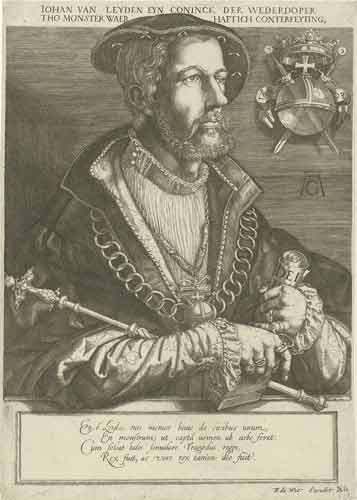
John of Leiden took practiced polygamy extensively. Documents that survive from his royal court list sixteen wives. Divara of Haarlem, widow of Jan Matthys, became van Leiden’’s principal queen.
Later stories sensationalized this into the most lurid and infamous tales surrounding Münster. One describes van Leiden personally beheading a wife who asked to leave or divorce him. Appearances of the story can be found in later histories, but many other details of this time are hard to confirm beyond doubt like the practice of polygamy.
This issue is present throughout Münster’s history. Much of what we know was written by opponents or those who had strong incentives to dissociate themselves with the losing cause.
What we do know, however, was radical enough on its own.
Van Leiden would soon take it a step further by proclaiming himself king.
John of Leiden: The Tailor Who Became King
On August 1534, the besieged inhabitants beat back a “serious assault” from the bishop’s troops. News of the successful defense further fueled their conviction that God was defending Münster.
John of Leiden’s rule evolved in new ways within weeks.
In September 1534, he declared himself king. Supporters compared him to David and promised him a kingship that would last until Christ returned to usher in the true Kingdom of God. Bernhard Rothmann published religious rationales for the kingdom.

The change was profound.
John of Leiden created a royal court and surrounded himself with royal trappings. He dressed in fine clothes and received visitors in public audiences. He began to style himself as a monarch with claims to territory and power far beyond Münster.
One printed court ordinance that has survived gives us unusually detailed evidence about his rule. In addition to listing 148 men who served in positions at his court, the document recorded the names of his sixteen wives. It even provides his style as king in the “New Temple of God.”
What the court list also shows, something often lost in retellings of the story, is that sixty- six of the one hundred forty-eight officials named were from Münster, and many had served in municipal roles before the rebellion. The kingdom was not an occupying foreign force that had seized control of an unwilling city. Münster citizens were deeply involved in running it.
But the display of monarchy was strangely incongruous. Van Leiden appointed himself ruler of an imminent kingdom of God. The kingdom he actually ruled extended only to the walls of Münster.
Meanwhile, the army at its gates was discovering it didn’t have to take them by force.
It could starve them out instead.


Hunger Inside the New Jerusalem
Attempts to storm the city had failed, and the blockade was intensified.
Life in the city grew ever harder as spring gave way to summer in early 1535. Food shortages became acute. Those who had anticipated the remaking of the world from the gates of Münster were reduced to living from day to day. Chroniclers, both at the time and since, record inhabitants tearing up roots and grass and turning to anything they could find once conventional food ran out.
Accounts of starvation are problematic, as hostile chroniclers had every incentive to depict the regime as demonic. But there is little doubt that conditions grew steadily worse as the siege continued. According to the Münster City Museum, the siege ring around the city was tightened in February 1535, and famine spread throughout the city.
Van Leiden’s government, however, managed to maintain order and continued to work on their followers’ belief that ultimate salvation was at hand.
Flight from the city was not a realistic option for most. The besiegers knew that if people were allowed to stream out of Münster, it would weaken the opposition by leaving fewer mouths for them to feed. The oppressed citizens were now a factor in the military equation.
Disillusionment set in as it became clear that no widespread revolt was forthcoming.
Münster was isolated.
Siege had replaced assault as the strategy of choice, and while the bishop’s army had failed to breach Münster’s defenses, hunger was doing the job for them. Ultimately, men inside the city walls provided the information that would end the Münster Rebellion.
Betrayal and the Fall of Münster
Two defectors from Münster in June 1535 found their way to the besiegers’ camp.
Heinrich Gresbeck was among them. Later, after the fall of the city, his written account would serve later historians as one of their primary sources on the rebellion. Obviously, Gresbeck had much to explain and excuse about his conduct once the regime had fallen. Nevertheless, his testimony is the lone surviving eyewitness account from someone who lived through the Anabaptist kingdom and later set down his experiences.
Gresbeck’s testimony and that of the other defector helped the attackers find a weak spot in the city defenses.
Late on June 24 and into the early morning of June 25, 1535, troops of the bishop managed to breach the city’s defenses. There was fierce hand-to-hand combat as defenders fought to halt their progress.
John of Leiden’s kingdom collapsed, and the Münster Rebellion was over.
It’s impossible to know how many died trying to defend the city, but the Münster City Museum conservatively estimates that about 650 Anabaptists were killed during its capture. Most of the Anabaptists’ leaders had been killed, though the final days of Bernhard Rothmann are a matter of some dispute. He may or may not have escaped the city.
John of Leiden was captured alive. As were Bernhard Knipperdolling and Bernhard Krechting. Killing them in battle would have squandered that opportunity for the prince-bishop.
These trials and subsequent punishments were meant to be an example.
The Execution of John of Leiden, Bernhard Knipperdolling, and Bernhard Krechting
The three captives survived for months after Münster’s capitulation. They faced interrogation and prosecution and were condemned to death.
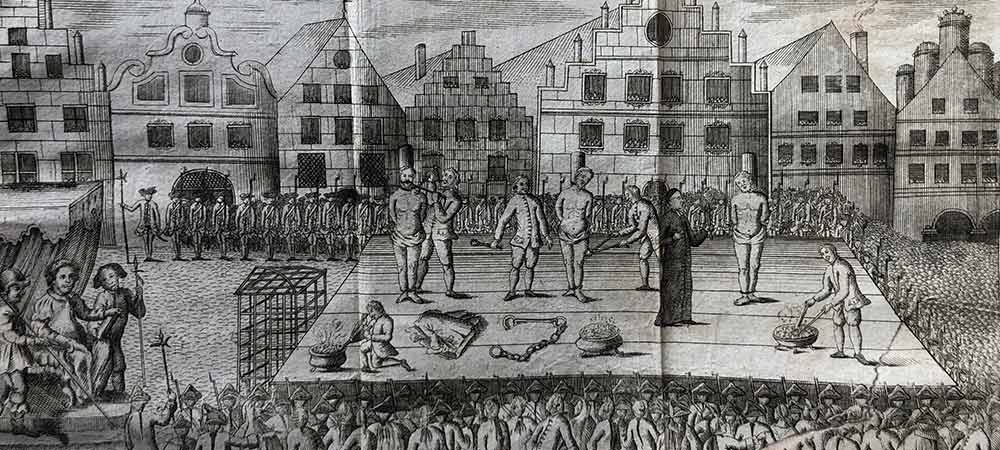
John of Leiden, Bernhard Knipperdolling, and Bernhard Krechting were escorted into Münster’ Prinzipalmarkt on January 22, 1536, for execution.
It was a cruel and calculated ordeal.
Accounts from the time period say that the three men were bound to stakes and prodded with red-hot iron tongs. Their execution was designed to serve as a lesson about the perils of revolt and spiritual heresy. It also served as retaliation for the outrages they committed while in power.
Authorities went one step further. Iron baskets were constructed to hold the remains of the executed men. They were loaded into the baskets and lifted up over Münster onto the tower of St. Lambert’s Church. There they were displayed for all to see, high above the square where van Leiden had proclaimed himself monarch. The symbolism was clear.
The prince-bishop had been restored, and in the heart of Münster, a visible reminder stood of what happened to those who threatened political and religious authorities.
The bodies were eventually removed.
But the baskets remained.
The Iron Cages That Still Hang Over Münster
Travelers who visit Münster today can still crane their necks to look up at St. Lambert’ s Church and see the three iron cages.
The triangular structures are known simply as cages, but baskets would be closer to what they actually were. These were not prison cells. They were coffin-like structures intended to hold and display corpses.
Sources from both the Landschaftsverband Westfalen-Lippe and University of Munster state clearly that the iron baskets that remain on the tower today are the originals from 1536. They contain, from the perspective of the observer a commemoration to Knipperdolling, John of Leiden, and Krechting’s.
That they survived at all is surprising considering what happened to the rest of the church. St. Lambert’ s tower was destroyed and rebuilt in the nineteenth century. Münster was also heavily bombed during World War II. The baskets were saved and restored to their home looking down over the Prinzipalmarkt.
Artist Lothar Baumgarten’s Three Will-o’-the-Wisps art installation has added lights to the inside of each cage since 1987. They glow at night creating a modern memorial from objects that were originally designed to terrify and shame.
Centuries later their purpose remains and will not allow onlookers to forget the horrors of the Münster Rebellion.
The Long Shadow of the Münster Rebellion
The Münster Rebellion long outlived John of Leiden as a tool used against Anabaptists. Catholic and Protestant writers could invoke Münster as a cautionary tale of just how dangerous radical religion could be. Luther reacted with outrage to what was happening in the city. Violence, polygamy, communal property, prophecy, and kingship gave opponents plenty of rhetorical ammunition to use against groups that weren’t nearly as radical as van Leiden’s regime would suggest.
Echoes of the association continued for centuries. Historian Kat Hill has written about how English religious writers invoked Münster throughout the seventeenth century as a byword for fanaticism, rebellion, and social disorder. English Baptist minister William Russel lamented in 1697 that his opponents would regularly hurl “John of Leyden” in the faces of Baptists who disagreed with the violent actions of the Münsterites.
Of course, the rebellion never determined the entire future of Anabaptism.
In fact, one of the most successful post-Münster Anabaptist leaders was Menno Simons, a former Catholic priest from the Netherlands. Simons’ teachings downplayed violence and helped foster Anabaptist communities devoted to adult baptism, strict religious practice, and nonviolence. His legacy would eventually be known as the Mennonites.
Similar commitments to pacifism also developed among other Anabaptist traditions.
The Münster Rebellion’s legacy is quite ironic for that reason. The most infamous example of violent Anabaptism would go on to serve as a lasting warning to traditions that would grow famous for their nonviolent beliefs.
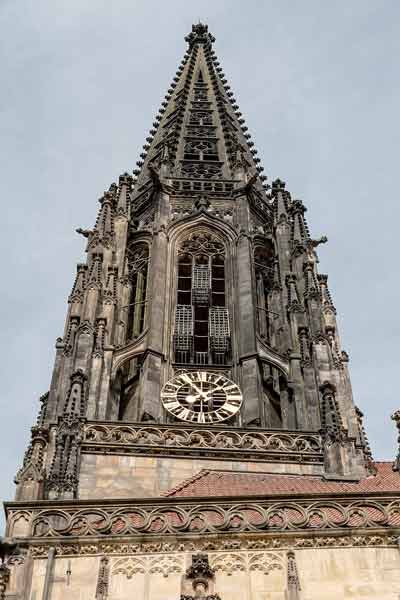
A special feature is three iron baskets attached to the tower, in which the bodies of the three leaders of the Anabaptist kingdom of Münster, Jan van Leiden, Bernd Krechting, and Bernd Knipperdolling, were displayed in 1536 after they had been publicly tortured and executed in the square in front of the church.
From 9 p. m. to midnight, a tower watchman or watchwoman blows a horn every half hour. The office has existed since 1379.
The Kingdom That Lasted Little More Than a Year
The Münster Rebellion was not simply an isolated incident of bizarre religious fanaticism. It occurred when Europe’s spiritual and political landscape was fracturing, and the siege mentality of Münster radicalized what was already a militant movement, driving it toward authoritarianism, violence, and reliance on prophecy.
John of Leiden flourished under these conditions, ascending from missionary to monarch in mere months. However, his kingdom of New Jerusalem was not to last. Siege and starvation, coupled with bad luck and treachery, eventually caused the fall of a kingdom believed by its disciples to be supernaturally protected. John of Leiden’s punishment was meant to stand as a lasting example.
Münster is a bustling German city once again five hundred years later, but three iron cages still hang from the steeple of St. Lambert’s Church. What the kingdom couldn’t destroy still haunts it today.


