

The Dramatic Downfall: Lessons from the Ottoman Empire’s Decline
 Reading Time: 24 minutes
 For centuries, the Ottoman Empire spanned three continents and connected diverse populations, religions, and languages. Yet its demise was not marked by a sudden fall. It disintegrated slowly—through military defeats, financial crises, political strife, and the gradual weight of a shifting global economy. By the 1900s, an empire once deemed permanent was struggling to hold on to one province and treaty at a time.
“Decline,” however, is a misleading word. There was also adaptation: reform, modernization, and repeated efforts to remake the state to meet new challenges. Some challenges were self-inflicted, others were a result of global competitors and economic change. The lesson we should take away from their story is nuanced: changing military dynamics, fiscal instability, internal challenges to legitimacy, and great-power geopolitics combined in a powerful way. As we work to understand similar trajectories today, there are real practical lessons in how those forces operated in tandem.

The Ottoman Empire at Its Height
At the height of its power, the Ottoman Empire’s system balanced centralization with pragmatism. While the Sultan’s government directed policy, taxation, and warfare, provincial practice varied considerably depending on local conditions. This pragmatic flexibility helped Ottomans govern diverse peoples who spoke many languages and lived across different terrains. In many ways, the government’s goal was not to make each province the same as the next but to manage the differences.
Meritocracy was one tool that allowed the Ottoman government to use its resources well. Palace schoolage and bureaucracy produced qualified candidates who could rise through the ranks with discipline, education, and good performance. “Merit is everything,” wrote sixteenth-century diplomat Ogier Ghiselin de Busbecq of the Ottoman Empire’s administrative system.
Effective provincial governance was designed to maintain order and collect taxes. Governors and local officials were responsible for keeping their domains secure, resolving disputes, and providing resources for the military. They did so through a mixture of careful record keeping, clear hierarchies of command, and pragmatic bargains with local elites. This flexible administration enabled the Ottomans to control distant provinces for centuries, even during trying periods.
Military might lent the Ottomans a competitive edge against neighboring powers. From the fifteenth to the seventeenth centuries, the Ottoman military was well organized and used weapons effectively on the battlefield. They balanced infantry, artillery, and cavalry in a way that matched the realities of early modern warfare. The Ottomans also developed a bureaucracy that could project power by mobilizing manpower and provisioning troops over great distances. Logistics were every bit as important as fighting skills.
Regional dominance magnified Ottoman strengths. The empire’s territory straddled major sea routes and landroads that connected Europe to Asia and North Africa. This allowed the Ottomans to control crucial chokepoints like the Bosporus and eastern Mediterranean. From Istanbul to Cairo, key cities along these routes supported the military and helped administer the empire’s extensive territories.
Commerce facilitated the military and underwrote the Ottoman court’s power. Through markets and port cities, Ottomans traded with Venice, Persia, and the Red Sea. Taxes on commercial activity (as well as agriculture and production in towns and cities) funded the government. Prosperity also allowed the government to cultivate an image of strength and stability.
In addition to maintaining a strong military, the Ottoman government tried to legitimize its authority over the people it governed. The Ottomans promoted themselves as rulers who preserved law and social order. Many subjects tolerated or even supported Ottoman rule because it maintained consistency and security. By balancing force with practical administration, the Ottoman system prospered—for a time.
Early Warning Signs
Long before the crises of the nineteenth century, which would shake the empire to its core, three weak points could be identified early on in Ottoman administration. Succession politics and factionalism at court intensified after Süleyman’s reign reached its zenith, as palace circles jockeyed for influence over appointments and policy-making. According to historians, political allegiances began to outweigh merit more than they had previously, and competition between powerbrokers increased within the ruling class.
This factionalism contributed to the government’s inability to agree on decisions and policies. Influential cliques could stymie reform efforts, shield incompetent favourites from removal, or leverage their supporters to have ministers ousted for political reasons. Meanwhile, the state’s administrative capacity grew far beyond what could be managed at its helm. Centuries earlier, when the empire was smaller and wars more localized, the bureaucracy could keep a tighter leash on the provinces. As more land and revenue sources were incorporated into Ottoman territory, it became more difficult to manage the sprawling province enclaves. As a result, local elites were able to negotiate with, work around, or outright replace state institutions.
War and taxation only exacerbated the administrative burden. Supporting military campaigns required funding, food, supplies, and transportation, all of which were expected to be provided by the provinces. Shortfalls in funding were often met with short-term solutions that helped keep the bureaucracy afloat but incentivized corruption.
In many cases, contemporaries described corruption not as a root cause of decay but as an obvious symptom. In one reform tome centered around the critiques of Koçi Bey, authors lament that “the gates of bribery open and posts start to be bought and sold.”
Highlighting this quote is important because oftentimes, “corruption” was the first sign that people noticed. When ministerial positions were subject to factional politics, provincial governors withheld taxes to fund their own defenses, and wars drained resources, bribery and favor began to take root. Corruption and cronyism spread as these elites were able to bypass the state.
By the time military defeats and European encroachment began in the empire’s later centuries, these pressures had hobbled the state’s ability to react as a centralized force. While insufficient succession protocols, factionalism, and administrative challenges did not cause the fall of the Ottoman Empire, they created considerable vulnerabilities for a once-unified empire.

Military Change and the End of an Advantage
The Ottoman Empire’s military was powerful—and quite modern—through much of the seventeenth century. Ottoman armies could effectively use the trinity of disciplined infantry, combined artillery, and siege-and-logistics-based campaigning that had long been developed by states across Eurasia. The issue was that European warfare was changing rapidly. Many scholars identify a “military revolution” in which advances in artillery and fortifications led armies to emphasize drilling, supply, and sieges with ever larger numbers of soldiers.
The result was that war had gotten even more expensive. Large armies required large budgets to maintain. Longer campaigns required a larger staff. Warfare was becoming a competition of who could muster money, gunpowder, and supply lines the fastest. Militaries that could not adapt quickly to raise money found themselves quickly surpassed. The Ottoman military system—which had previously allowed it to compete effectively—was optimized for a past era of campaigning.
The Janissaries were at the center of this growing capability gap. What was once a small elite force attached directly to the Ottoman state had grown into a powerful political actor over the centuries. By the late 1700s, any attempt to modernize the military by regulating the Janissaries was met with stiff resistance from those who benefited from the status quo. Selim III tried to modernize the Janissaries, but his efforts provoked opposition that led him to form a separate army of his ‘new order’ soldiers instead.
The problem was that you cannot have a successful modernization program if your existing institutions can sabotage your efforts. Over time, this sensitivity to change made reform more difficult and expensive. The Ottomans were losing their competitive edge merely by playing defense on reform.
War costs and poor performance began to compound. Once-smoked guns began losing ground to better-equipped rivals. The failed Siege of Vienna in 1683 marked the start of a decades-long war between coalitions and the empire that would leave the Ottomans on the losing end. The Treaty of Carlowitz in 1699 ceded Transylvania and much of Hungary to the Austrians.
Loss of territory had a cascading effect. Frontiers act as buffers, tax collectors, and recruiting grounds for armies. Retreating empires have to defend more effectively on less territory. Each lost mile lays siege to your treasury. The failed siege had a psychological impact, too. Many actors within Europe now understood that Ottoman momentum could be stopped, and a reversal made to look inevitable.
By then, it was already too late; enemies of the Ottoman Empire had once again surpassed them in warfare with modernized armies. The moral of the story is simple: Military power is not a stock value. It depletes unless maintained by training, funding, and flexible institutions to keep pace with it. Warfare has evolved more rapidly than tradition.
Economic Pressures and Fiscal Crisis
Global changes in trade and finance further taxed the Ottoman Empire’s resources. European navigation and naval power rerouted Asian goods to Europe, while Portuguese and Dutch competition affected traditional networks in the Indian Ocean and eastern Mediterranean. Temporary revitalizations of Middle Eastern trade could not prevent the empire from encountering stronger competitors, enjoying a smaller share of the profit margins from long-distance trade, and contending with previously unknown trade volatility.
High levels of state expenditure depended largely on stable, predictable revenue from customs, agricultural taxation, and urban dues. Changes in trade patterns increasingly worked to the Ottomans’ Empire’s disadvantage. Meanwhile, European merchants benefited from capitulations and expanded commercial influence at the potential expense of Ottoman producers and tax collectors.

Debasements and price instability also created difficulties. From the late sixteenth century onward, Istanbul and other markets periodically experienced price shocks, to which the state responded by increasing minting and debasement. As economic historian Şevket Pamuk has detailed, debasement and price increases fed into each other throughout the Ottoman “price revolution.” Daily market trips became an exercise in uncertainty for households and businesses, as well as soldiers paid in coin.
Currency issues resurfaced with a vengeance in the nineteenth century. Pamuk also notes a major debasement campaign by Mahmud II: between 1808 and 1844, the silver content of the kuruş dropped precipitously, along with a sharp depreciation in the exchange rate and increasing prices. When confidence in money falters, soldiers’ pay does not keep up with living costs, and the treasury cannot readily pay its obligations.
Covering budget shortfalls often fell to the tax-farming system. Tax farmers advanced liquidity to the treasury in return for the right to collect taxes, but tax burdens often fell on rural populations. Tax-farming rates were often collected as aggressively as possible in the provinces to ensure profit for tax farmers and mitigate risk. As one study of nineteenth-century tax-farming puts it, there is no evidence that tax-farming eased the peasant burden, and it may have contributed to tax revolts in both Rumelia and Anatolia.
Urban residents also felt the pressure. As producers in the countryside were taxed more heavily, supply contracted, food prices rose, and urban residents faced shortages and instability. Fiscal pressures enhanced the power of local notables who managed collection, credit, and security for the state. The central state’s weakness was compounded by its own efforts to extract resources from society.
Foreign loans added insult to injury in the mid-to-late nineteenth century. The Ottoman Empire took on large loans beginning in the 1850s, and ultimately defaulted on its sovereign debt in 1875. The Default of 1875 was unprecedented: the Ottoman Empire had lost control over its own finances and was deemed insolvent by European creditors. In 1881, after restructuring some of their debt, Ottoman revenues were placed under the control of the Ottoman Public Debt Administration to ensure that future obligations would be paid. Foreign control of Ottoman revenues was just one way in which fiscal weakness became a problem for sovereignty.
Provinces, Autonomy, and Fragmenting Control
As the central authority weakened, the provinces grew accustomed to the power accruing to local elites. Known as ayan, these local elites were originally little different than brokers – men of property with clients, capital, and clout who could organize tax collection, security, and rebellion. Eventually, many assumed semi-independent roles, bargaining with rather than merely complying with the central government.
These developments were significant because they altered how the state worked. In times of need, when money and men were required quickly, the Ottoman Empire would subcontract to provincial strongmen. Although this practice enabled the state to continue functioning during crises, it also demonstrated to the provinces that resistance was effective. After local elites realized they could negotiate tax payments, extract concessions and subsidies, or simply take up arms, imperial control could not be easily reasserted.
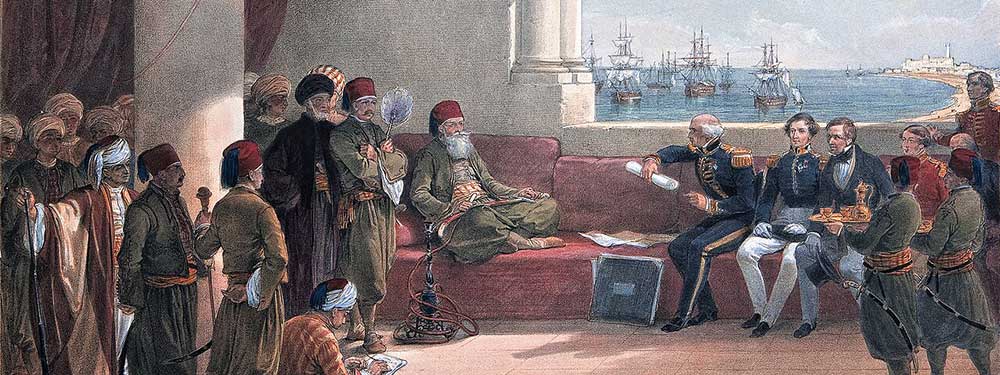
The most well-known example came in Egypt. Muhammad Ali was appointed governor in 1805 and consolidated his control by creating a modernized army and bureaucracy. Although he remained part of the empire only in name, his tactics and ambitions demonstrated the provincial appetite for sovereignty.
Similar tensions arose along the empire’s European border. Autonomy fed into rebellion, creating a cycle of crises that required the Ottoman government to constantly respond. If these conflicts were accompanied by concessions or independence, it further emboldened the province and demoralized the center.
Arabia and the Ottoman Maghrib faced similar problems. Both regions required the Ottomans to govern at arm’s length due to distance and local autonomy. In Arabia, the geography and strength of local religious-political movements made direct control difficult, if not costly. In places like Algeria, Ottoman Empire’s control was more nominal before the Scramble for Africa began.
The Ottomans responded with centralization, largely through administrative reform. The nineteenth-century Tanzimat reforms sought to create administrative consistency, increase central authority, and promulgate clear rules throughout the empire. However, locals who were comfortable with the status quo pushed back against these reforms because their subsidies and privileges were under threat. In practice, centralization often felt like colonization to the provinces.
Ultimately, this led to a vicious cycle. Weak central authority empowered provincial actors, leading to increased calls for centralization. Reforms were expensive and undermined the government’s own legitimacy, further weakening it. By the last century of the empire, the Ottomans were fighting to keep their territories as much as to keep their neighbors at bay.
Nationalism and Identity Fractures
For generations across three continents, order, reliable taxation, and the social contract of the Ottoman Empire were good enough to unite many peoples. That began to change in the nineteenth century. Ideas about nationhood reached more people through educational systems, churches, printed media, and political associations. Identities solidified, loyalty to the Sultan ebbed in regions where language, faith, and shared history became the focus of political life.
The Balkans turned out to be the powder keg. Revolutions and Balkan Wars occurred in bursts that fed back into each other: every uprising showed other groups that resistance was possible, and every explosion in the region drew others in to take advantage. In Ottoman Bulgaria, a series of events known as the April Uprising in 1876 met with great resistance and savage retaliation, drawing international attention and helping to fan the conflict into what became known as the “Great Eastern Crisis”.
None of these uprisings took place in isolation. They were driven both by local concerns (tax loads, abuses by the Empires representatives, banditry, etc.) and by the expectation of foreign support. Serbia and Montenegro fought the Ottoman Empire during the Ottoman–Serbian Wars of 1876–1878, tying themselves into the broader conflict as it spiraled.

The millet system, which sorted the empire’s peoples into religious confessions, helped manage the empire’s diversity for centuries by giving each religious community autonomy over matters of “personal law”. In this way, many everyday decisions were made at the community level, which could limit the number of points upon which communities and the empire might chafe against each other. But in many cases, this also grouped people into large confessional groups, giving later nationalists convenient borders to achieve.
But as populations grew more conscious of their national identities, the old benefits of millets met new challenges. When the question of “who are the people?” moved from a matter of shared confession to shared nationhood, autonomy was no longer sufficient. Soon, every nationality wanted its own sovereignty, its own army, borders, and foreign ministry. The stability that autonomies could provide within a larger entity was no longer compatible with what national movements sought to achieve outside an empire.
European great-power intervention deepened these cracks. Not only could they claim to police the empire’s minorities and require reforms from the Sultan, but they could also intervene on behalf of their sympathies when violence broke out. Moral pronouncements were mixed with geopolitical competition. Minority politics had become tangled with great power politics: how could the Ottoman Empire hope to reform when the European powers could pick and choose the pieces they wanted? The Treaty of Berlin in 1878 redrew maps and trimmed Ottoman Europe smaller still.
By the later years of the Ottoman Empire, identity politics became something of a stress test. Each insurgency undermined the populace’s trust in the central government’s ability to deal effectively with the matter; each foreign intervention loosened more groups’ bonds to Istanbul and strengthened their claims; each successful intervention and reform empowered minorities and made other populations anxious about their futures. Stability in diversity is possible for empires—it’s just that when external pressures align with growing nationalism and inconsistent reform, questions of identity can become the cracks that redraw the map.
Diplomacy and the Great Power Trap
The Ottoman Empire was the central focus of what Europeans termed the “Eastern Question” by the late 1700s and throughout the nineteenth century. The Eastern Question was not a single problem; it was a centuries-long debate about what to do with the Ottoman Empire as it grew weaker and who would benefit from that weakness. The problem was built into the system: almost any domestic crisis—an uprising, reform, dynastic dispute—risked triggering foreign intervention because great powers always feared that their rivals might gain an advantage.
Too often, that “meddling” took the form of intervention. Great powers might claim to be defending trade privileges, minority rights, or stability, but they were also playing the long game against each other. The result was that the Eastern Question dominated European diplomacy: everyone wanted to pull the Ottoman strings, but no one wanted their rivals to do it. The constant pushing and pulling left the Ottoman Empire tied to the bargaining table, struggling to maintain its sovereignty.
Capitulations were another way that the empire was kept weak. Foreign merchants and their home countries negotiated trade treaties with the Ottoman government that gave foreigners special privileges and legal exemptions inside Ottoman lands. While these capitulations supported trade, they also tied the Ottoman economy to European interests. Foreign merchants gained advantages that made it difficult for Ottoman authorities to tax and police trade on an equal footing.
Capitulations were not the sole “cause” of Ottoman weakness, but they did create a growing imbalance between what the Ottoman government needed and what it could do. You cannot run a state if you cannot tax, police, and regulate your people and commercial activity. Foreign privileges amounted to incentives for the Ottomans to leave well enough alone—at the cost of domestic inconvenience—in return for European peace. But this formula ensured dependence, and European states grew more powerful relative to the Ottoman state throughout the nineteenth century.
Conflict with Russia made this dependence a matter of survival. Russian leaders dreamed of expanding their empire southward, gaining warm-water ports, and exercising power over Orthodox Christians in Ottoman lands. The Ottomans, for their part, prioritized defending frontier lands and maintaining their own prestige. So when Russia invaded, war became an existential issue. Defeat meant greater insecurity, which could only be compensated for by making alliances with other powers. Weakness required allies, and allies drew Istanbul deeper into the continent’s power politics.
That Russia would eventually face Britain and France on opposite sides in a war with the Ottoman Empire would have seemed ridiculous to Europeans several decades earlier. But by the mid-nineteenth century, Britain and France were ready to defend the Ottomans in the Crimean War, not because they loved Istanbul but to keep Russia from gaining too much power in Europe. In short, the empire survived some periods in history because its rivals feared one another more than they feared Ottoman decline.
That helps explain why European diplomats started referring to the Ottoman Empire as the “sick man.” Istanbul was treated as both weak and too important to fail. The saying may be far more popular than the historical record supports, but it’s not inaccurate. Dependency turned Ottoman fortunes into a bargaining chip for European powers. When your survival is only conditional on the calculations of your enemies, you can never be truly independent.
Reform Under Pressure: Tanzimat and the Limits of Renewal
The The Late Ottoman Endgame of reform (1839–1876) was the Ottoman attempt to centralize and modernize its administration as European powers closed in around it. Centralizing reformers wanted a stronger, more predictable Ottoman state that could fend off foreign intervention and prevent its provinces from breaking away. Put differently: they wanted to make their government more “modern” while avoiding domestic delegitimization—or foreign loss of territory.
This dilemma was evident from the beginning. The Imperial Edict of Gülhane, issued in 1839 and marking the start of the reform era, promised to uphold “life, honor, and property” and to reform taxation and the seemingly arbitrary requirements for military conscripts. The edict announced that henceforth, law would be used to provide redress and improve governance, rather than simply punish deviance from order. Reformers also hoped that standardizing legal codes and procedures would help stem European justification for intervening in Ottoman affairs to protect minorities.

The edicts of reform were followed by waves of new legal and administrative structures. Commercial, maritime, and criminal codes were translated from European languages and used to renovate older Ottoman laws. But reforms also sought to change how justice was administered: making it more “modern” and legible to foreign powers.
Another reform edict followed in 1856, promising equal education, government appointments, and treatment before the law, regardless of religious confession. However, the reforms were partially induced by diplomatic pressure from Britain and France during and after the Crimean War. Reform could help buy time—but it could also cause conservative subjects of the Ottoman Empire to suspect their empire of favoring foreign powers.
Military restructuring took similar steps. As early as the eighteenth century and continuing through the Tanzimat, Ottoman sultans established new educational institutions to train military officers and technicians. Reform-era schools included the War School (Harbiye) and schools for military medical training. These schools aimed to train specialists who could understand and manage modern drill, weapons, tactics, and logistics. Control over education was political: those who trained the next generation of officers would mold the next generation of the state.
Motivated reforms ran up against hard reality, however. Warfare and crisis made funding erratic while modernization required reliable budgets, trained technicians, and decades of peace to take hold. When money was tight, reforms happened on paper but not in practice—particularly in the provinces. Opposition also had an effect. Reforms threatened the status of certain groups and sparked fears that they would lose influence or income, or that religious-social hierarchies would be undermined. Howard L. Davison’s analysis of the politics behind the 1856 reform edict illuminates how even a popular concept like equality could be resisted in times of internal political stress.
Ultimately, Tanzimat did manage to reform much of the Ottoman administration—but not enough to stop further territorial losses. External pressure encouraged reform, but a lack of time or internal divisions undermined it. The lesson, perhaps, is that modernization is also political in nature: it is not enough to design new rules; you have to maintain support for them.
The Late Ottoman Endgame
By the mid-19th century, however, some younger Ottomans began to argue that change was needed not simply in laws but in politics. Advocating constitutional government, open debate, and a stronger sense of inclusive “Ottoman” citizenship across religious identities, the Young Ottomans believed that a representative system would restore the state’s legitimacy and diminish foreign intervention. Casting reform in the language of loyalty to the empire, they tested the limits of imperial authority. From above, these debates appeared dangerously iconoclastic; many reforms called into question the legitimacy of the palace-centered state itself.
The first attempt at constitutional government came in 1876, when a parliament was convened. Many reformers hoped that it would prove liberalization compatible with state resilience. But little had changed. War, debt, and fear of chaos made many politicians reluctant to relinquish control. The constitution itself became both inspiration and proxy in struggles over the future direction of the empire.
The reign of Abdülhamid II was a turn away from constitutionalism and towards autocracy. The Sultan suspended parliament, and the state expanded its capacity for surveillance, censorship, and centralized control. Order was slowly restored, but the underlying causes of dissent and weakness remained: provincial revolts continued to break out, debt skyrocketed, and European interference became more intrusive than ever. Autocracy had stabilized the status quo, but at the cost of convincing many dissenters that only radical change could preserve the empire.
Radicalism inspired the Young Turk revolution of 1908, when reformist officers and activists pressured the Sultan to reopen parliament. This ushered in what is known as the Second Constitutional Era. Promoting their ideals with the revolutionary slogans of the past and present—”hürriyet, müsavat, uhuvvet” (“liberty, equality, fraternity”) —the Young Turks won support for the cause of constitutional government. But turning opposition into effective administration proved difficult. Parties polarized, emergencies were declared, and ideological differences undermined the government. Ambitious dreams of reform confronted the political realities of ruling a poor and fractious empire beset by crises.
The turbulence of the post-1908 period culminated in a coup attempt in 1909, countered by ethnic and sectarian violence that resulted in mass killings. Facing a constitutional crisis, the CUP (Committee of Union and Progress) became convinced that the empire needed stricter controls to survive. As it had in 1876, momentary liberation ended in coercion.
The Balkan Wars of 1912-1913 delivered the next crippling blow. The Ottomans lost nearly all of their European territories, as Ottoman Christians fled northward as refugees into Anatolia. The Empire was lost in a matter of months, leaving panic and bitterness in its wake. The Ottomans were now a small country beset by enemies on all sides.
In the aftermath of the Balkan defeat, Ottoman leaders doubled down on a solution that had failed them twice before: They entered the world war hoping that victory on the battlefield might salvage what little they could of the empire. It did not work. War brought devastation and final defeat, after which the empire’s institutions rapidly collapsed. Partition schemes, resistance, and a whole new period of strife would follow.

Aftermath: From Empire to Nation-States
In defeat, the Ottomans were dealt with less like vanquished foes and more like a geopolitical chessboard to be rearranged. Allies drafted partition schemes that would divide Ottoman lands into Allied occupation zones and new states. In 1920, these concepts took legal form with the Treaty of Sèvres, which would have partitioned much of Asia Minor and drastically reduced Turkey’s territory and sovereignty.
Many Turks considered these terms to be ethnic suicide. Sèvres also failed to win approval due to a national resistance movement in Ankara led by Mustafa Kemal. Fighting erupted, and negotiations collapsed, leaving military decisions on the battlefield to determine the country’s future. The Ottoman Empire’s defeat ended one war, but the struggle over what would replace the empire continued.
Turkish War of Independence fronts of war. Turkish nationalists resisted Allied forces on several fronts between 1919 and 1923, until the Turkish Revolution triumphed and led to the establishment of the Turkish Republic. On October 29, 1923, Mustafa Kemal pronounced the establishment of the Republic of Turkey, fulfilling his aspiration.
The Treaty of Lausanne was signed on July 24, 1923, and superseded the Treaty of Sèvres. The negotiations reinstated Turkey’s sovereignty and confirmed the border of the modern Turkish state. Thus ended attempts to partition Anatolia among Allied Powers, although it would not regain most of its Arab provinces outside Anatolia and East Thrace.
The non-Anatolian Arab lands were divided between France and Britain under the new mandate system of the League of Nations. Britain took mandate positions in Mesopotamia and Palestine, while France took Syria and Lebanon. British and French administrators exerted tremendous influence in drawing borders and political institutions whose legacies continue today. For Arabs who had once been connected to Istanbul by religion and trade, they now felt as though they were being governed by foreign powers once more.
Much of the Balkans had already slipped from Ottoman hands into various forms of independence or heightened ethnic consciousness before World War I. However, in the post-war period, minority rights became ‘frozen’ into new state borders, leaving ethnic tensions to ferment. Issues like refugees, population exchanges, and national self-determination took center stage. Identity conflicts did not end with the empire; they were multiplied with nation-states.
North African territories and relationships with Istanbul became memories rather than administrative realities. Some places had already ossified, with Europe slowly replacing the Ottomans in places like Algeria and maintaining its foothold in North Africa. Regions that had historically been under loose Ottoman sovereignty now charted new courses as Ottomans faded away.
What followed was a series of territorial claims and bloody struggles to determine the post-imperial order. The partitions attempted through treaties such as Sèvres were fought over in wars such as the Turkish War of Independence. What eventually survived were nations and national identities that, in many cases, took shape along the remnants of the Ottoman nightmare.

Lessons from the Ottoman Empires Decline
- Adaptation must match the pace of global change.
The Ottomans were not indifferent to new technology or new diplomacy; their rivals often simply adapted more quickly. As war, commerce, and finance changed, older imperial advantages gradually lost their decisive edge. The lesson is straightforward: states can recover from error, but have trouble surviving once their rate of learning lags behind the world. - Military strength depends on finance and institutions.
The soldiers of the Ottoman Empire could still put up a fight, but war had changed. Professionalism required a constant money supply, trained personnel, and dependable logistics. With pinched budgets, supplies broke down, and reforms were not implemented. Military strength isn’t strictly measured by guns, but by who pays them, who trains them, who equips them, and who can replace them. - Legitimacy and inclusion matter as much as coercion.
The Ottoman Empire managed to maintain control for centuries by establishing an order that large swaths of the population found acceptable. When nationalism emerged, populations clamored not just for security but also for rights, recognition, and representation. The lesson is as clear as it is obvious: coercion may quell resistance temporarily, but recognized legitimacy holds a state together when the heat is on. - Overreliance on foreign credit and concessions reduces sovereignty.
Borrowing and buying trade privileges brought temporary calm. But these actions also created vulnerability to external pressure. Defaulting on debts shifted economic influence to foreign powers. Institutions. Dependency can feel like a rescue, until you find yourself trapped. - Reform without stable coalition support can backfire.
Efforts by Ottoman reformers to update the law, administration, and army faced opposition from groups whose power was threatened by change. When reform was imposed without consensus, it stalled and increased distrust among the populace. The lesson here is clear: reform needs to be political as well as technical, or it will only exacerbate polarization.
Conclusion on the Ottoman Empire’s Decline
It did not fall because of one incompetent Sultan. It did not fall because of one lost war. It did not fall because of one unfavorable treaty. Empires don’t fail because of single events. The Ottoman Empire fell because of a series of challenges that accumulated over time: military revolutions that drove up the price of war, financial crises that hollowed out institutions, provincial rebellions that loosened central control, and nationalist uprisings that shattered centuries-old loyalties.
\Intervention and indebtedness did not cause every setback the Ottoman Empire faced. In fact, many of their problems began long before Europeans actually set foot on Ottoman soil. But when it came to turning obstacles into existential threats, there was nothing quite like foreign involvement.
The Ottoman experience matters because it is a template of resilience and decline. It is a lesson about what makes a great power strong: not just territory and traditions, but the capacity to adapt; to pay for war; to establish legitimacy; and to forge coalitions that can carry you into an era of reform. As Bernard Lewis famously remarked, “The Ottoman Empire did not fall; it was dismantled.”


