

The Rise and Fall of Ancient Babylon: Hammurabi, Nebuchadnezzar, and an Empire’s Legacy
 Reading Time: 20 minutes
Out of a small town on the plains of Mesopotamia grew the great city of ancient Babylon, which for many years dominated politics, trade, religious life and learning. On the Euphrates, in modern-day southern Iraq, its kings subjugated many lands and many peoples around them, built impressive public monuments, and left a legacy of laws and other institutions. Much of this outlived the end of their own freedom.
Of the many kings of Babylon, Hammurabi and Nebuchadnezzar II were pre-eminent. The first made Babylon the seat of a sizeable state embracing much of Mesopotamia in the 18th century BC; the second was responsible for a considerable revival of its fortunes and power over 1000 years afterward. Both their deeds and the fall of their respective kingdoms are worthy of note.
Before Babylon: The Civilizations of Ancient Mesopotamia
The area in which Babylon developed contained many of the first cities and highly developed civilizations. As the Greek translation indicates, all areas between the Tigris and Euphrates rivers were known as Mesopotamia. There was extensive area suitable for crop production and, hence, settlement and trade, provided adequate irrigation was available.
Early Sumerians developed and founded several different city-states, including Uruk, Ur, and Lagash. All showed evidence of writing, large temple complexes, various governmental structures, and elaborate systems for directing agricultural activities and outputs. All of these features were to be continued and developed further by subsequent states.
Much of Mesopotamia was brought together under one or more rulers of the Akkadian Empire, most famously Sargon of Akkad, in the course of the 3rd millennium BC. Elements of government and, in particular, the Akkadian language, survived the disintegration of this Empire. Centralized government over much of southern Mesopotamia was also achieved, for a relatively short period, under the Third Dynasty of Ur, which fell at about 2000 BC.
Relatively little is known of the early history of Babylon compared with other, earlier cities. Various documents show it was known well before its establishment as a separate state, which was achieved early in the 2nd millennium BC. Many different kings and other leaders vied for supremacy over various cities, areas of cultivated land, and key trading routes.
Several lines of Amorites gained kingships and dominion over other areas and cities. One group ruled in Babylon, and from there, Hammurabi and his successors built a vast empire.
The Rise of Babylon: From Small Kingdom to Regional Power
According to the Middle Chronology, Sumu-abum first made Babylon a major independent state around 1894 BC. There is considerable uncertainty about dates in this period of history, due to variations between the various available chronologies.
All of the earliest known kings of Babylon ruled only over a relatively small area. In all directions were a number of other sizeable and powerful states, most notably Larsa in the south, Eshnunna to the east, and Mari, far to the north on the middle Euphrates. It was vital that Babylon negotiate skilfully with all these neighbors, remain militarily strong, and take advantage of disputes between others.
Over a number of subsequent reigns, the area under direct control of the kings of Babylon increased, and the city’s defenses and prosperity increased. Extensive systems of canals irrigated much of the surrounding countryside and linked many of the trade routes running to and from different parts of Mesopotamia. Canals would have been very valuable for communication and transport, as well as providing water to irrigated settlements.
With so many other states in the area with changing alliances and degrees of amity towards one another, it is not surprising that many military expeditions would be mounted against others to gain control of particular towns, sources of water, or simply to curb the power of another ruler.
Thus, at the accession of Hammurabi in 1792 BC, Babylon was a well-established state, although far from pre-eminent. Many more years would pass before it achieved imperial status and dominated much of Mesopotamia.

Hammurabi: The King Who Transformed Babylon
Hammurabi was King of Babylon from c. 1792 BC and reigned for around 42 years. There was much to build upon in his inherited kingdom, although it was still in the shadow of several other great powers to the north and south. Under Hammurabi, it rose to become one of the great cities of the ancient world and the major imperial capital of Mesopotamia.
It appears from various inscriptions that in the earlier part of his reign he devoted much effort to improvements within his own kingdom. The building of temples and city defenses, digging canals, endowing temples, and other activities all helped to consolidate his rule and further develop the resources of his land.
He was also very adept in his dealings with other rulers. Many letters to and from Mari have survived, showing a great deal of interaction and diplomacy, requests for military aid and other favors, and information about other states between various Mesopotamian kings.
Thus, for most of his reign, Hammurabi was only one of several kings with great wealth and armies at their command.
Ancient Babylon would emerge supreme, although at this time it was by no means the obvious outcome. Hammurabi was adept at exploiting discordance between other rulers and, in several instances, fortunate enough to take advantage of rivalries between other kings.
Only towards the end of his reign did he embark on successful military campaigns against several of these other kingdoms.
He defeated a number of significant rivals in succession and extended his rule over most of central and southern Mesopotamia. From being one candidate to rule part of this area, Babylon was now supreme over a very large empire.

Hammurabi’s Conquests and the Creation of the First Babylonian Empire
Toward the end of his reign, Hammurabi extended his dominion over a number of other areas. Particularly significant was his victory over the state of Larsa under its king Rim-Sin I, which added many prosperous cities and large areas of cultivated land to his domain.
As a result of subjugating these cities to his rule, his power would have increased considerably, both politically and financially. All their religious buildings, civil officials, farmlands, trading interests, and so on would now form part of an extended Babylonian organization.
He also waged war on a number of states to the east, most prominently Eshnunna, all presumably of great strategic importance because of the strategic links between Mesopotamia and lands beyond. He was therefore able to bring under Babylonian control areas that would probably not otherwise have fallen under its influence.
Alliances could clearly break down: although Hammurabi and Zimri-Lim of Mari allied at various times against others, they ultimately became adversaries, with the result that Mari was overrun by Hammurabi and was considerably damaged in the following years of Babylonian supremacy.
In 1750 BC, at his death, Hammurabi left Babylon pre-eminent, if not dominant, in a large area of Mesopotamia. Many areas with varying customs, forms of government, economic systems, and interests would have fallen within this area of Babylonian control. It would plainly have been necessary to govern these areas and to provide justice in the King’s name.
The Code of Hammurabi: Law, Justice, and Royal Authority
As well as being a successful conqueror, Hammurabi bequeathed to posterity a body of law which is probably better known than any other in the ancient world. It was best preserved in the text inscribed on a monolith nearly 2.5 meters high, unearthed at Susa (in southwestern Iran) between 1901 and 1902.

Around 282 laws can be read from the surviving and legible sections. Hammurabi is shown at the top of the monolith, in the presence of Shamash, the sun god and god of justice. Thus, he wished to imply a divine source of power over, and duty towards, justice.
A wide variety of topics is covered in Hammurabi’s Code, from land and other property, buying and selling, marriage and bequests, to the duties of tenants and certain craftsmen, and bodily harm. All are of great interest in defining many economic ties and classes of people.
There are a number of instances of the ‘eye for an eye’ principle, but not enough for all parties to have been equally well ‘treated’ in equivalent circumstances, particularly with regard to differences in class. So this is another aspect of contemporary society which has been faithfully represented in these laws.
Of course, many laws would predate Hammurabi, as is clear from at least two other law codes to be found in Mesopotamia: Ur-Namma and Lipit-Ishtar. To what extent the individual laws of Hammurabi’s code would have been invoked is difficult to know. In any event, it makes a remarkable proclamation of kingship and is a very important document relating to all aspects of Babylonian life.
From Hammurabi’s Decline to Assyrian Domination: Babylon’s Struggle for Survival
Hammurabi was succeeded by his son Samsu-iluna, who then ruled most of southern and central Mesopotamia. Many underlying problems with such an extensive realm began to surface shortly after he came to the throne: several cities in the south revolted, and other areas previously conquered by Hammurabi also seceded. Various wars, strains on trade, and the general administration of such a widespread area all took their toll on Babylon’s supremacy. Many successors of Hammurabi followed, but all ruled a much reduced area.
About 1595 BC, the city of Babylon was overrun and looted by Mursili, King of the Hittites. He made no attempt to remain and rule the area, but the invasion marked the end of the line of Babylonian kings that began with Hammurabi. A succession of Kassite kings then ruled for a number of centuries, but little is definitely known of their origin. They largely continued pre-existing practices in general law and custom, but naturally added certain features peculiar to themselves.
As well as continuing much existing practice, the various kings would have wished to assert their own characteristics and customs. There is no reason to doubt a continued high level of literary and other scholarly activity in Babylon and elsewhere in the kingdom, and a continuing involvement with other major states. Many correspondences with Egypt have survived from the Amarna archive, concerning, amongst other matters, the offer of daughters and wives for marriage to Egyptian kings and the sending of various precious commodities.
Various wars and other difficulties, including incursions into the country by the Elamites, finally brought the end of the Kassites in the course of the 12th century BC. A number of other dynasties followed, with varying degrees of outside domination, and further attempts at achieving full independence. Religion and culture continued fairly normally, so that in many ways Babylon retained its position of prominence, although politically less significant.
Assyria was a formidable opponent for Babylon in the first millennium BC, conquering large areas of the Near East. At times they were allies; at others, Babylon rebelled or was at war with Assyria. Given the sanctity of Babylon and its religious establishments, it was desirable for various Assyrian kings to be recognized as rulers of Babylon, rather than treating it as just one of many provinces under their control.
After considerable opposition and hostilities, Sennacherib at last overran and greatly destroyed Babylon in 689 BC. Much temple and other property was destroyed, to the consternation of many far and wide, since it was naturally considered one of the holiest places in all Mesopotamia. His son Esarhaddon was keen to repair the damage and rebuilt much of the city. Further hostilities with Babylon during the time of Ashurbanipal show that it continued to be a problem area for the Assyrians.
Thus, at the end of the 7th century BC, after long periods under foreign rulers, all aspects of national life, religion, learning, and general pre-eminence seemed little affected. With Assyria now showing signs of weakness, due to a variety of causes, the opportunity arose for an independent Babylon to flourish once more, indeed to build up an impressive area of dominion, under Nabopolassar and especially under his son, Nebuchadnezzar.

The Neo-Babylonian Empire: Babylon’s Return to Power
Towards the end of the 7th century BC, taking advantage of difficulties within Assyria and from other directions, the Babylonians were able to reassert their supremacy under Nabopolassar, who took the city in 626 BC and was the first of a line of kings.
This began a protracted conflict with Assyria, and Nabopolassar eventually gained the support and alliance of the Kings of Media, who ruled a large area to the east and northeast of Mesopotamia. With their combined strength, the two powers were able to mount serious attacks on Assyrian supremacy.
Nineveh was taken and overrun in 612 BC, but fighting continued with remnants of the Assyrians for several years. Of all the states able to profit from the weakness and eventual destruction of Assyria, none did so more than Babylon.
As a result of these successes, Nabopolassar laid the basis for further extension of Babylonian rule. However, there would be further struggle over much of the old Assyrian empire, with Egypt seeking to maintain a foothold in Syria and the Levant.
Nebuchadnezzar would bear the brunt of hostilities with Egypt. Under him, Babylon was firmly established as one of the great empires, and he laid the foundations for the city’s greatest building program.

Nebuchadnezzar II: The King Who Restored Babylon’s Greatness
Nebuchadnezzar ruled from 605 to 562 BC, after the death of Nabopolassar. It was probably the most splendid period, both politically and militarily, and in terms of great building projects, of the Neo-Babylonian empire.
He showed some skill as a general before succeeding to the throne: the Egyptians were decisively beaten at Carchemish in 605 BC, in a battle which would go a long way to deciding the fate of much of Syria and adjacent areas.
This affirmed Babylonian supremacy over much of the West, against rival claims by Assyria and Egypt. Nebuchadnezzar therefore continued to lead military expeditions to all parts of his empire to quell any discontent and ensure safe lines of communication to the lands around the Mediterranean.
He was also a great builder and restorer. The wealth at his disposal from all areas of the empire is well illustrated by the numerous temples, palaces, city defenses, processional ways, and other monuments.
He is commemorated in 2 widely contrasting sources: the Babylonian chronicles portray him as a pious king, foremost a restorer and builder, while the Bible focuses mainly on his various expeditions against Judaea and, finally, the overthrow of Jerusalem. Each gives a valuable aspect of his long reign.
Nebuchadnezzar and the Conquest of Jerusalem
The various wars waged by Nebuchadnezzar in this region were significant for all the states lying between Egypt and Mesopotamia. The kings of Judah would have to consider whether they could accept Babylonian overlordship, or whether to look to Egypt for assistance.
After an attempted revolt, the Babylonians marched on Jerusalem in 597 BC. Jehoiachin was deposed and carried off to Babylon, with Zedekiah made king in his place, as is clear both from the Bible and Babylonian records.
This arrangement was, however, short-lived, and Zedekiah also revolted. There was therefore a further Babylonian advance and a protracted siege of Jerusalem, which was finally taken either in 587 or 586 BC (depending on modern chronologies).
The Temple was destroyed, along with much else in the city, and a number of inhabitants, including at least some of the upper classes and leading men of all kinds, were carried into exile. These were traumatic events, long remembered in Jewish tradition.
The Babylonian Exile had such far-reaching consequences for Jewish religion, literature, and life. To Babylon, it was simply proof of her great power over anyone who rebelled against her. Its effects on Judah were far-reaching, even after Nebuchadnezzar’s death.

Inside Nebuchadnezzar’s Babylon: Magnificent Temples, Mighty Walls, and the Legendary Hanging Gardens
Babylon reached the pinnacle of its splendor under Nebuchadnezzar II, who wished to build temples in honor of various gods, further fortify the city, and impress with the riches of his vast kingdom. All types of buildings, including palaces, temples, city walls, and processional ways, are mentioned in various royal texts, and the result of all this building activity must have been a spectacular city, famous far and wide.
The famous Ishtar Gate, with its rows of blue glazing and relief carvings of various animals, including bulls and dragons, was one of several entrances to the city, giving access to the Processional Way with its ornamented flanking walls. Many religious processions and ceremonies would have taken place along it, above all during the 12-day New Year (Akitu) festivities. In this way, religion, the king, and the status of the city as a holy city were all linked together.
Further additions to the city wall and other fortifications were made, and several temple complexes were extended. The principal shrine of the city god Marduk was Esagila, and adjacent to it was the very large ziggurat Etemenanki, which may well be the original of the Tower of Babel story. These were only some of the impressive buildings that must have astonished visitors to the city, testifying to its skills as builders and to its importance as a religious as well as secular focus.
It is probably the so-called Hanging Gardens that have achieved the greatest notoriety in connection with Babylon and have been included on many lists of the Seven Wonders of the Ancient World. They were variously depicted by Greek and Roman authors as an impressive series of terraces, planted with all kinds of trees and other vegetation, skilfully irrigated. It was said that Nebuchadnezzar built them to gratify the homesickness of one of his queens for the hills of her native land; how far this is true is impossible to know.
To date, no satisfactory identification of the gardens’ location in Babylon has been found, nor is there any definite mention of them in the many texts of Nebuchadnezzar. It has even been proposed that they should be located at Nineveh, where there are references to extensive gardens and complicated systems of channels and water-lifts.
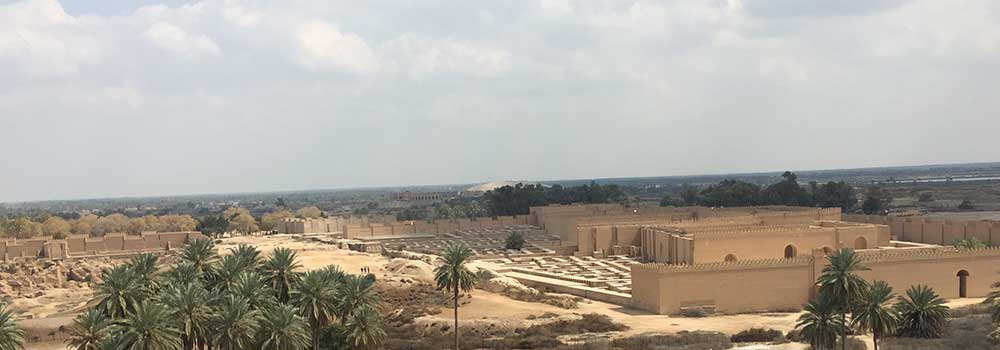
However, the true location and, indeed, the existence of the Hanging Gardens, apart from the many literary descriptions, is unknown. They serve as a reminder of the remarkable feats of building carried out in this area, while many other buildings, for example, the Ishtar Gate, the length of the Processional Way, temples, and others, have all been found. It was clearly a very impressive city, leaving a deep impression on many writers in later ages.
Babylonian Religion, Science, and the Final Years of Nebuchadnezzar’s Dynasty
As well as military conquest and impressive buildings, many other aspects played a significant part in Babylon and its history: religion, maths, astronomy and general learning. All were practiced to a great extent in and around the many temples throughout the land, by priests, scribes and other scholars, and all continued regardless of who may have been ruling at the time. Thus, in many ways, Babylon remained pre-eminent, even in times of relative political weakness.
It is hardly surprising that religion should be all-pervading, given the large number of deities to be worshipped and propitiated, covering all aspects of nature, man, and superhuman powers. Of these, Marduk became pre-eminent as Babylon’s power and prestige grew. He was the victor over the primitive forces embodied in the goddess Tiamat, and the creator of the universe as understood by the Babylonians, according to the long creation myth, the Enuma Elish. Thus, the king of Babylon would be representative of the gods on Earth, at the very heart of their world.
Many rituals, presents, and processions would take place over the days of the Akitu, or New Year festival, in honor of Marduk and to demonstrate and ensure the favor of the gods towards the ruler. There are obvious parallels between many later writings, notably the Old Testament, and Babylonian and other Mesopotamian stories and beliefs. Many may well be derived from common sources, and it would be unwise to assume direct copying in all instances.
Considerable skill was also achieved in mathematics. With a base-60 system, it was possible to do a considerable amount of complicated calculations with fractions and other problems, as many examples survive. One very well-known table of squared numbers relates to the sides and diagonals of right-angled triangles, as evidenced on the Plimpton 322 tablet. It is almost certainly from Babylonian origins that we divide 1 hour into 60 minutes and 1 minute into 60 seconds.
Considerable interest and skill were displayed in studying the stars and other bodies visible in the sky, and their various cycles and appearances. More and more use was made of mathematical techniques to forecast future events from the first millennium BC onwards. Much of this work would be continued by the Greeks and form the basis of much later work. So once again, learning continued to radiate out from Babylon well after the end of its sovereignty.
Various problems arose after Nebuchadnezzar died in 562 BC. His son Amel-Marduk succeeded him, but he seems to have been deposed and put to death after a reign of little more than 2 years. He was replaced by the general Neriglissar, son-in-law to the royal family, who reigned for about 4 years (560-556 BC) and carried out various military operations.
After his death, his young son Labashi-Marduk succeeded him, but a group of conspirators deposed him after a few months. They installed Nabonidus as king; he became the last of the independent kings of Babylon, reigning from 556 BC. He pursued various building schemes, including religious ones, but various difficulties arose during his time as king.
By the end of six years after Nebuchadnezzar’s death, there had been several new kings, murders, and other instabilities. All these pointed to weaknesses in the royal house and a general lack of firm government, which had prevailed for a long time under Nebuchadnezzar. It continued to be a great religious and intellectual center, but politically its position was very precarious. Persia and Cyrus the Great would loom larger still to the East, and in due course end the free existence of Babylon.
Nabonidus and the Fall of Babylon: How Cyrus the Great Conquered the Babylonian Empire
Nabonidus was king of Babylon between 556 and 539 BC, the last of a line of independent native rulers. He did not appear to be closely related to Nabopolassar, the original member of this dynasty to become king. Various regicides and rival claimants had followed over the preceding decades. He pursued building and temple restorations around the kingdom, but in all directions there were increasing signs of difficulties and threats to Babylon.

Considerable controversy has arisen over the degree to which Nabonidus worshipped the moon god Sin, and whether this went so far as to alienate many priests, particularly those of Marduk. It is difficult to know how far such hostility was warranted, not least because much information comes from sources hostile to Nabonidus or from his successors.
For a number of years, he chose to live away from the capital, at the distant oasis of Tayma in the northern Arabian desert, delegating many functions to his son Belshazzar. On what grounds he wished to do this is unclear and much debated, with a wide variety of religious, trading, political, and other military considerations advanced. It is certain, however, that the king’s absence from his capital figured largely in subsequent traditions of the last years of the kingdom. To the east lay the ever-increasing might of Cyrus and his Persians.
Cyrus had subdued much of Media and lands further afield, so he, too, could claim to rule a very large empire. Eventually, his ambitions and those of the Babylonians came into collision. The Nabonidus Chronicle describes battles with the Persians, notably at Opis, the subsequent fall of at least Sippar, and the eventual march of the victors to Babylon. There seems to have been no actual battle at the city itself, but there was considerable fighting earlier.
It was thought that various measures, such as diverting the course of the Euphrates, enabled the Persians to gain access to the interior of the city. Such was the apparent strength of Babylon’s defenses that this was an attractive suggestion as to how it might be conquered; but the Greek writers are all very late sources on this. From Babylonian sources, one gets the general picture of widespread defeat once key battles had been lost.
Cyrus wished to portray himself as pious and a restorer of correct practices in the temples. To this end, the so-called Cyrus Cylinder was found at Babylon in 1879. This extols his virtues and good relations with the gods, denounces the failings of Nabonidus and others in failing to fulfill their religious duties, and so forth. It would be mistaken to regard it as an objective statement of facts, but clearly it was designed to gain the maximum cooperation of at least sections of Babylonian society.
Thus, all native rule ceased in 539 BC. Far from being laid waste or deserted, however, Babylon continued to be a major city in western Asia under Achaemenid rule, with important religious and other intellectual activities. In many ways, therefore, Babylonian civilization survived the loss of its independence and of its last native king.
The Fall of the Babylonian Empire and Its Decline Under Foreign Rule
There were many factors lying behind the downfall of Babylon in 539 BC. A number of kings reigned in quick succession after 562 BC, the year of Nebuchadnezzar II’s death, amid various intrigues and rivalries, so that a general climate of insecurity prevailed. Such conditions were very undesirable for the ruler of so large a territory, in view of the need for firm government and sound political organization.
Various features of Nabonidus’ conduct and policies were held against him, notably his excessive interest in the cult of Sin, his long absence at Tayma, and his connexions with certain priestly groups. Many of these charges must be received with some reservation, since they appear in writings with an obvious pro-Cyrus bias. In any case, none would have availed against the steadily increasing power of the Persians, who by this time had subdued several other great states and were amply equipped to attempt further conquests.
The city and its surroundings survived the subjugation by Persia, and indeed formed one of the most prosperous districts of the Achaemenid Empire, owing no doubt to the fertile land and favorable geographical position. Very large quantities of business and other documents show that normal activities went on much as before.
Attempts to shake off the Persians were made more than once, at least under Darius I and Xerxes. There was thus still a strong body of opinion with distinct national or local feelings and desires. In spite of the revolts, the city clearly continued to enjoy high religious and other prestige, judging by the continued existence of many temples, much learning, and important economic interests.
It was natural that Alexander should march into Babylon once he had defeated Darius III in the great battle of Gaugamela in 331 BC, and he subsequently spent time there on other occasions in connection with his proposed conquests, ultimately ending. After his death there in 323 BC, there were prolonged rivalries and conflicts between the various leaders, ultimately ending with several large areas of the former empire falling under separate rule.
Babylon was now progressively eclipsed politically and commercially by Seleucia on the Tigris, which grew rapidly in size and significance. But there was no abrupt end to Babylon; temples and much learning persisted, and many other aspects of city life carried on for several hundred years.
Eventually political interests moved elsewhere, routes of trade altered, buildings deteriorated, and so on, all tending to reduce the size and magnificence of the city. It was thus relatively inconspicuous, though temples, palaces and other buildings lay in ruin over a wide area. All the same, there was much of value in Babylonian law, science, literature, religion and elsewhere, to be inherited by subsequent peoples and countries. So in many ways the old Babylonian empire lived on.


