
King Cnut the Great: The Conqueror Who Forged a North Sea Empire
 Reading Time: 33 minutes
 King Cnut was a Scandinavian conqueror who became one of the most powerful kings of the early 11th century. After seizing the English throne in 1016, he also became king of Denmark and, from 1028, king of Norway. His position also gave him influence over other parts of Scandinavia and the North Atlantic world. England became the richest part of a web of territories on both sides of the North Sea, which English Heritage has described as Cnut’s Scandinavian empire.
Cnut’s accomplishments were far removed from the popular conception of Vikings as raiders and pirates. He learned to govern using English institutions and worked with local nobles and the Christian Church as a European monarch. Historians often refer to his group of kingdoms as the “North Sea Empire,” although this is a modern name for a personal union of kingdoms, and not what Cnut himself called his territories.
How did a Viking conqueror establish such an extraordinary network of power?
The answer begins with the royal Scandinavian dynasty into which Cnut was born.
Born Into a Dynasty of Viking Conquerors
Long before King Cnut established what historians now call the North Sea Empire, he was born into one of Scandinavia’s most powerful royal dynasties. We do not know when Cnut was born. Most guesses suggest some time in the late tenth century, around the year 990, but the surviving sources do not permit historians to be sure. Nor is his birthplace certain. The surviving evidence makes it clear that Cnut was born into a dynasty already competing for power across Denmark and the wider Viking world. His family gave him both a claim to kingship and a tradition of conquest that would characterize his career.
His father was Sweyn Forkbeard, the Danish king who shifted Scandinavian power toward England. Sweyn became king of Denmark by the late tenth century and later led repeated campaigns against the English kingdom of Æthelred II. Medieval sources portray Sweyn as a formidable warrior-ruler, but details of his rise to power vary across sources. By 1013, Sweyn had done what no previous Danish attacker had managed to do permanently, by forcing Æthelred into exile and being accepted as king across England. Cnut therefore grew up in a family where kingship was secured not only through inheritance, but through military strength, alliances and the ability to win the loyalty of powerful men.

Behind Sweyn, Cnut had another important family member: his grandfather Harald Bluetooth. Harald ruled Denmark in the tenth century, and his kingship helped strengthen royal authority over a kingdom still coming together. The famous Jelling stone, raised by Harald, declares that he “won for himself all of Denmark and Norway and made the Danes Christian”. Historians treat such royal claims with some caution, particularly the extent of Harald’s authority over Norway. Yet the inscription provides remarkable contemporary evidence of a dynasty linking conquest, political unity and Christianity. Those ideas would later become central to Cnut’s own approach to kingship.
Very little reliable evidence survives for Cnut’s childhood. Later writers have attempted to fill in some of the gaps, but accounts written generations after his birth are difficult to separate from family legend. Cnut probably grew up in a Scandinavian royal household, where warfare, ships, gift-giving, political alliances, and personal loyalty were essential to power.
Christianity was also becoming increasingly important to Danish kingship during this period. It would therefore be misleading to imagine Cnut’s youth in a purely pagan Viking culture. He came from a society that was already changing, as Scandinavian rulers became more closely connected with Christian Europe.
The identity of Cnut’s mother remains uncertain. Medieval writers provide some clues, but historians have proposed different women, from Polish or other Slavic ruling families, without reaching any identification beyond reasonable dispute. This uncertainty reveals how little contemporary material survives from Cnut’s earliest years. We have much more information about his later career. By the time he first appears clearly in the historical record, however, he was no sheltered prince. He belonged to a dynasty accustomed to turning ships, armies, marriage alliances and royal ambition into political power. Across the North Sea, England would soon provide that dynasty with its greatest opportunity.
England Before Cnut: A Kingdom Under Viking Attack
England had strong royal institutions, regional government, taxation, and the ability to raise armies and fleets when Cnut began his conquest. It had faced decades of Scandinavian attacks before Cnut, which had placed the kingdom under great pressure. Æthelred II, known to history as Æthelred the Unready, had been king since 978. Scandinavian armies struck coastal communities and then penetrated inland, often finding that English commanders did not work together. The rivalries of the kingdom’s leading nobles also hampered resistance. By the end of the century, raiders returned with larger armies and greater ambitions.
England was wealthy and well organized, but its wealth and relatively weak defenses made it vulnerable to new expeditions. Æthelred’s government repeatedly attempted to buy off the attackers. England paid large sums of silver to Scandinavian armies in exchange for their agreement to stop attacking. Later historians often refer to these as Danegeld; the Anglo-Saxon Chronicle records a payment of £10,000 in 991, with larger sums paid in later years.
Buying off the attackers could be effective, but it was not a lasting solution. England’s wealth let its kings raise enormous payments through taxation, but it also attracted new expeditions. Viking leaders came to understand that England offered much more than portable treasure. It had prosperous towns, productive farmland, established taxes, and a royal government that might itself be taken.
Tensions came to a head on November 13, 1002, when King Æthelred ordered the killing of all Danes living in England, on St. Brice’s Day. The king’s own surviving charter records that the Danes were supposedly plotting to kill him and his advisers, but it is possible that this was only an excuse for an attack. The true scale of the massacre is unknown, and it is unlikely that Danes were killed in every part of the kingdom.
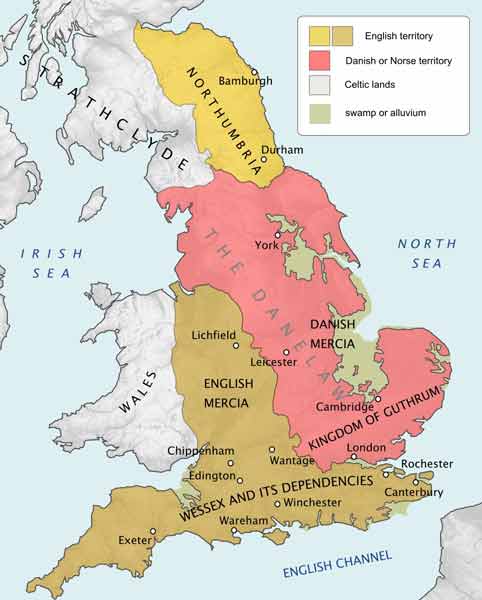
Large areas had substantial Scandinavian-descended populations, which made a kingdom-wide extermination unlikely and probably impossible. Archaeological discoveries have been connected with the massacre, but the accuracy of these claims is debated. Tradition later held that the massacre was one of the causes of Sweyn Forkbeard’s invasions, but Scandinavian attacks had already started well before 1002. It probably intensified an existing conflict rather than creating it.
Over the next decade, Sweyn Forkbeard and other Scandinavian leaders increased pressure on England. Raids were larger, longer, and increasingly political. Armies could winter in England rather than simply strike the coast and sail home. In 1009, the formidable Thorkell the Tall arrived with a major army that campaigned in southern England for several years. Canterbury was captured in 1011, and Archbishop Ælfheah was later killed by members of the Viking army after he had refused to allow a ransom to be paid for him. These campaigns showed that England’s defenses could be penetrated again and again despite the kingdom’s resources.
By 1013, Sweyn was no longer coming merely for tribute. He was returning with a campaign to take the English crown itself. Towns and regional leaders began submitting as his forces advanced, and Æthelred’s own political position was now collapsing. This was a crucial change in the conflict. What had begun as renewed Viking raiding decades earlier was becoming a war over control of England. Sweyn’s son Cnut was with this expedition and first entered the historical record in the context of a royal conquest. The dynasty that was eventually to create the North Sea Empire was about to win its first English crown.

Sweyn Forkbeard Conquers England
Sweyn Forkbeard’s invasion of 1013 proved impressively rapid. His forces first arrived at Sandwich before heading north to the Humber and the River Trent. The Anglo-Saxon Chronicle records that Northumbria, Lindsey, and the Five Boroughs submitted to him. They provided hostages as sureties of their good behavior. Sweyn then advanced south, leaving ships and hostages in his son Cnut’s care while he campaigned through the central and southern parts of the country. The expedition was now operating as something very different from a raiding army. Sweyn was receiving submissions from communities and political leaders as a king laying claim to the country as his own.\
London put up a stronger resistance. Æthelred was present in the city, and he was now joined by Thorkell the Tall, who had entered the English service. Sweyn initially failed to take the city, and moved west instead. Oxford and Winchester submitted, and then much of southern England did too. As resistance crumbled, London eventually followed suit, and the Anglo-Saxon Chronicle records that Sweyn was now recognized “by all the nation as full king.” Medieval political allegiance was not always fixed, but the statement certainly conveys the scale of Æthelred’s collapse. After more than thirty years as king, the English monarch fled with his family into exile in Normandy.
Sweyn’s victory left his son Cnut in a unique position. The young prince had played a part in the campaign that had made his father king of England. Surviving sources tell us little about his personal role in the invasion, but the later Encomium Emmae Reginae, a work composed with the purpose of praising Queen Emma and her family, gives Cnut a significant part in his father’s expedition. Historians must handle this source carefully, not least because it was written decades after the events it describes and has clear political purposes. Nevertheless, Cnut likely gained direct experience in campaigning, negotiation, and the political geography of England.
The conquest then foundered very suddenly. Sweyn died on February 23, 1014, just a few weeks after he had secured the kingdom. His death left England with no settled English succession. The Scandinavian fleet agreed to take Cnut as king, but leading English nobles then invited Æthelred to return from Normandy, and took pledges of better government from him. Cnut’s first opportunity to rule England was slipping away almost as fast as it had arrived. Sweyn had shown that England could be conquered. Now his son had to show he could do it again.
Cnut’s First Attempt to Claim the English Crown
The Scandinavian army had pledged itself to Cnut in 1014, but he was not, in practice, king of England. English political figures had not lost the power to make decisions, and many wanted Æthelred restored to the rule of Sweyn’s young son. The Anglo-Saxon Chronicle says that Æthelred would be a “more gracious lord” if his people would receive him again. He landed from Normandy during Lent, and English armies were soon in the field against Cnut. The young Dane was on the defensive without his father’s personal authority and the wide-scale submissions Sweyn had taken from the people of England.
Cnut was not about to stay and face destruction. As he retreated, however, the Anglo-Saxon Chronicle includes a notorious episode. Sweyn had taken hostages from English communities during his conquest of the previous year. Cnut reportedly gathered up these captives at Sandwich, cut off their hands, ears and noses and then left them to die. The episode is in a near-contemporary English chronicle with obvious hostility to Scandinavian invasion, and it cannot be accepted at face value. There is no reason to think it is a pure fabrication. If true, it does show that Cnut’s later image as lawgiver and Christian ruler was built on a violent start.
The defeat was serious, but not fatal. Cnut returned to Scandinavia, where he could mobilize his family’s political connections and military resources. Sources disagree on some details of his movements. Later Scandinavian traditions add colorful episodes, but not all of them are confirmed by contemporary evidence. The essential point is that Cnut did not give up his claim. Instead, he planned another invasion that could overcome Æthelred’s kingdom rather than rely on the political settlement his father had left behind.
The 1014 campaign may have taught Cnut a vital lesson. Military strength alone would not secure an English crown. A conqueror required ships and warriors, of course, but he also needed allies, hostages, money, political defections, and some part of the English elite to do more than just hold his conquest. When Cnut returned in 1015, he would come with a powerful army and pursue the throne in his own name. The young prince who had fled England was now beginning the campaign that made him king.
The Great Invasion of 1015
Cnut returned to England in 1015 with a fleet set upon conquest. The Anglo-Saxon Chronicle sets his landing at Sandwich and notes his movements around the coast towards Wessex. Later accounts provide grandiose numbers for the size and magnificence of his ships, but the precise details of Cnut’s fleet cannot be verified with any certainty. It is certain, however, that he was in command of a large Scandinavian army. Experienced warriors formed part of Cnut’s army, drawn from a world in which military service might bring silver, land and status.
England was already divided. Æthelred’s son Edmund, later known as Ironside, had quarreled with the powerful noble Eadric Streona and established his own political base in the north of England. Eadric then switched sides and joined Cnut, providing ships and men. Changing sides of this kind was significant. Cnut was not leading foreigners against a unified English population. Cnut’s invasion was becoming embroiled in rivalries between elements of England’s own aristocracy. Englishmen would fight on both sides.
Cnut’s forces moved through Wessex and then struck north into Mercia. Cnut’s army could move, forage, and ravage territory while forcing local leaders to choose between resistance and submission. The Anglo-Saxon Chronicle records campaigns across several regions as the English sought to coordinate a coherent response. Æthelred’s worsening health did not help. Royal authority was fragmented at the moment England faced one of the most perilous invasions of its history.
By the start of 1016, Cnut’s invasion was becoming a contest for the whole of the kingdom. His army was in northern England, while Edmund mobilized support against him. York and other key centers became embroiled in the conflict. The war was now about more than whether Viking armies could extort tribute from English kingdoms. Two rival political groupings were fighting to decide who would govern England. When Æthelred died in April 1016, that contest narrowed to a remarkable contest between Cnut and Edmund.
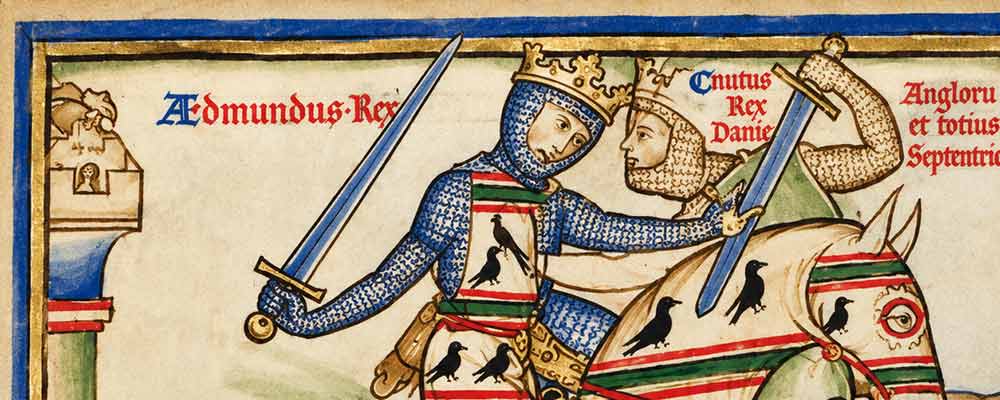
Edmund Ironside: Cnut’s Greatest Rival
Æthelred died in London on 23 April 1016 after a reign of just under thirty-eight years. His death did not resolve the succession. London’s citizens and political community seem to have supported his son Edmund, but another group of leading men now declared their support for Cnut. England had two rival kings, and both were able to summon armies and regional support. Cnut had the numerical advantage of the powerful invasion force which had come from Denmark in 1015–1016. Edmund, on the other hand, was a forceful opponent and came to be known later by the epithet “Ironside” for his reputation for resistance.
The Anglo-Saxon Chronicle gives a rapid account of a series of campaigns in 1016, as Edmund rapidly raised successive armies to take the field against Cnut. Battle was joined at Penselwood in Somerset and at Sherston in Wiltshire, but the outcome of neither was decisive. Edmund then forced the surrender of London while Cnut’s forces attempted to hold the city. The chronology of the fighting reveals a quickening pace. Both sides understood that political allegiance could rapidly switch to the victor after a major battle or surrender.
London was particularly important. It was a wealthy trading center and royal stronghold, a place of significant political authority. Cnut’s forces now attempted to isolate the city. But Edmund’s ability to continue to take the field denied a quick victory. The war now raged through southern England, as armies maneuvered through a landscape already ravaged by years of invasion. The terse account of the Anglo-Saxon Chronicle has little to say beyond the fact of battle. But its very insistence on a sequence of fighting reveals how bitterly contested the crown was. So bitterly, in fact, it would come down to one decisive battle.
The Battle of Assandun and the Conquest of England
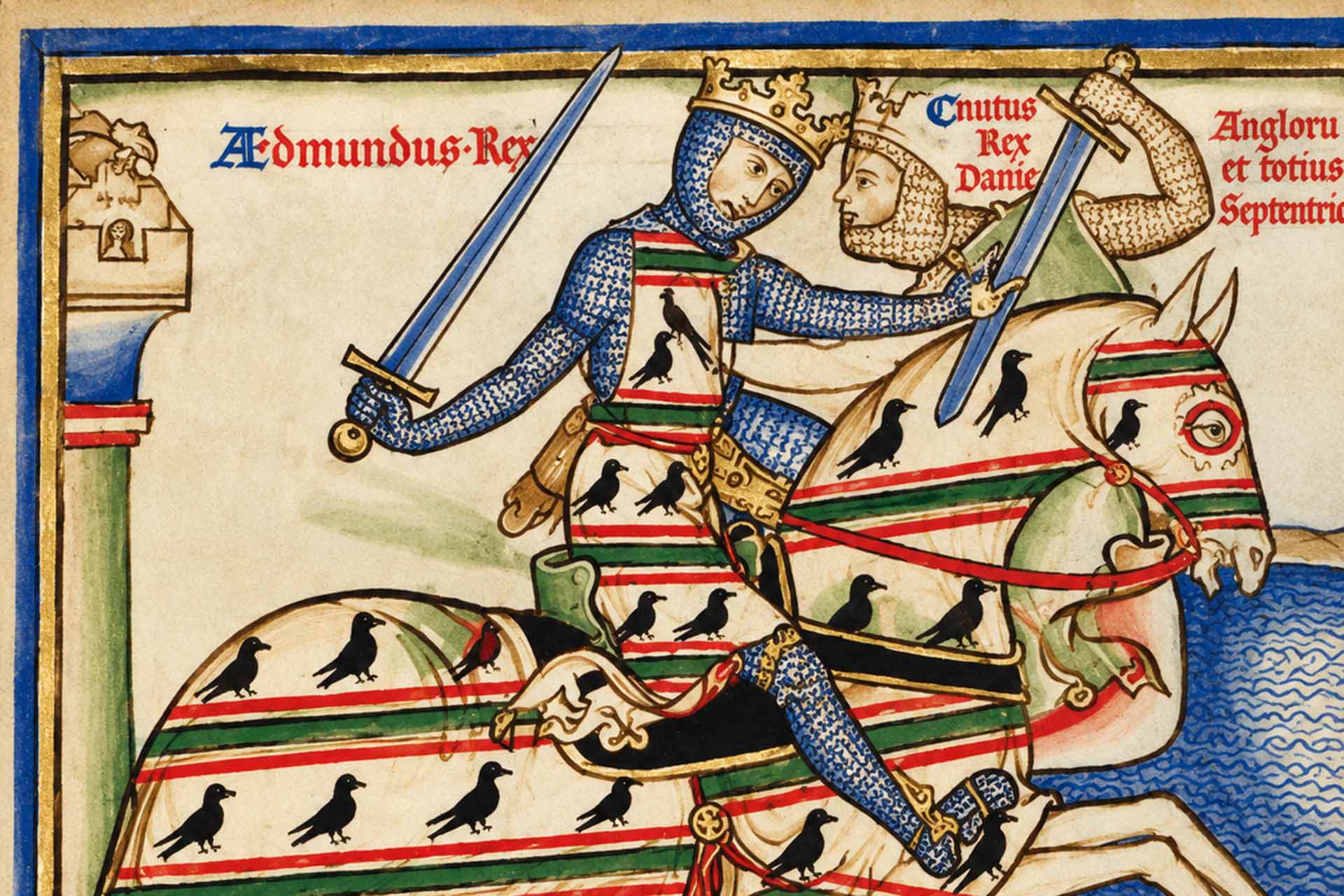
Assandun changed the balance of power. A number of senior English figures had been killed, including Ealdorman Ulfcytel and a number of other men named by the Anglo-Saxon Chronicle. Cnut had at last won the sort of battlefield victory that was needed to force a negotiation. But Edmund still retained enough support that further warfare would drain both sides. Rather than a last, uncertain campaign, the two kings met and settled their differences.
The two kings divided the country. The sources differ in some of the details, but Edmund seems to have retained Wessex while Cnut took control of territory north of the Thames. The arrangement amounted to a mutual recognition of the other as king. Later accounts also state that the settlement specified what would happen if either ruler died. Modern historians should be skeptical of determining precise terms from later narrative accounts, but the division itself is well attested.
The settlement was short-lived. Edmund died on November 30, 1016. His cause of death is unknown. Later medieval writers have provided lurid stories of murder, including a famous account that he was killed while using a privy, but there is no contemporary evidence for this sort of account. His death ended the last credible English challenge to Cnut’s power. The political assembly accepted Cnut as king, and by 1017 he controlled all of England.
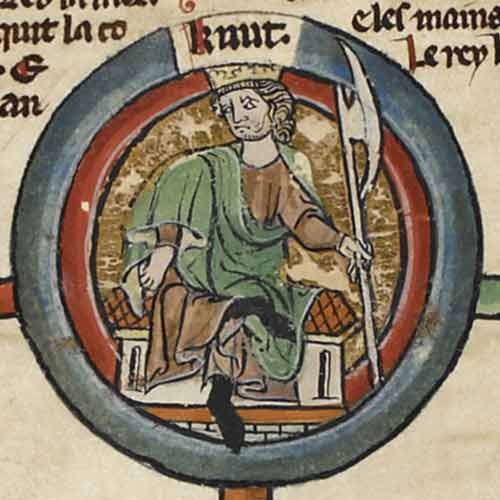
Cnut had done what his father had only managed temporarily. But gaining the kingdom raised a new issue. England was not territory to be plundered. It was a sophisticated polity with bishops, nobles, shires, courts, taxes, mints, and long traditions of Christian kingship. If Cnut wanted to keep his crown, he needed to shift from commander of an invading army to a king whose rule English institutions would uphold.
The first years of Cnut’s kingship combined reconciliation with ruthless political security. The country was divided into large regional commands, and Cnut put trusted men in charge of strategically important areas. Some were Scandinavian associates, while others were English nobles willing to work with the new regime. It was a practical response to conquest. Cnut could not personally rule every area of the country, and his power was only as strong as his local deputies.
At the same time, potential enemies were dealt with. In 1017, Cnut ordered the killing of Eadric Streona, even though Eadric had supported his cause. Other leading figures were executed, exiled, or pushed from power. Reconstructing the precise motives in every case is difficult, but the pattern is clear. Cnut eliminated men whose dynastic connections or personal ambitions might threaten his new throne. His road to stable kingship was not peaceful.
Cnut also had to find a way to accommodate the enormous Scandinavian army that had won England for him. In 1018, a vast payment was raised to reward and dismiss much of the fleet. The Anglo-Saxon Chronicle says England raised £ 72,000, with an extra £10,500 from London. These are eye-watering figures that demonstrate the extraordinary fiscal capacity of the English state, even if medieval accounting must always be handled with care. A much smaller force remained with the king.
The assembly at Oxford in that same year helped establish the basis of Cnut’s political settlement. An early English law code records that Danes and English agreed to observe the laws associated with King Edgar. Archbishop Wulfstan of York played an important role in shaping Cnut’s laws. Rather than discard England’s legal traditions, the conqueror embraced them. This accommodation was a major step in turning military victory into legitimate government.
Emma of Normandy provides Marriage of Power & Transformation Into an English King
One of Cnut’s most significant political acts was his marriage in 1017 to Emma of Normandy. Emma was a particularly high-status bride. She was the widow of Æthelred II and the sister of Richard II, duke of Normandy. By marrying England’s former queen, Cnut could tie his new regime to the dynasty he had overthrown, while also improving relations with Normandy itself, where two of Æthelred’s sons had been welcomed.
The marriage made succession even more complex. Emma already had children by Æthelred, including the future Edward the Confessor and Alfred Ætheling. They remained outside Cnut’s immediate regime. The king and queen later produced children of their own, including Harthacnut and Gunhilda. England’s political future now involved several branches of a single extended royal family all with claims to make.
Cnut had also had a long-term partner in Ælfgifu of Northampton. A woman from a significant English family, their union produced at least two sons, Svein and Harold Harefoot. Medieval marriage customs and terminology make their exact legal relationship to Cnut difficult to categorize with modern terms. One certain fact is that she predated Emma and remained politically important throughout her life.

Emma herself would be a major political presence at Cnut’s court. The later Encomium Emmae Reginae was commissioned on her behalf and presents events in a way designed to vindicate her actions and her children’s positions. It is therefore invaluable but partisan evidence. Cnut’s marriages illustrate how important dynastic politics could be as well as battle. A conqueror who had taken England with an army would now use family connections to justify his attempt to keep it.
Having disposed of his immediate rivals, Cnut increasingly governed through the institutions he had inherited. England was already one of the most developed royal governments in northern Europe. Shires, local courts, royal officials, taxation, written law, and a network of mints gave the king tools Scandinavian rulers could rarely match. Destroying this system would only have weakened Cnut himself.
Cnut’s legislation demonstrates the point. The Oxford Agreement of 1018 saw Cnut accept Edgar’s laws as the starting point for government. His later law codes drew extensively on earlier English legislation, especially material associated with the reign of Æthelred. Archbishop Wulfstan of York appears to have played a central role in their composition. He was presenting his government as a continuation of legitimate English kingship rather than a permanent foreign occupation.
The king also depended increasingly on English aristocrats. Godwin, who would eventually become Earl of Wessex, rose dramatically during Cnut’s reign and would become one of the kingdom’s most powerful figures. Scandinavian leaders remained significant, but the king could not rule successfully without local elites’ cooperation. Patronage let him build a political class whose fortunes were now tied to his regime.
By the 1020s, the king’s public image had changed significantly. He still commanded warriors and fleets, but royal documents now presented him as a defender of law, Christianity, and social order. Cnut’s transformation was not sentimental but practical. English traditions gave his conquest legitimacy and provided machinery for its government. The Viking invader had not become a different person or stopped being a Scandinavian ruler. He had learned how to be an English king as well.
The Viking King Becomes a Christian Monarch
Christianity was central to Cnut’s claims of legitimate kingship. The family had converted before their conquest of England, but to rule a kingdom so invested in the faith, a show of support for the Church was necessary. Cnut patronized bishops, gave gifts to religious houses, and associated himself with saints and holy places. He thereby placed himself within a long tradition of Christian English kingship.
Archbishop Wulfstan of York was especially important. Wulfstan had served Æthelred and then collaborated with the man who had conquered his kingdom. The archbishop’s involvement in Cnut’s legislation shows how ecclesiastical expertise was quickly leveraged in the service of a new dynasty. The laws promoted church dues and tithing, fasting, moral conduct, and the protection of religious institutions as well as secular order.
Religious patronage could also address the problems raised by conquest and violence. At Assandun, the place where he had defeated Edmund Ironside, Cnut founded or endowed a church dedicated to the commemoration of the battle. This medieval link between victory, repentance, and religious patronage was not uncommon among European kings. It should not be pressed into modern conceptions of guilt or remorse, but it did present Cnut’s rule within a Christian understanding of kingship.
Cnut’s Christianity did not eliminate Scandinavian political culture. He still relied on his warriors, his ships, personal loyalty, and conspicuous wealth. Instead, these elements existed alongside Christian kingship. That combination made his government effective on both sides of the North Sea. Cnut could present himself to Scandinavian elites as a successful warrior with the spoils to prove it. To English clergy and other European rulers, he offered a far more traditional and legitimate image.
Cnut’s transformation was on display most clearly in 1027 when he made a trip to Rome. The journey placed him among the political and religious elite of Christian Europe. He attended the imperial coronation of Conrad II, whom Pope John XIX crowned Holy Roman Emperor. The Danish king’s presence signaled that the former Viking invader now moved in the highest circles of European monarchy.
The trip is associated with a remarkable letter that has survived. Cnut introduced himself to his English subjects as the king of “all England, and of Denmark, and of the Norwegians, and of part of the Swedes.” The language offers rare contemporary evidence for the extent of his claimed authority at this stage in his rule. He explained that he had traveled to Rome to pray for the welfare of the people under his rule.
Cnut also described his meetings with Pope John XIX, Emperor Conrad, and other rulers. The king wrote that he had negotiated benefits such as lower tolls and safer passage for merchants and pilgrims traveling from his lands toward Rome. The reality of every benefit is difficult to measure, but the letter reveals the image the king wanted to project to his English subjects: he was a ruler who could use international diplomacy for their benefit.
In that way, Rome meant far more than personal pilgrimage. Cnut showed that his authority belonged in Europe’s Christian political order. Only a little more than a decade earlier, he had arrived in England with an invading fleet. Now he stood alongside an emperor at Rome while laying claim to several kingdoms. Few episodes better illustrate the scale of his political transformation.
Denmark: King Cnut’s Second Crown Lays the Groundwork for the North Sea Empire
England was only the first step in Cnut’s larger monarchy. His brother Harald II had succeeded Sweyn Forkbeard as king of Denmark, but he died without a known surviving heir. Chronology is uncertain, but Cnut seems to have secured the Danish throne by 1018 or 1019. He now ruled large kingdoms on both sides of the North Sea.
Denmark held particular significance for Cnut. It was his family’s dynastic heartland and source of royal legitimacy. Yet England had richer fiscal and administrative resources. Holding both crowns let Cnut draw on different sources of strength. English silver and military manpower could support Scandinavian campaigns, while his kingship in Denmark also gave his rule in England a wider dynastic basis.
Ruling two kingdoms meant travel and deputies. Cnut could not remain in England and expect Denmark to run itself. One of his surviving letters of 1020 was addressed to an earl named Thorkell during one of Cnut’s Danish absences, promising good government and reminding English subjects of their obligations. It is direct evidence of a king administering realms across the sea.
England and Denmark formed the core of the North Sea Empire. Yet Cnut had not forged a centralized state. Each kingdom had its own laws, elites, customs, and political institutions. Their union rested above all on one monarch. That arrangement could be the source of great power when Cnut was strong, but would later be difficult for his successors to maintain.
Cnut’s rising power alarmed other Scandinavian rulers. Olaf Haraldsson of Norway and Anund Jacob of Sweden had good reason to resist a king who already controlled both Denmark and England. Their resistance led to warfare in the 1020s, when control of Scandinavian trade routes and political allegiance became part of a larger struggle for regional dominance.
One of the most famous encounters was the Battle of the Helgeå, generally dated to around 1026. Sources are later and provide conflicting descriptions. The location, sequence of events, and outcome of the battle remain matters for debate among historians. Scandinavian saga traditions, written much later, add colorful detail that cannot simply be treated as eyewitness reports. What is clear is that Cnut survived the challenge and retained control of Denmark.
Cnut had resources his rivals found difficult to match. England could provide wealth, ships, and men, while Denmark gave him a strategic base in Scandinavia. Military power was only part of his approach. He could also distribute money, cultivate dissatisfied nobles, and build alliances inside rival kingdoms. Those tools became especially important in Norway.
The conflict demonstrated how Cnut’s English conquest had transformed Scandinavian politics. England was no longer simply a destination for Viking expeditions. A Scandinavian king now used England’s wealth to shape events in Scandinavia itself. Cnut’s empire was beginning to operate in both directions across the North Sea.
The Conquest of Norway & Forging the North Sea Empire
Cnut’s most important Scandinavian conquest followed in 1028. Sailing to Norway, Cnut brought a large fleet and an army. In the years before his arrival, he had already undermined the Norwegian king Olaf Haraldsson’s political position. Norwegian nobles were dissatisfied with their king, and Cnut had means to encourage them to move against him. For one, his wealth as king of England and Denmark provided powerful patronage.
Olaf fled Norway as Cnut’s position grew stronger. Cnut accepted the Norwegian crown. Norway sat atop an impressive pile of crowns: England, Denmark, and now Norway too. The moment of conquest placed him at the peak of his power. His rule stretched across much of the North Sea world. His government in England and Denmark was real. In other parts of Scandinavia, however, Cnut’s claims were looser, especially in parts of Sweden and beyond, and should not be confused with actual governance.
Cnut initially used Håkon Eiriksson to rule Norway. But Håkon’s accidental death at sea soon became a significant problem. Cnut later gave authority in Norway to his son Svein and Svein’s mother, Ælfgifu of Northampton. Later Scandinavian traditions say their rule became unpopular. These sources must be read with care, however, because many were written long after the events they describe.
Norwegian resistance was soon renewed. Olaf returned to Norway in 1030 but was killed at the Battle of Stiklestad. Olaf’s death did not bring permanent security to Cnut’s dynasty. Olaf’s reputation as a saint grew quickly after his death. This increased the power of the king Cnut had displaced in memory. Norway exposed a potential weakness in Cnut’s political system. He could secure a crown through conquest but not necessarily command political loyalty from across the sea.
At its height, Cnut’s monarchy included England, Denmark, and Norway, with claims or influence in parts of Sweden and the wider Scandinavian world. Many modern historians call this collection of territories the “North Sea Empire.” Cnut himself never used that name. It is a useful modern description, but it can create a false impression if imagined as a single, centralized state under a single government.
The reality was more flexible than that. England was still governed through English laws and institutions. Denmark kept its Danish political culture and traditions. Norway also had its own local elites and political assemblies. Cnut ruled each kingdom differently, through relationships with local leaders. The kingdoms of his monarchy shared a monarch; they lacked a uniform or shared administration. Historian Timothy Bolton has described Cnut’s achievement as an Anglo-Danish regime built through a network of deliberate international connections.

The sea itself made this flexible arrangement possible. Modern readers consulting maps may see England and Scandinavia as separate landmasses divided by the North Sea. For Cnut, the North Sea was also a route. Ships brought armies, messengers, merchants, silver, royal officials, and the king himself between his territories. Maritime power connected Cnut’s territories rather than simply dividing them.
Cnut had therefore reshaped the geography of Viking expansion and settlement. Scandinavian armies had earlier crossed the sea to raid, settle, and demand tribute. Cnut used the same maritime networks to rule. For a brief time, England was part of a political system oriented as much toward Denmark and Norway as toward continental Europe. Oxford scholarship has described Cnut’s realm as something closer to a North Sea empire, with England and Denmark especially closely connected.
How Cnut Ruled an Empire Across the Sea & The Wealth Behind Cnut’s Power
Distance defined Cnut’s monarchy. A medieval king could not give an order in Winchester and expect it to arrive in Denmark at the same time. Ships could be delayed by weather; winter limited travel on land. Above all, a long absence gave ambitious nobles the opportunity to build their own power. Cnut needed trusted men who could manage while he moved between his kingdoms.
Earls played an important role in England. Godwin and Siward were powerful figures who wielded considerable regional influence, while royal officials handled the ordinary business of taxation, justice, and administration. Cnut did not create this machinery. He took over a strong English state and modified it to suit a ruler whose interests and ambitions extended far beyond England.
Government in Scandinavia worked differently. Local assemblies and aristocratic networks mattered, and Cnut often used deputies connected to regional elites. Personal relationships were key. A king was always distant, but one whose authority was challenged needed to have it accepted by influential men with the power to persuade, or, if necessary, force, others to accept.
That is also why the North Sea Empire was both impressive and fragile. Cnut’s achievement was to hold several different political systems together without making them identical. His presence, reputation, wealth, and family connections held it together. It was a remarkable arrangement, and for much of his reign it worked. But whether it could survive him was another question.
In one vital respect, England gave Cnut an advantage few Scandinavian rulers could match: access to a wealthy, highly organized tax system. Anglo-Saxon kings had developed the means to raise large sums of money when Viking threats were at their greatest. Conquest turned the machinery that had been used to pay for war against Scandinavian armies into a resource that their Scandinavian king could use for his own ends.
The huge payment of 1018 demonstrates that capacity. England could produce silver on a scale that could reward armies and buy political loyalty. Cnut would later use this wealth as part of his Scandinavian strategy. Medieval sources talk of him buying support in Norway, but such payments were not simply crude bribery. Gift-giving and the purchase of rewards were normal parts of medieval politics, providing bonds between warriors and nobles on one side and rulers on the other.
England also had a sophisticated coinage system. Royal mints produced standardized silver pennies stamped with the king’s name and image. Cnut kept this system going rather than replacing it with a Scandinavian alternative. English coins traveled widely and are found in large numbers in Scandinavian hoards, the product of deep economic links criss-crossing the North Sea.
Ports and trade further strengthened those links. Merchants traded wool, metalwork, foodstuffs, luxury goods, and silver through maritime trading networks that predated Cnut. His political achievement was to place several important parts of that trading world under one ruler. Armies built the North Sea Empire, but its endurance also depended on taxes, coins, ships, commerce, and the ability to turn wealth into loyalty.
Tale about King Cnut Commanding the Tide & Final Years
No single story about Cnut is better known than the one about the king who tried to stop the tide. In its most popular versions, “King Canute” sits on the shore and orders the sea to halt its advance. The waters mock him, soaking the haughty king and exposing the folly of his pretensions. That version gets things precisely backward and misses the point of the earliest surviving account.
The story appears in Henry of Huntingdon’s Historia Anglorum, written in the twelfth century, about a century after Cnut’s death. Henry records that Cnut set his throne by the sea and commanded the incoming tide to turn and respect his authority. When the water disobeys and climbs up over the king’s chair, Cnut uses its failure to make his point: that earthly kings have only limited power in comparison to God.

The episode’s point is to show Cnut as a humble man rather than a deluded one. And it is not contemporary evidence. No source from Cnut’s lifetime appears to record the episode, so we cannot know whether it actually happened. Henry was writing moral history, and his memorable stories illustrated his points about kings and the divine order.
The episode still tells us something important about Cnut’s later reputation. A Scandinavian warrior and conqueror had come to be remembered as a paragon of Christian kingship, a man capable of understanding the limits of earthly authority. Oxford research suggests that the tide episode is part of a larger body of post-Conquest stories that portrayed Cnut as a pious patron. The legend may not tell us much about what happened on a beach in England, but it tells us much about how medieval writers wanted to remember him.
By the early 1030s, Cnut was at the high point of his prestige. He held the crowns of England and Denmark and claimed Norway’s throne. His authority extended further into Scandinavia than his predecessors had managed to maintain. Nevertheless, the apparent solidity of the North Sea Empire disguised several unresolved issues. Norway remained an unruly territory that was difficult to control, and Cnut’s succession plans included sons from different unions.
Some of his sons had already been given significant roles. Svein ruled Norway alongside Ælfgifu of Northampton, while Harthacnut, Cnut’s son by Emma, had a connection to Denmark. Harold Harefoot, another son of Ælfgifu, also remained a possible claimant to some of the kingdoms. Such arrangements allowed Cnut to maintain control over distant territories, but they also created multiple dynastic centers of power.
Cnut died at Shaftesbury in Dorset on November 12, 1035. The cause of his death is uncertain. No contemporary source reports a definitive diagnosis or an exhaustive description of his final illness. He was probably only in his forties, though uncertainty about his birth date makes an exact age impossible to calculate. His body was taken to Winchester, one of Anglo-Saxon England’s great royal and ecclesiastical centers, and buried there. Later reordering and rebuilding of Winchester Cathedral disturbed and rearranged royal remains, making precise identification difficult.
His death left the empire reliant on one man, something that had not been the case for most of the preceding two decades. Cnut had navigated dynasties, aristocrats, churches, armies, and kingdoms. No single imperial office or administrative system would automatically transfer intact to one heir. The North Sea Empire had weathered Cnut’s absences. Surviving Cnut himself would prove much harder.
The North Sea Empire Fractures & the Road to 1066
The question of succession was immediately reopened at Cnut’s death. Harthacnut had a strong claim as Cnut’s son with Queen Emma, but he was based in Denmark. In England, Harold Harefoot established his power and was eventually accepted as king. The competing claims of Harthacnut and Harold became a struggle in which the divisions of a family were also divisions in political loyalties.
Norway had already begun to slip away. Magnus the Good, son of Olaf Haraldsson, became king in 1035, restoring a native dynasty. Cnut’s hold on Norway had rested on political relationships that his heirs could not continue to reproduce. One of the largest pieces of the North Sea Empire, therefore, began to dissolve almost immediately after Cnut’s death.
Harold Harefoot died in 1040, and Harthacnut was able to become king of England in addition to Denmark. For a time, the crowns were reunited. Harthacnut’s reign in England was short, and he was unpopular in later English tradition, which especially resented the heavy taxation that he employed to maintain his fleet. He died suddenly in 1042, and had no known legitimate heir.
Edward the Confessor, son of Æthelred and Emma, became king. The English crown returned to the dynasty that Cnut’s family had replaced. Within seven years of Cnut’s death, much of his great political structure had been dissolved. The speed of its collapse did not mean that the empire had been a mere imaginary construction. Rather, it showed that medieval unions of kingdoms could be particularly dependent on the authority and personal relationships of a single ruler.
Cnut’s reign transformed the royal family that ruled England in the decades before 1066. The key figure is Emma of Normandy, who had been queen to both Æthelred and then to Cnut, and who had children with both kings. Her sons thus represented competing dynastic lines within the same family network.
Harthacnut’s death in 1042 left the way clear for his half-brother Edward the Confessor to become king. Edward had spent much of his early life in Normandy after Cnut’s conquest, and his return brought the West Saxon royal line back to the throne. But Norman connections remained important in his court. Meanwhile, Earl Godwin, whose own rise to power had taken place under Cnut, became the most important English nobleman.
Godwin’s son Harold Godwinson eventually succeeded as king after Edward’s death in January 1066. William, duke of Normandy, challenged his claim, while Harald Hardrada of Norway led an invasion based partly on Scandinavian claims and agreements that had developed in the decades after Cnut. The world of 1066 was thus linked in several ways to the political upheavals of the previous half-century.
Cnut did not “cause” the Norman Conquest, and 1066 was not an inevitable consequence of his reign. But his dynasty tied England more closely into the politics of Normandy and Scandinavia. His conquest also showed another truth: a powerful foreign ruler could seize the English crown by combining military victory with domestic political support. In 1066, England would be faced with that reality once more.
Cnut the Great: Viking Conqueror and Architect of a North Sea Empire
Describing Cnut as a Viking king is both right and reductive. He came from the Scandinavian martial elite that had attacked England for generations. He took the throne through invasion, naval might, and martial triumph. After initial failure, Cnut launched a second invasion, overcame Edmund Ironside, and was crowned king of England in 1016. In little over a decade, his rule stretched across England, Denmark, and Norway. No previous Viking conqueror had claimed undisputed rule of England and Scandinavian kingship on such a scale.
However, Cnut’s lasting success came after the fighting ended. The monarch of the 1020s was far more than a Viking warrior wearing an English crown. He preserved English institutions, promulgated law, maintained the kingdom’s coinage, worked with bishops and native nobles, and championed the Christian Church. The settlement of 1018, which upheld traditional English law, exemplifies how Cnut chose adaptation over outright imposition of Scandinavian rule. By governing the society he had conquered, Cnut turned a military victory into a remarkably stable reign.
Cnut was part of a broader, changing European world. He journeyed to Rome in 1027, developed ties with other leading Christian monarchs, and presented himself as a legitimate ruler rather than a foreigner seizing England. At the same time, ships, warriors, personal loyalty, and Scandinavian political networks were critical to his power. Cnut therefore straddled two worlds. Warrior kingship and Viking conquest coexisted with Christianity, written law, taxation, diplomacy, and established royal government. In his work on Cnut, historian Timothy Bolton has examined this shift from Scandinavian conqueror to a more Anglo-Saxon style of kingship.
The nature of the North Sea Empire itself reflected this mixture. England, Denmark, and Norway were not provinces of a centralized state. Each had its own laws, customs, political institutions, and powerful elites. Cnut held the territories together through dynasty, wealth, military power, diplomacy, and his personal authority. The North Sea linked these lands, allowing ships to carry rulers, armies, silver, merchants, and messages between them. For a time, Cnut turned maritime routes previously associated with Viking raids into the basis of an international monarchy.
The system’s fragility became clear when Cnut died in 1035. His successors could not sustain the political balance he created. Norway slipped away, while disputes between Harold Harefoot and Harthacnut complicated the English succession. Harthacnut briefly reunited England and Denmark, but his death in 1042 opened the throne to Edward the Confessor. Cnut’s North Sea Empire was largely gone within seven years of its founder’s death.
The system’s short life should not diminish Cnut’s achievement. He started his campaign for England as a Scandinavian conqueror and finished as one of northern Europe’s most powerful Christian kings. His career explains why the end of the Viking Age cannot be tied to a simple disappearance of Viking warriors. Men like Cnut transformed conquest into kingship and integrated themselves into the political order they had once attacked. His empire did not last beyond him, but Cnut’s reign is one of the most remarkable moments when the histories of Viking Scandinavia and medieval England became inseparable.


