From Murder to Mea Culpa: Thomas Becket’s Martyrdom and Henry II’s Reckoning
 Reading Time: 24 minutes
 The murder of Thomas Becket within Canterbury Cathedral on December 29, 1170 sent shockwaves throughout medieval Europe. An archbishop had been slain within one of England’s holiest sites by knights who were, in some way, acting on behalf of the king. The act turned a vicious political conflict into an act of sacrilege and posed a question that continues to color Becket’s story today: just how culpable was Henry II for the violence that had been committed in his name?
The path to Canterbury had begun with friendship, trust, and royal favor before falling apart into exile, threats, and open defiance. Becket’s death turned a controversial churchman into a martyr and a king into a public object of outrage, papal bullying, and fear of divine retribution. This article traces that journey from alliance to rupture, from murder to sainthood, and finally to the king’s momentous public penance at Becket’s tomb.
Thomas Becket Before the Rift
Thomas Becket was born in London around the year 1118, the son of a wealthy and influential Norman merchant family. In London, his father Gilbert was prominent in the city’s commercial society, and he could offer his son a life beyond the reach of the vast majority of his contemporaries. He was a clerk, but he did not come from one of the most powerful noble families. However, in his family connections and his career, he was able to bridge urban, clerical, and royal society in a way that was unusual in his day.
Becket was educated in London and spent some time in Paris, acquiring the learning and culture expected of an ambitious churchman and administrator of the period. He was able to use these skills to enter the household of Theobald, Archbishop of Canterbury. He worked and studied under Theobald, being exposed to diplomacy, canon law, and the complex politics of the English Church. Theobald entrusted him with missions, and through him, Becket was able to be introduced to the wider world of royal government.
In 1155, Henry II made Thomas Becket his royal chancellor. In that post, he was one of his most effective servants, dealing with records, royal revenues and accounts, negotiations with others, and the formulation of royal policy and ideas. He was often described by contemporary writers as having a polished manner and expensive tastes. He kept a large household and was always well dressed. When representing Henry, he did so with the appropriate panache of a powerful royal official.
He was a useful servant not only in his ability to play this role. He also proved to be a loyal, energetic, and politically useful servant of the king, aiding him in diplomacy and military affairs as well as the management of his resources and lands. Henry came to rely on him for his intelligence, directness, and ability to translate the king’s words into action. They became close friends, and later chroniclers would describe them as trusted companions, hunting, traveling, and eating together.
The nature of that friendship came to have important consequences. When the see of Canterbury was left vacant, the king naturally assumed that Becket would be as useful and amenable to his will in the role of archbishop as he had been in the role of chancellor. Henry seems to have assumed that personal loyalty and the habits of friendship would allow the relationship’s pattern to remain the same. The problems of the coming conflict were rooted in that erroneous belief: Thomas Becket’s elevation was not to preserve the old partnership but to place him in a position that would require resistance to the very power that had elevated him.
Henry II’s Church Reform and Becket’s Appointment
Henry II inherited the English crown in 1154 after a long period of civil war known as the Anarchy. A royal authority weakened by the conflicts between King Stephen and Empress Matilda had allowed barons to increase their autonomy at the expense of the crown. Henry’s preferred solution to this disorder was to strengthen royal government and the authority of the crown, reassert royal justice, and make the government of England more uniform. A key goal of these reforms was to ensure that no institution could operate entirely beyond the crown’s reach.
Henry had been particularly concerned with areas of overlap between the jurisdiction of the royal courts and the Catholic Church courts. Clerics accused of a crime could claim to be subject only to canon law and be tried in ecclesiastical courts instead of the king’s courts. In Henry’s view, this division of jurisdiction was particularly problematic where a crime had involved violence, theft or murder. The Church courts were more likely to impose spiritual sanctions, such as suspension or removal from office, than the physical punishments available under royal law.

The issue of “criminous clerks” was symbolic of a larger contest of authority. Henry believed that a cleric who had been found guilty of a crime in a Church court should then be subject to the royal punishment for that same offense. The Church hierarchy in England saw this as trying one man twice for the same crime and as an attack on the Church’s autonomy. The conflict was not simply over criminals, but over who had final authority in areas where royal law and canon law overlapped.
Henry had seized upon the death of Archbishop Theobald of Canterbury in 1161 as an opportunity to solve the problem by appointing a loyal and trusted man to Canterbury. Henry quickly advanced Thomas Becket, on the grounds that his former chancellor would be well placed to carry out royal policy from the highest office in the English Church. Becket was elected archbishop in 1162, despite some uncertainty over whether a royal administrator known for his wealth and service as a political operator was the kind of man to lead the Church in spiritual matters.
He quickly surprised Henry with his new behavior. He resigned as chancellor, led a more austere public life, and began to vigorously defend the rights of the Church. He opposed efforts to bring clergy more firmly within royal jurisdiction and treated his new office as a responsibility distinct from his prior obligations of personal loyalty. Whether this change in attitude was due to sincere conviction, a political calculation, or some combination of the two, it did serve to alter the relationship between the two men.
Henry had felt betrayed by Becket’s resistance, both personally and as a political obstacle to his policies. He had raised a trusted servant to Canterbury with the expectation of cooperation, but instead found an opponent with the full authority of the Church behind him. A reform movement that had begun by seeking to limit criminality now became a contest over loyalty, law, and sovereignty. Henry felt that Becket had abandoned their partnership. Thomas Becket felt that the office had changed the nature of his obligation and what he was bound to defend.
The Constitutions of Clarendon
In 1164, Henry II summoned the leading bishops and nobles to Clarendon to define, as he saw it, the traditional rights of the English crown. The result was sixteen clauses known as the Constitutions of Clarendon. Henry presented them as a restoration of the customs observed by earlier kings and not a new attack on the Church. In practice, the document, especially when given the force of a formal royal act, sought to place firm limits on ecclesiastical independence and bring disputed areas of law under closer royal control.
The most explosive question concerned clergy accused of serious crimes. Henry wanted his officials involved in the initial decision about whether an accused person truly belonged in a Church court. He also expected convicted clerics to face secular punishment after losing clerical status. Becket and his supporters argued that this would expose churchmen to the risk of punishment twice for the same offense and weaken the authority of canon law.
Other clauses restricted appeals to the pope, required royal approval before senior clergy left England, and gave the crown influence over disputed Church appointments. They also covered lawsuits involving Church property and the imposition of ecclesiastical penalties on royal officials. Taken together, the Constitutions sought to prevent important legal and political questions from falling outside the king’s control.

Becket hesitated at first, under intense pressure, but appears to have given verbal agreement to respect the king’s customs. Perhaps he hoped to avoid an open break. However, when asked to place his seal on the written document, he refused. After consulting other churchmen and reflecting on his duties as archbishop, he withdrew even his earlier acceptance and treated the Constitutions as a threat to spiritual authority.
Henry saw this reversal as direct disobedience. He believed Thomas Becket had first accepted the settlement and then humiliated him before the court. To the king, the issue was royal law and the obedience owed by a subject he had promoted. To Becket, the archbishop’s office carried obligations that stood above friendship, gratitude, and personal service to the crown.
The dispute now became larger than either man. It tested whether royal custom could govern the Church, whether English clergy could appeal beyond the kingdom, and whether an archbishop owed final loyalty to king or pope.
The Constitutions of Clarendon turned a tense disagreement into a struggle over law, loyalty, and sovereignty. From this point forward, compromise became harder because both men believed surrender would betray the office they held.
Northampton and Thomas Becket’s Exile
In October 1164, Thomas Becket presented himself before Henry II’s royal court at Northampton Castle. The occasion was intended to be a legal hearing, but the atmosphere was more political. Thomas Becket was charged with offenses arising from his time as chancellor, including the surrender of crown money and various claims of contempt. The king used the occasion to make his views on episcopal responsibility known and to test the archbishop’s will in resisting secular judgment.
The charges themselves created a dilemma for Becket. He was liable to account for the use of crown money as a former chancellor but as archbishop he claimed the rights of his spiritual office protected him from being treated like a common royal servant. He also believed the court had already prejudged the case. He would only appear before it under protest, and allowing it to take its course would allow the king to put the Church under the authority of the Crown.
The situation was tense at Northampton. Bishops and nobles argued with Becket and attempted to persuade him to come to terms. He refused to accept the final judgment of the secular court and lodged an appeal to the pope. In his supporters’ account, he took the proceedings with the archiepiscopal cross of his see on his breast, a clear statement that he was under the law of his ecclesiastical office. Henry was enraged at the defiance, and the gesture made any settlement unlikely.
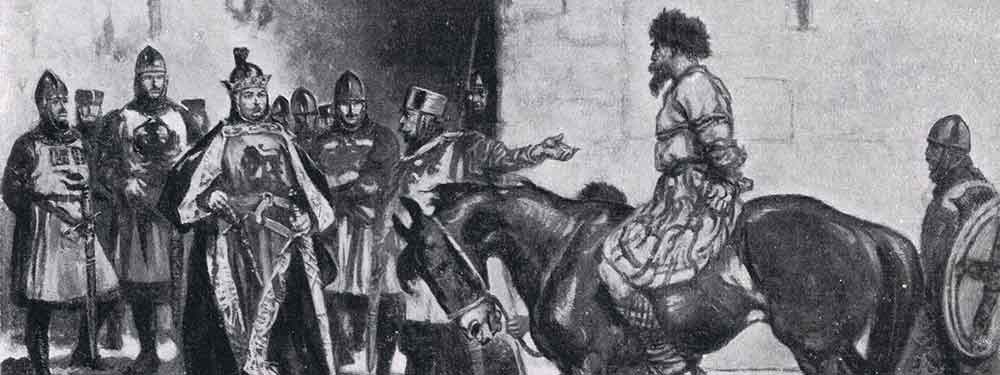
The Archbishop soon came to understand that his position in England was untenable, and he was likely to be imprisoned or forced to submit. He escaped from the court at Northampton, traveled secretly in disguise through England, and left the country. He is reported to have worn the rough clothes of a common monk and carefully to have avoided showing the trappings of his high office. The archbishop’s flight changed the dispute with the king into an international conflict. The involved parties now included the English crown, the papacy, and the French monarchy.
Becket spent close to six years in exile. He was first protected by King Louis VII of France, then hosted by Cistercian monasteries, including Pontigny, for most of his time. Alexander III of Alexandria was sympathetic to his cause but wanted to avoid an outright schism with Henry II. The pope was locked in a contest with rival popes backed by the Holy Roman Emperor and needed political friends and allies. Alexander’s support for Becket was genuine but pragmatic.
Henry reacted to the exile by attacking those associated with Becket. The archbishop’s family and servants were driven from England, and the religious houses that had given him sanctuary were threatened with royal vengeance. The king hoped that such measures would isolate and weaken the archbishop, and force him to submit. Instead, the retributive actions deepened Thomas Becket’s sense of victimhood and the arguments about legal authority were transformed into a bitter struggle of exile and revenge.
Failed Reconciliation and the Coronation Crisis
During Becket’s exile, the breach was repeatedly tried to be healed. Pope Alexander III and King Louis VII of France both attempted to reconcile the two parties, while bishops and diplomats passed messages between them. Meetings were arranged, and promises were discussed. There were moments of apparent progress and hope of peace. But each time, the efforts failed because the conflict was no longer only a matter of law. It had become personal, and neither Henry nor Becket trusted the other’s words.
Henry required Thomas Becket to accept the royal customs and return without humiliating the crown. Becket insisted on protection for the Church and the right to act as archbishop without fear of reprisals. Even when their language was less inflammatory, old resentments lay close to the surface. Questions over confiscated property, exiled supporters, clerical authority, and the Constitutions of Clarendon made any agreement difficult. Honor was as important as policy, because each man felt that compromise would be interpreted as surrender.
The crisis was deepened in 1170 when Henry arranged the coronation of his eldest surviving son, Henry the Young King. Medieval rulers sometimes crowned an heir during their own lifetime to secure succession, and Henry wished his son to be publicly recognized as his heir. But the ceremony was performed by Roger, Archbishop of York, with assistance from other bishops. Canterbury had long claimed a leading role in English royal coronations, so Becket saw this as an attack on his office.
He responded by using papal authority against the churchmen who had performed the coronation. He suspended or excommunicated several bishops, including figures close to the king. To Becket, the penalties served to defend Canterbury’s rights and the authority of the pope. To Henry, they threatened the dignity of his dynasty and challenged a ceremony meant to secure his kingdom’s future. The coronation had turned a constitutional quarrel into a direct struggle over royal legitimacy.
Temporary reconciliation was achieved later that year when Henry and Becket met at Fréteval. The king allowed the archbishop to return, and they exchanged signs of peace. But the agreement left several key questions unresolved. Becket did not completely rescind the punishments against the bishops, and Henry did not fully restore all that the archbishop had demanded. Their public peace concealed deep resentment and created only a narrow pause before the final confrontation.
By the time Becket made ready to return to England, the coronation crisis had made violence more likely. The bishops hastened to Henry’s court with reports of Becket’s actions. The archbishop remained determined to enforce Church discipline. Each side believed the other to have broken faith. Failed reconciliation had not ended the conflict; it had concentrated years of anger into a dispute over authority, honor, and the future of the English crown.
Becket Returns to England
Thomas Becket returned to England in December 1170, after almost six years in exile. Thousands of people had turned out to watch the archbishop return to English soil. In the minds of many, he had returned as a champion of the Church, unbroken by royal pressure and demands. The moment was a moral victory for Becket’s supporters. He had survived exile, defied the king and returned to England with the full authority of the papacy behind him.
None of that, however, guaranteed a return to peace. Royal officials were still on guard, and several bishops feared Becket’s energy in disciplining those who had opposed him. The coronation crisis had hurt people, particularly among churchmen who had been directly involved in crowning Henry the Young King. Thomas’s return therefore inflamed old wounds instead of healing them.
The greatest immediate dispute concerned the excommunications and suspensions the Archbishop had imposed. He would not lift them without a proper act of submission from the bishops in question. In his eyes, rescinding the penalties too quickly would damage the authority of Canterbury and make his years of resistance in exile meaningless. His opponents regarded that same refusal as a deliberate insult to the king and the dignity of the realm.
The quarrel was no longer simply a personal dispute between two powerful men, who could vent their anger on one another in private. It had become a contest that involved royal succession, papal authority, episcopal loyalty, and the very nature of obedience. In each corner, there were individuals who felt that backing down would be to let down the great institution they represented. The fact made compromise more difficult and the consequences of failure much more serious.
The risk of violence also increased because the dispute was taking place amid armed nobles, ambitious courtiers, and men eager to prove their loyalty. In such a climate, an angry complaint from a king might be seen as permission for private action. Becket had returned to his cathedral, but not to safety. The final stage of the crisis was now only days away.
“Will no one rid me of this turbulent priest?”: Henry II’s Outburst and the Four Knights
News of Becket’s behavior spread quickly and reached Henry II while he was in court at Normandy. His bishops presented the archbishop as insubordinate and dangerous. He had already suffered years of broken diplomacy, exile, and public insult. News of his return to England and the punishments he continued to mete out drove the king into a fit of rage before his household members.
The words most commonly attributed to the king are “Will no one rid me of this turbulent priest?” However, no trustworthy source from the time records him as saying precisely that. Medieval chroniclers transmitted several different versions of the king’s complaint. Some have Henry castigating the “cowardly” men around him who allowed Becket to disobey their lord. The exact words matter because they were not necessarily a direct order, even if they did express anger and a call for action.

Speech from a king carried unusual weight. The monarch did not need to write an order for an ambitious retainer to feel as though they understood his will. Henry’s rage could be interpreted as permission, particularly for men who were hoping to prove their devotion. The risk lay in the gap between what the king desired and what his servants thought would please him. Once violent language entered a court based on obedience, it could produce results the speaker could not anticipate or control.
Four knights acted in the moment: Reginald FitzUrse, Hugh de Morville, William de Tracy, and Richard le Breton. All were closely tied to Henry’s service or the wider royal household. They departed Normandy at different times or in small groups, crossed the English Channel, and later reconvened before traveling south towards Canterbury. The speed of their movements indicates that they saw the matter as pressing and that they would be rewarded for intervening.
Their motives cannot be fully known. Devotion to Henry might have mingled with personal ambition, anger at Becket, and a desire to demonstrate their courage before the court. They may have initially meant to arrest the archbishop or force his submission rather than kill him. But they had taken up arms and were acting without clear legal justification. That allowed a political confrontation to become a private mission defined by royal rage.
Henry’s outburst therefore became the hinge point between bitter words and physical violence. It is impossible to know if he wanted Thomas Becket killed, but his anger created an atmosphere in which four knights believed they should act. The episode remains a stark example of how a ruler’s words could constitute an implied command even without a formal order.
The Murder in Canterbury Cathedral
On December 29, 1170, the four knights arrived at Canterbury and entered the archbishop’s lodging. They demanded that Thomas Becket answer for the harm he had done to the king and the bishops whom he had excommunicated. The encounter quickly grew hostile. Accounts written in the days and weeks after his death say that the knights commanded Becket to revoke the excommunications and place himself under the king’s authority. When he refused, they left to fetch their weapons.

Serving men in Becket’s household tried to persuade him to flee or at least to hide. He refused to leave the cathedral, however. He could not forsake the church that was his office. Moreover, he thought that to flee in fear would be to signal that he was afraid of men acting lawlessly. He moved toward the church as evening prayers were about to begin. Monks tried to close and secure the doors with chains, but he ordered them opened. A house of prayer, he said, should not be a fortress.
The knights entered the cathedral in armor and swords drawn. They demanded that Becket surrender. Perhaps they meant to drag him away from Canterbury and take him before the king’s court. Becket pushed back, saying that he would not allow himself to be dragged away. Words turned to blows near the steps that led toward the altar of St. Benedict.
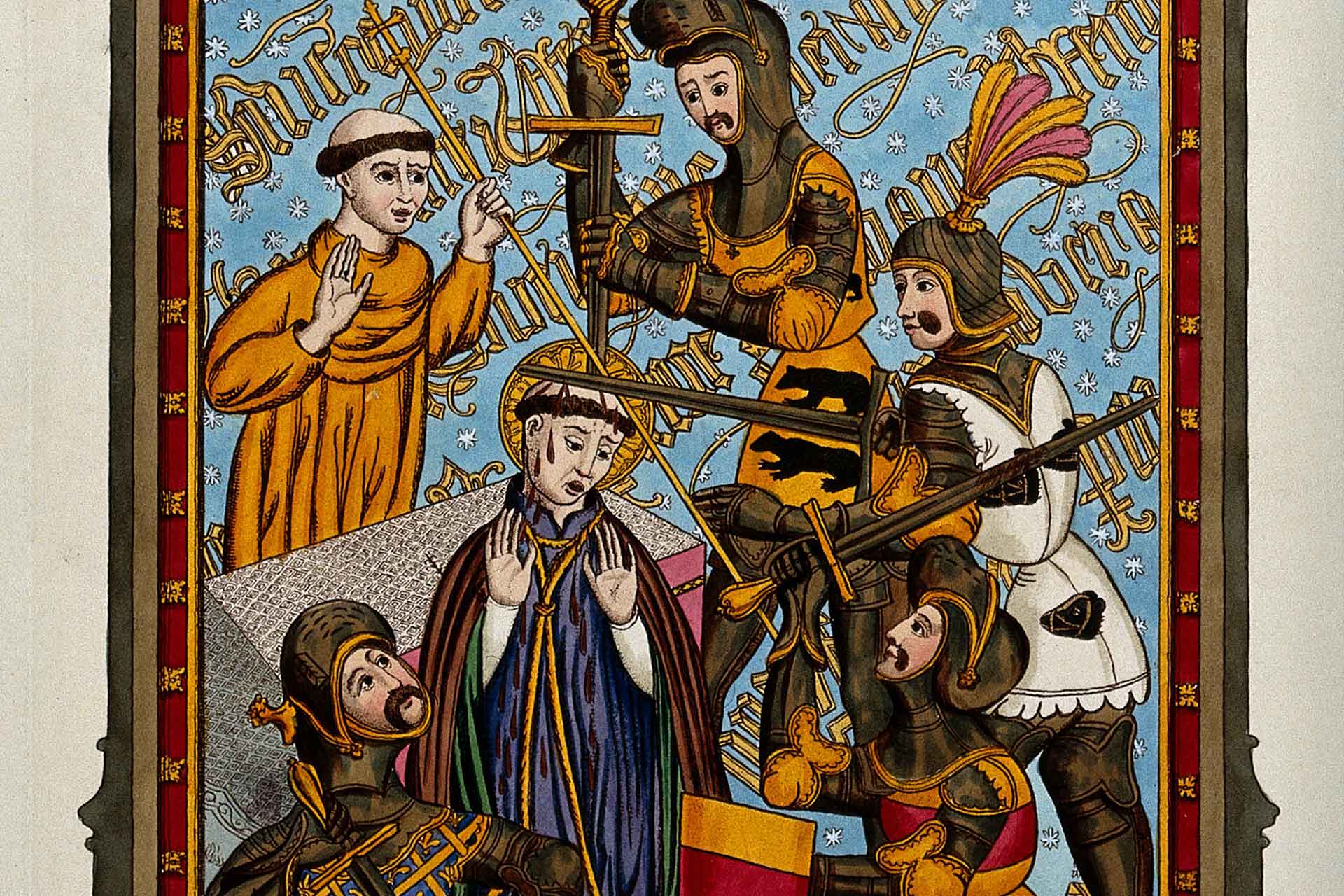
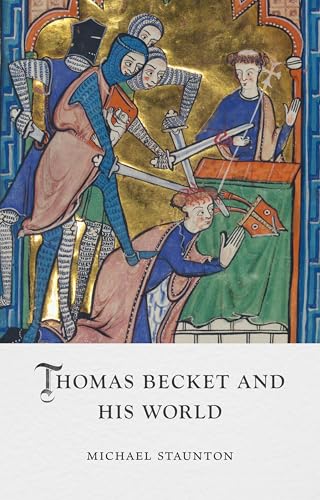
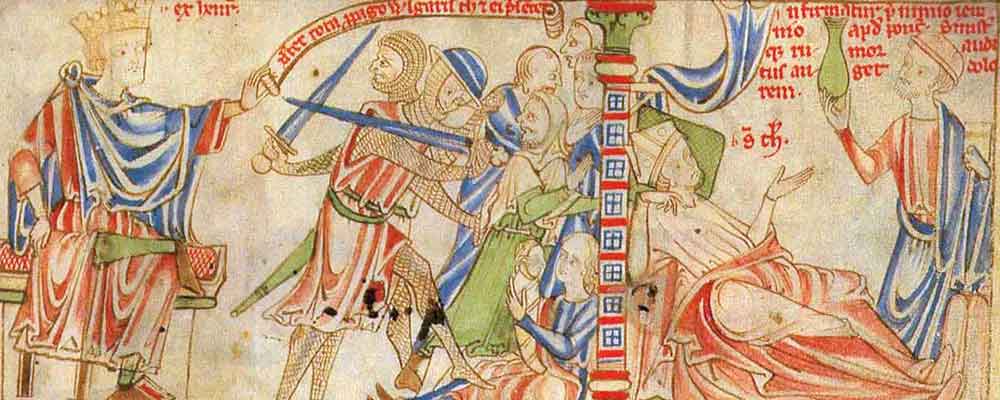
Edward Grim, a cleric present at the scene, described the attack in one of the most detailed accounts. The knights beat the archbishop as he stood near the altar. Grim threw himself in front of Becket and had his own arm wounded in the process. One of the blows cut into Becket’s head. Grim shielded his master with his body as he was hit again. The next blow felled the archbishop. Grim said that a final stroke shattered the top of Becket’s skull. The sword pierced his head so deeply that blood and brain matter spattered on the stones around his body.
The killing stunned the cathedral. An archbishop had not died on a battlefield or in a private chamber but in the heart of English Christianity. His blood had been spilled near an altar, during the Christmas season, by armed men associated with the king. The sacrality of the place made what might have been viewed as a brutal political assassination into an act of sacrilege.
Place shaped what came after. The knights had intended to make an example of a rebellious churchman. The cathedral made Becket seem like a martyr killed while upholding spiritual authority. The news of the murder spread. The violence came to seem inextricable from the holiness of the place where it had been done. In death, Thomas Becket achieved a moral stature that exile and negotiation had not allowed in life.
From Archbishop to Martyr
News of Becket’s murder spread throughout England and across continental Europe. The killing of an archbishop within Canterbury Cathedral itself was a horror to the clergy, nobles, and ordinary worshippers. Anger turned towards Henry II and the royal court, even though there was no written order for a murder to be found. Many felt that the king’s rage had created the conditions that made the attack possible.
The supporters of Becket began presenting his death as martyrdom almost immediately. Tales spread that he had died upholding the rights of the Church against the unlawful demands of the crown. His tomb became a focus of prayer, and stories of healing and other miracles drew increasing attention. These accounts helped transform Becket’s image from a controversial political player into a holy man whose blood had consecrated his cause.
Pilgrims traveled to Canterbury to seek contact with the martyr’s power. Some brought away water mixed with traces of blood associated with the murder. Others sought healing or protection by praying at his tomb. Churchmen recorded miracle stories, giving Becket’s cult both popular energy and written form. The place of the murder itself became a part of the experience, fusing the cathedral’s stones to the memory of the sacrifice.
Pope Alexander III canonized Becket in 1173, less than three years after his death. The speed of the decision indicated how strongly the Church took to the interpretation of his murder. Canonization also increased the political cost for Henry. The man he had once treated as a rebellious archbishop was now officially to be honored as a saint and martyr throughout Christendom.
In his death, Becket gained more influence than he had ever enjoyed in life. In exile, he had struggled to force Henry into a lasting compromise. As a martyr, he became a symbol of resistance to royal overreach, and a source of spiritual authority which lay beyond any court. His memory could not be arrested, exiled or negotiated with, and that made it far more powerful than his living opposition.
Canterbury soon became one of medieval Europe’s great pilgrimage destinations. Visitors came from across England and from abroad, bringing offerings which enriched the cathedral and spread Thomas Becket’s fame. Centuries later, Geoffrey Chaucer would use The Canterbury Tales to describe pilgrims traveling to his shrine. The archbishop’s political defeat had become a lasting religious victory. The murder Henry had tried to have everyone forget would remain part of European memory.
Henry II’s Political and Spiritual Reckoning
Henry II explicitly denied having ordered Thomas Becket’s murder. No written word to that effect has survived, and the four knights who killed Becket seem to have acted without the protection of any legal writ. But the king could not so easily be absolved. Years of threats, anger, and pressure against Becket had made violence appear to be a likely way to secure royal favor.
That distinction was important. Henry may not have clearly said that Becket should be killed, but rulers were not judged on written instructions alone. A king’s words had power, and it was dangerous to think that private orders given in anger could be repudiated with impunity. The murder forced Henry to face the reality that rage as a political tool could not easily be separated from the actions that it provoked.
The papacy quickly became a central part of the crisis. Henry needed to avoid excommunication, to maintain his authority, and to placate widespread outrage across Europe. Negotiations with Pope Alexander III led to the Compromise of Avranches in 1172. Henry swore that he had neither commanded nor desired Becket’s death, but that he accepted responsibility for the anger and pressure that had helped to cause it.
As part of the settlement, Henry promised to restore certain Church rights, allow freer appeals to Rome, and avoid certain customs deemed harmful to ecclesiastical liberty. Henry also accepted crusading obligations as part of his reconciliation with the Church. The agreement did not renounce royal power, but it did demonstrate that even a strong king could be compelled to make concessions when political authority and religious scandal came into conflict.
The Great Revolt of 1173–1174 gave Henry II a further motive to fear that Thomas Becket’s murder had brought divine punishment. His sons rebelled, and while the Angevin Empire of the Plantagenet dynasty was at its peak, powerful nobles in revolt, together with the king of France and the king of Scotland, joined the attack. Revolt spread across Henry’s lands, and threatened the multi-national empire that he had taken so long to build. For a medieval ruler, such disaster was a threat not only to political but also spiritual authority.
As the crisis developed, private denial was no longer enough. Henry had to show that he accepted moral responsibility, even if he rejected the charge of ordering murder. His enemies would use Thomas Becket’s martyrdom as an accusation, while his supporters needed proof that the king had restored his relationship with the Church. A visible act of repentance had become essential to the survival of both his reputation and his rule.
Henry’s Penance at Canterbury
In July 1174, Henry II found himself at Canterbury while still faced with the threat of rebellion. His sons, rival nobles, the king of France, and William the Lion of Scotland had all raised the standard against him. Henry could not therefore make the journey as a purely private act of devotion. It had to be both public and momentous. The murder of Thomas Becket still loomed over the king’s authority, and reconciliation with the martyr was now politically urgent.
As he approached Canterbury, Henry doffed the signs of his royal authority and walked part of the way to Canterbury. Medieval chroniclers presented it as a calculated show of humility. The king crossed the threshold of the cathedral not as a man entitled to obedience but as a sinner seeking grace. Before the tomb of Becket he admitted that his anger had in part created the conditions for the archbishop’s murder.
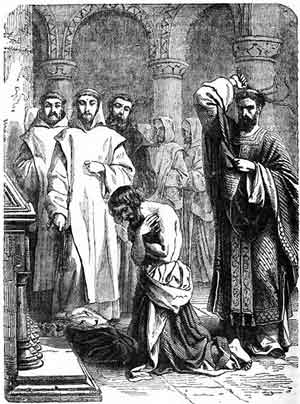
Henry then submitted to a ritual punishment. Chroniclers like Roger of Hoveden described bishops whipping the king with rods. This was followed by further blows from monks. The whole act inverted the normal hierarchy of medieval society: the man who commanded armies and castles accepted punishment from churchmen. It did not mean he was admitting to having given a direct order to kill, but it did show the king accepting moral culpability for words and actions that had encouraged violence.
He then spent several hours after the ceremony near Becket’s tomb in prayer, including an overnight vigil. The long hours of fasting, submission, and worship gave the penance a spiritual depth that a perfunctory public gesture would have lacked. To medieval observers, they could restore a ruler’s damaged relationship with God and the Church. It also allowed Henry to present himself as a Christian king who was capable of repentance.
William the Lion of Scotland was captured at Alnwick by forces loyal to Henry soon afterward. Supporters were quick to link the victory with the king’s penance and to suggest that Thomas Becket had forgiven Henry and that divine favor had been restored. The timing gave the Canterbury ceremony enormous symbolic power. A threatened king had humbled himself before a murdered saint, and almost immediately his political fortunes seemed to change.
Whether the penance was sincere or a calculated political act cannot be judged with certainty. Henry had strong political reasons to perform it, but medieval faith and medieval political strategy were not separate realms. Henry could have feared divine punishment for his actions while also understanding the political value of public repentance. His penance was probably both a personal act of remorse and a practical one: a way of rebuilding authority at a moment when his kingdom faced its greatest danger.
Legacy, Myths, and Conclusion
The Becket controversy did not bring a total victory for either the Church or the crown. Henry’s royal courts continued to grow, and his legal reforms bolstered the English monarchy for centuries. The Church also retained important claims to the punishment of clergy, the right of appeals, and spiritual supremacy. This settlement, following Thomas Becket’s death, was a compromise shaped by scandal, not a final constitutional solution.
Becket’s martyrdom also set moral limits on how openly kings could intimidate their senior clergy. Future monarchs continued to pick quarrels with churchmen, but Canterbury had made such struggles more perilous. An archbishop slain by royal servants could emerge in death more powerful than in life. Becket’s shrine was a reminder that force could silence an opponent while creating a saint.
One persistent myth is over Henry’s exact words. “Will no one rid me of this turbulent priest?” was a later paraphrase, not a proven quotation. Medieval chroniclers produced several versions of his outburst, and no certain evidence exists that Henry gave a direct order to kill Becket. The absence of a command did not absolve the king of moral culpability for creating an atmosphere in which violence was welcome.
Thomas Becket should not be remembered simply as a powerless victim. He was also a skilled administrator, a determined churchman, and a forceful political actor who used exile, papal power, and excommunication to confront the crown. He could be a harsh disciplinarian, and his lack of compromise helped deepen the crisis. Acknowledging that complexity makes his martyrdom more meaningful, not less, because it illustrates how a political struggle became a sacred legend.
Becket’s memory proved potent enough to unsettle another king centuries later. In 1538, Henry VIII ordered his shrine to be destroyed and his cult to be erased during the break with Rome. Yet the contrast remained: Becket fell beneath swords in Canterbury Cathedral, while Henry II later approached the same site in public penitence. Henry retained his throne and later restored his power, but Thomas Becket won the struggle over memory.


