The Black Dinner and the Bloody History Behind the Red Wedding
 Reading Time: 24 minutes
 The Black Dinner began with two young men on horseback riding to Edinburgh Castle in 1440. William Douglas, 6th Earl of Douglas, and his younger brother David were invited into the chambers of the child king James II to share in the feast that had been prepared for them. Hospitality turned quickly to accusation, judgment, and execution, creating one of Scotland’s most notorious tales of political betrayal.
In popular fiction, the episode became the inspiration for the Red Wedding in George R. R. Martin’s A Song of Ice and Fire. In both, the protected meal becomes a carefully orchestrated trap. The historical reality is less clear than the fable. The death of the two Douglas brothers is a fact, but the bull’s head, the pleading king, and the details of the event are from later versions. The question remains: where the written record ends and dramatic recollection begins.
Scotland Under the Child King James II
February 1437 was a turning point in Scotland’s history. King James I was assassinated at Perth, and his six-year-old son became James II. A child monarch could not personally make decisions about government, and so royal authority rested on a council of guardians, councilors and magnates who acted ‘in the king’s name’. As agents, they had wide influence, and the reality of royal authority could depend on who was best able to control the boy, his household, or access to it.
The royal minority was more than an inconvenience or an uncertainty. It was a contested space in which appointments, lands, revenues and the whole direction of government could be fought over. Scotland’s great families knew that dominance over James II could yield political dividends. Men who styled themselves guardians or protectors of the crown were also protecting their own estates, allies and personal ambitions. The problem was not with the royal title but with the king’s incapacity to wield its power himself.
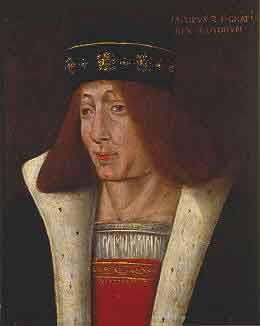
There were several parties who could make a claim. Sir Alexander Livingston had influence with the young king and his mother, while Sir William Crichton held major offices and was captain of Edinburgh Castle. The great Douglas family was outside this inner ring of government. Its wealth and armed resources could endanger royal ministers, and rivalries made government unstable. Each feared another would use the king’s authority against it.
Edinburgh Castle was a center of this conflict because it was both a fortress and a royal residence. Control of the castle enabled whoever held it to regulate access to the king, what information came to him, and which orders might bear his seal of authority. The castle’s walls offered safety, but they also enabled ministers to use the king against his rivals. A royal invitation from such a place carried a weighty authority, even if the plan behind it was shaped by factional interests.
In that way, political rivals could act in James’s name to pursue aims the young king could not begin to comprehend. Orders could be issued in his name as an act of royal justice even when senior nobles had helped shape the accusation and decision. Later Scottish chroniclers said that James was distressed by events surrounding the Douglas brothers, but details are uncertain. What is clear is that the child king’s very presence was a legitimizing influence over what others could control.
The crisis in the minority of James II was, therefore, not a period of simple weakness. It was a struggle over who was best placed to speak with the crown’s voice. The Black Dinner grew from that dangerous divide between royal authority and personal rule. James possessed the title of king, but the adults around him controlled the machinery of power—and could turn a royal banquet into an instrument of political elimination.
The Rise of the Black Douglases
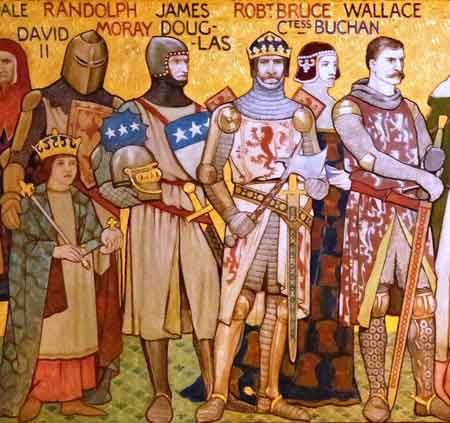
The Black Douglases were among the most powerful noble families of medieval Scotland. The family rose to prominence during the Wars of Scottish Independence, with Sir James Douglas, a close companion of Robert the Bruce. He later became known as the “Good Sir James.” The younger Douglas led raids, skirmishes, and campaigns against the English. He became famous for his daring and skill as a warrior. This legacy attached enduring associations of bravery and resistance to the Douglas name.
Military service earned the Douglas family land and status. Successive lords of Douglas acquired estates throughout southern Scotland. They also built and held strategic strongholds in the Borders and southwest. This property gave them wealth, armed men, and control over important military routes. Marriage alliances to the royal family and support for royal wars enhanced the family’s reputation. Victories against the English made Douglas military commanders especially useful to the monarchy. By the fifteenth century, the house of Douglas was a major political force in Scotland. They had become more than simply a family of border fighters.
Military service earned the Douglas family land and status. Successive lords of Douglas acquired estates throughout southern Scotland. They also built and held strategic strongholds in the Borders and southwest. This property gave them wealth, armed men, and control over important military routes. Marriage alliances to the royal family and support for royal wars enhanced the family’s reputation.
Victories against the English made Douglas military commanders especially useful to the monarchy. By the fifteenth century, the house of Douglas was a major political force in Scotland. They had become more than simply a family of border fighters.
The rise of the Black Douglases also created a threat to royal power. The house controlled estates, castles, armed retainers, and family alliances. It could amass resources to rival the crown. In a kingdom where the king was a child, such power seemed dangerous. A Douglas earl could distribute rewards and punishments and raise military support without royal consent.
The family inspired loyalty by providing protection and patronage to many. It also inspired fear because its leaders could act almost like independent princes. Royal ministers were anxious that the Douglases might come to dominate the young James II. They also feared that the Douglases might replace one faction with another. That combination of admiration and suspicion provided the political context for the Black Dinner.
William Douglas and His Brother David
William Douglas was not yet out of his teens when he inherited the title of 6th Earl of Douglas. As the son of a powerful nobleman and military leader, William had inherited control over great estates and one of Scotland’s most venerated family names. William was young, but royal ministers were not able to ignore such a political force. His wealth, lands, and dependants gave him more influence than many men twice his age.
Young William’s brother David was of similar age and shared the status of his elder sibling, and the danger that status incurred. The young brothers were at the head of a dynasty with many branches and a long history in the wars against England. They were powerful symbols of Douglas power, though neither had the age of an experienced statesman. In a well-ordered kingdom their youth might have simply encouraged careful mentoring. In the minority of James II it left them open to exploitation by men who feared what they might become.
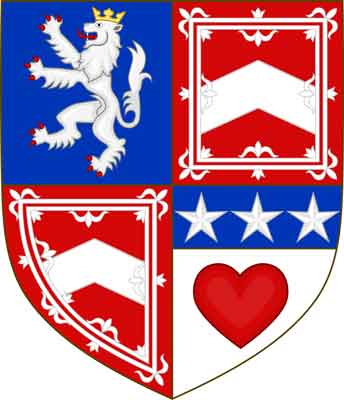
The influence of the young earl was built not simply on the great landed wealth he had inherited but also on the loyalty that was attached to the Douglas name. Supporters had someone to look to as the natural head of a network of relatives, tenants and armed retainers. Royal officials may have worried that he would eventually come to dominate the king’s government, or at least provide an alternative to those who had already established control of access to James II. Whether he had such ambitions or not mattered less than the power he was able to wield.
Accounts which were written after the event have sometimes portrayed the young earl as proud or difficult to control, but direct evidence about his character is scant. Much of what has survived was written after his death and coloured by the drama of the Black Dinner. It is probably more accurate to see him as a young noble who found himself in an unusually dangerous position. William had inherited the political enemies of his family before he had a chance to build his own strategy.
The young earl and his brother therefore became enemies because of what they represented rather than because of what they had already done. Their deaths would have weakened one branch of the Douglas family, changed the direction of a great inheritance, and cleared a path for ministers who were afraid of losing control of the crown. Their youth makes the episode all the more brutal. Two boys had entered Edinburgh Castle carrying the burden of a dynasty and met rivals willing to remove that future before it had fully developed.

The Men Behind the Invitation
Sir William Crichton was at the heart of royal government during the minority of James II. He served as Chancellor of Scotland and keeper of Edinburgh Castle. This combination of a major office and the great fortress, where the young king sometimes lived, allowed him to control important royal documents, to have direct access to the monarch, and to use the castle as a secure political base. Later tradition consistently places Crichton at the center of the invitation that brought the Douglas brothers to Edinburgh.
Sir Alexander Livingston was another magnate with an interest in the leadership struggle. He controlled the king’s household and held Stirling Castle. He was a political rival of Crichton, with an interest in limiting the Chancellor’s access to James II. The two men were political rivals with much to gain from the downfall of the Black Douglases. Eliminating the young earl could safeguard both their careers against a single noble family capable of dominating the royal government.
James Douglas, Earl of Avondale, had the clearest family interest in the brothers’ deaths. Later known as James the Gross, he was their great-uncle and a senior member of the wider Douglas dynasty. When William and David Douglas died without heirs, James assumed the earldom and became the 7th Earl of Douglas. The Oxford Companion to British History says that their removal “was probably planned with his benefit in mind.” This puts him in a role that is more than a distant observer.
The three men may have been anxious about what William Douglas could become when he reached full adulthood. He had extensive lands, a famous name, and the fealty of armed retainers. In a kingdom ruled by a child, those resources might have allowed him to displace existing ministers and take control of government. Killing the brothers removed an immediate threat and redirected Douglas’s power toward an older relative who may have been easier to work with.
Yet historians cannot identify one proven mastermind with complete confidence. Contemporary evidence is brief and tells the reader little about planning, motives, or private agreements. Some sources highlight Crichton’s control of the castle; others link Livingston to the executions; and still others assign greater responsibility to James Douglas, as he was the one who inherited the title. The most cautious conclusion is that the Black Dinner served several interests at once, even if the exact level of cooperation is uncertain.
The Invitation to Edinburgh Castle
In 1440, William Douglas, 6th Earl of Douglas, and his younger brother David were summoned to dine with the youthful King James II in Edinburgh Castle. The invitation offered recognition and friendship, a place at court, and the chance to reset their relationship with the crown. For two young men whose family’s power was a source of concern for the king’s ministers, the invitation may also have sounded like an opportunity to relieve tension and prove their good faith.
Hospitality was a serious matter in medieval noble culture. A host had an obligation to the safety of guests in their care, especially during a meal held under the aegis of royal authority. Eating from the same table established a temporary bond of trust even between political enemies. To kill someone who had accepted safe conduct to a feast or hospitality within a castle was therefore more than murder. It was a break with the norms and practices that made diplomacy, and by extension noble society, possible.
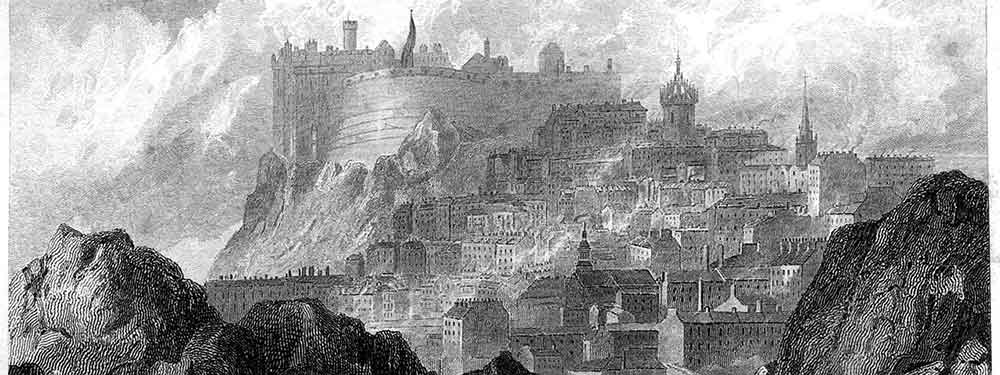
An invitation from or associated with the king should have offered even greater security. James II was a child, but his name gave the banquet a degree of royal legitimacy. William and David had every reason to expect that no one would dare to harm them in the monarch’s presence. Accounts written after the fact portray the banquet as a carefully laid trap, exploiting the appearance of royal friendship to draw the brothers into a place where their enemies were in control.
We don’t know how suspicious the brothers were of the invitation before entering the castle. They may have accepted it gladly, unwilling to turn down a royal summons and risk appearing disloyal. They may also have brought attendants but had insufficient force to challenge the castle’s guards. Once inside the walls of Edinburgh, their family’s wealth and military followers counted for little.
The setting was also full of political significance. The Douglas heirs were being brought into a royal fortress commanded by Sir William Crichton, one of the individuals most threatened by their rise. Outside the castle, William Douglas was an imposing figure, with a powerful base of land, blood, and followers. Inside the fortress, his rivals controlled the gates, the guards, and access to the king. The invitation flipped the power balance before the banquet had even begun.
The Black Dinner
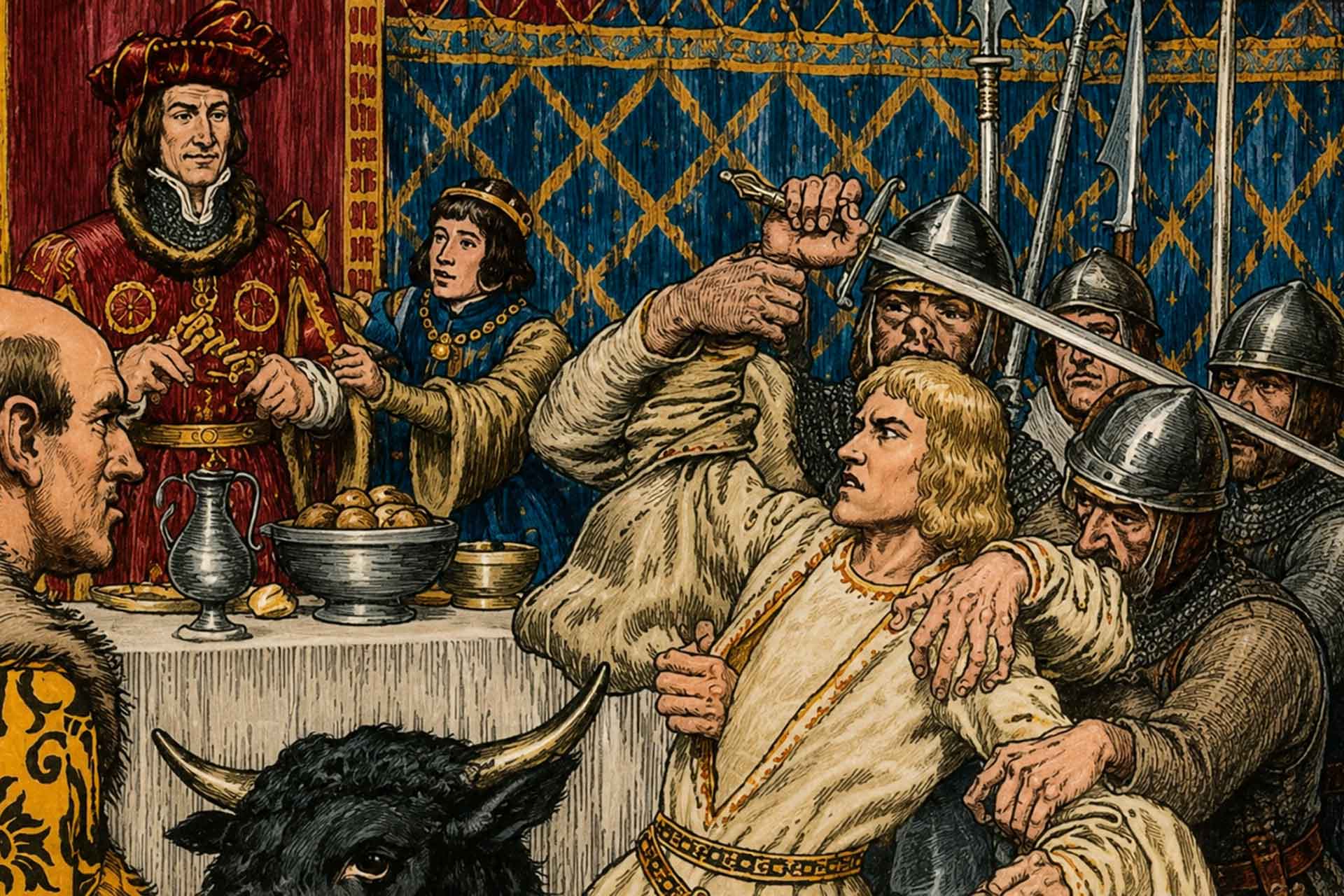
The earliest version of the banquet is a formal meal eaten inside Edinburgh Castle. William Douglas and his brother David are described as sitting with the ten-year-old King James II and other officials. The men and the setting presented a show of friendship from the king. In context, it was also a trap from which there could be no escape. They were surrounded by political opponents and armed guards, at the center of a walled fortress and many miles from armed supporters in other areas.
Later sources also describe the meal as initially calm, making the subsequent shift in tone more ominous. Douglas’s chroniclers later stated that the king dined with them in conversation, delaying the signal for some time. If true, this indicates that the banquet was designed to make the brothers more relaxed and ultimately unable to resist. Hospitality formed part of the trap, rather than a safeguard from it.
The best-known detail is the appearance of a black bull’s head placed in front of William Douglas. In later Scottish culture, the object was used to signal death or condemnation in court. Its sudden appearance would have signaled to the brothers that the meal was over and that a judgment would now begin. The image also became so intertwined with the incident that it gives the Black Dinner much of its enduring theatrical force.
The bull’s head, however, does not feature in the earliest surviving accounts. It is a later addition in chronicles written years after the event had become legend. For this reason, historians are cautious when it is mentioned. It may reflect a genuine part of the ritual or a genuine memory. It may also have been embellished or inserted into the story to make the betrayal more comprehensible and visceral for later audiences.
What is more certain is that the feast was followed by arrest. William and David were seized within the castle and removed from the royal board. Their status as formal guests provided them with no defense, once their opponents decided to take action. The shift from banquet to imprisonment also destroyed the idea of royal hospitality and redefined the king’s household as the setting for political violence.
The Black Dinner became notorious because it combined ceremony and betrayal. The two brothers were not defeated in battle or captured while rebelling. They were invited to the king’s court, received warmly, and served food. They were then arrested and escorted away under the authority of the crown. That process made the event more than an execution. It became a cautionary tale about trust used as a weapon.

The Trial and Execution
When the banquet concluded, William Douglas and his younger brother David were delivered from the royal table and delivered into custody. The change from guest to prisoner seems to have been sudden. Within Edinburgh Castle, the brothers lacked access to the armed retainers who had pledged loyalty to House Douglas. All the gates, all the soldiers, all the law belonged to their enemies, and they had almost no opportunity to resist.
Chronicles record a hurried trial taking place within the castle. Proceedings were often described as a mock trial, since the outcome seemed clear before the judgment was pronounced. Charges of treason or disloyalty, or even of an excess of power dangerous to the crown, were available. But the surviving evidence does not contain an agreed statement of the charges, the list of witnesses, or the arguments of counsel.
Accusations about their power may have been more important than specific crimes. William Douglas held large estates, armed retainers, and a family name deeply associated with military power in Scotland. As a teenager, he stood for a great house that might challenge royal ministers. His political threat came from what he might do, not from a specific rebellion already in motion.
The language of treason and law gave these executions the appearance of royal justice. In reality, the case seems to have been argued by men who had much to gain from the Douglas brothers’ disappearance. A real trial would have taken time and required evidence and an opportunity for the accused to reply. The swiftness of the decision implies that legal forms were deployed to give an appearance of due process to a political judgment already made.
Taken outside, William and David Douglas were beheaded, despite their youth and noble rank. A companion of the brothers, Sir Malcolm Fleming of Cumbernauld, is said to have been executed as well. These deaths removed the principal heirs of one branch of the Douglas name by a single stroke. No battlefield defeat or public rebellion had made this action possible; their enemies did so by invitation, imprisonment, and controlled judgment.
Later chroniclers asserted that the young James II pleaded for his guardians to spare the brothers. This detail gives the story an extra measure of tragedy by pitting an innocent child against ruthless ministers acting in his name. However, the scene comes from later narratives and may have been created for dramatic effect. James may have spoken, but the surviving evidence cannot prove what he said or what he understood.
Executions were political killings presented in the language of lawful punishment. Royal authority provided the setting and the words, while private rivalry seems to have driven the outcome. The Black Dinner became infamous for combining hospitality, judgment, and death into a single controlled event. William and David were not only convicted; they were removed as obstacles by men who used their ambition to justify an injustice.
What Do the Sources Actually Tell Us?
The paucity of surviving evidence for the Black Dinner makes it a challenging episode for historians. The deaths of William Douglas, David Douglas, and Sir Malcolm Fleming are a fact that is not in serious dispute. Documents dated closer to 1440 provide little information on the banquet, the charges, or the precise sequence of events. This silence created room for later storytellers to add to the account.
Some of the closest sources still contain major gaps in the story as it has been retold over the centuries. Walter Bower’s Scotichronicon, written within living memory of the Black Dinner, described the deaths of the young Douglases and treated the episode as a major act of treachery. Yet Bower’s account, like many chronicles of the period, does not preserve all of the specific elements that became familiar in later retellings. He wrote close enough to the event that his account is extremely useful, yet he was still a man of his era, influenced by the political and moral preoccupations of his own age.
Later Scottish chroniclers from the mid-15th to the early 17th centuries added scenes that made the entire Black Dinner episode a more memorable story. The black bull’s head, the banquet guests running in terror, and the child king pleading for the lives of his noble guests were all elements of tradition that appeared in works written long after the killings had become a part of national memory. These details may well preserve fragments of older oral stories, but they cannot be verified through surviving contemporary records. As a source moves farther from the year 1440, its dramatic elements must be treated with greater care.
Details of the trial itself are also unclear. No complete set of formal charges survives, no witness lists, and no record of the legal procedure that was followed. It is possible that the brothers were charged with treason, but the rapidity of the proceedings and the manner of execution suggests that the political fears of the Albany chiefs and royal councilors mattered more than any real guilt. In the same way, historians cannot say with certainty which state official devised the plan or how closely Crichton, Livingston, and James Douglas coordinated their actions.
The core of the story remains, however, bleak and real. Two young nobles were invited into Edinburgh Castle, arrested, condemned, and executed by men who had much to gain from their deaths. Even if the black bull’s head never appeared over the dining hall door and the child king never pleaded for the lives of his noble guests, the element of betrayal at the heart of the story still happened. The absence of detail should lead historians to caution, not to dismissal.
Legend, by its nature, changes the facts while preserving the overall meaning of events. In the case of the Black Dinner, later storytellers turned a poorly recorded political execution into a starker warning about the perils of broken hospitality and concealed ambition. The added symbols made the entire episode easier for people to remember, but they can also obscure the line between historical evidence and storytelling. Recognizing both layers in the sources allows the Black Dinner to be studied as both history and a potent Scottish legend.



Who Benefited From the Douglas Deaths?
William Douglas and his brother David were two young heirs at the center of what was likely Scotland’s most powerful noble network. Douglas held the earldom, and David could have been useful to the continuation of a more direct dynastic line. The deaths of both figures took leadership away from that branch of the family before either man had had a full political life.
The most obvious beneficiary from these deaths was the brothers’ great-uncle James Douglas, Earl of Avondale. In the wake of the deaths, he was awarded the earldom and became the 7th Earl of Douglas. He would later be known as James the Gross, but by that name, he was able to take the family’s title, standing, and vast estates. The speed of that transfer has led some historians to speculate if inheritance had become a part of the motive for execution.
Inheritance, however, does not fully account for the interests of every party involved. Both Sir William Crichton and Sir Alexander Livingston already had a position in the government of the young James II. Douglas’ ascent was likely to challenge their place. Eliminating him would prevent the earl from having direct access to the king and perhaps from usurping those already influencing royal policy.
The murders also illustrate how the power of the crown could be pressed into the service of private vendettas. The brothers were accused, tried, and executed in a royal castle. This gave the work of factional murder the sheen of legitimate punishment. James II was not old enough to have had much personal influence over the process, but his title and presence still gave it a veneer of legality that had been shaped by elder nobles in search of their own security and advantage.
The Black Dinner weakened two potential Douglas heirs, but it did not cripple the family’s power. James the Gross inherited the title, and the Black Douglases were still a major player in Scottish politics. The family’s later conflicts with James II would become more violent. The murders changed who led the dynasty, but not the more fundamental political problem posed by Douglas wealth, land, and armed strength.
The Continuing Conflict Between the Crown and the Douglases
The Black Dinner eliminated William Douglas and his brother David. But it did not end the power of the Black Douglas house. The earldom passed to their great-uncle, James the Gross, who maintained the dynasty’s lands, alliances, and armed power. The Black Douglases were still capable of challenging royal ministers and exerting influence over much of southern Scotland. The executions shifted the leadership of the house, but did not resolve the underlying problem for the crown.
James the Gross died in 1443, passing the earldom to his son William, the 8th Earl of Douglas. The new earl inherited a noble network with resources and armed retainers comparable to the crown’s. William and James II began with a working relationship, and the earl enjoyed a prominent position at court. As the king aged, however, he became less patient with subjects who were powerful enough to act independently.
Their rivalry was fueled by William’s alliances with other great nobles. James II saw the danger that such agreements could produce a private political bloc, operating outside his control. The crown demanded that the earl end his alliances, but Douglas argued that these partnerships were necessary to protect his family. The conflict was therefore not just personal. It concerned whether or not powerful lords could form alliances that constrained the king’s ability to govern.
In February 1452, James invited William to Stirling Castle under a promise of safe conduct. In a private meeting with the king, Douglas was ordered to end his alliances. The earl refused. According to later chronicles, James II drew a dagger and attacked him, after which royal attendants joined the assault. William was stabbed multiple times, and his body was thrown from a window.
The killing had an ominous echo of the Black Dinner. Once more a Douglas leader entered a royal castle with an expectation of safety and was killed by men connected to the crown. But James II was no longer a child. He was a mature king who had used violence to remove a political rival. The murder showed how intractable the struggle had become, and how little trust now existed between the monarchy and the Douglas house.
William’s brother James became the 9th Earl of Douglas and continued the opposition to the king. James II struck back with a campaign against the family’s castles, lands, and allies. The crown actively encouraged Douglas supporters to defect and offered rewards to those who abandoned the earl. By seeking to weaken the family’s network before confronting it militarily, the king turned a private feud into an effort to bolster royal government.
The conflict ended in 1455 with a decisive royal victory over the Black Douglases at the Battle of Arkinholm. The 9th Earl fled into exile, and his estates and titles were forfeited to the crown. The Black Dinner was thus only an early episode in a struggle that would last another fifteen years. It has a greater historical importance in how it prefigured a larger contest over whether Scotland would be dominated by great noble families or by a monarchy determined to rule in its own name.

From the Black Dinner to the Red Wedding
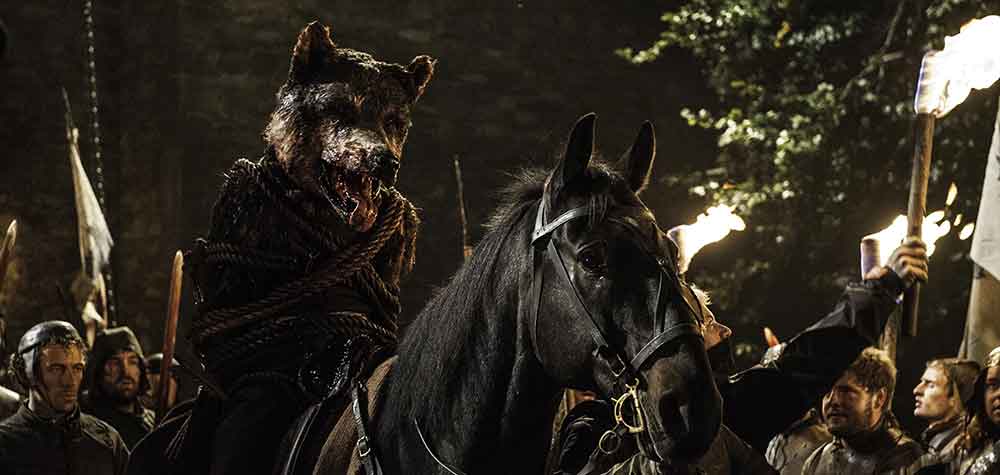
The Black Dinner was an influence on George R. R. Martin’s Red Wedding in A Song of Ice and Fire. Martin has mentioned real episodes in Scottish history during conversations about the history behind his own fictional massacre. Like the Black Dinner, the Red Wedding episode in Martin’s fiction is introduced with an offer of peace. Invited guests enter a sanctuary space, share food with their hosts, and learn too late that the event was carefully planned to destroy a political rival.
Hospitality becomes a tool of violence. William Douglas and his brother David enter Edinburgh Castle as honored guests of the boy king James II of Scotland. At the Red Wedding, the Starks of Winterfell and the Freys of the Twins meet for a marriage feast intended to repair a long-standing alliance. In each story, the ruler in control of the space stages a ceremony and false friendship to place dangerous rivals in a context where resistance and escape are difficult.
That structure makes the betrayal more upsetting than a plain battlefield death. The victims are isolated from much of their fighting power and persuaded to lower their guard. Music, food, conversation, and ritual create an illusion of safety. Hidden calculations drive the plot. Guests and rulers share certain aspects of social space until guards move, doors close, and the feast turns into an execution.
Hospitality had a special moral power in medieval society. A noble host was expected to shelter invited guests, even when relations between the families were on the verge of boiling over. Meals could be stages for negotiations because both sides trusted certain rituals to constrain violence. Breaking that protection at a banquet affected more than the direct victims. It also weakened the rules that allowed political rivals to meet without every large-scale meal becoming an ambush.
That is why the two episodes have continued to shock. The murderers gain more than a straightforward battlefield victory over their enemies. They also exploit the victims’ trust in commonly held ritual practices. The black bull’s head reportedly served at the Douglas banquet became a recurring theme in later Scottish retellings. Martin’s bread and salt at the Red Wedding similarly establishes the protection of guests before that bond is explicitly broken. The ritual of safety becomes part of the trap.
Martin has also mentioned the Glencoe Massacre of 1692 as an influence on the Red Wedding. At Glencoe, government soldiers accepted shelter from a clan member of the MacDonalds before turning on their hosts. In that event, the relationship was reversed from the Black Dinner: invited guests killed their hosts after being fed and sheltered. The two episodes from Scottish history offered Martin historical models of ritual hospitality twisted by political violence.
The Red Wedding is not a retelling of the Black Dinner. Its characters, motives, scale, and results all belong to Martin’s own fictional world. In contrast, many dramatic details of the 1440 banquet are drawn from late chronicles rather than more firm contemporary evidence. The connection is in a shared historical pattern. Both stories present a method for rulers and factions to turn a place of trust into a killing ground—and a reason why betrayal at the table can feel more horrifying than violence in the open.
Legacy, Myths, and Conclusion
The Black Dinner is one of Scotland’s most vivid stories of betrayal, in part because so much is packed into it: youth, power, hospitality, and sudden death. Two young brothers became guests of the King in Edinburgh Castle and did not leave the fortress alive. The story has lingered not only because of who died, but because the bloodshed seemed to masquerade as ceremony. A banquet that should have offered protection became the context for a political killing.
The most famous details of the story are unconfirmed. Chroniclers wrote that a black bull’s head was presented to William Douglas as a symbol of his fate, and some claimed the young James II pleaded for mercy. These dramatic scenes may have preserved an older oral tradition, but they are not corroborated by contemporaneous evidence. It is best to approach them as important elements of the legend rather than as proven facts.
What is known is serious enough. William and David Douglas were plucked from the King’s table, judged, and executed in a fortress controlled by their political enemies. Their deaths hurt one branch of the Douglas family and advanced the careers of men who feared and inherited their power. The Black Dinner was not just a banquet that became brutal. It was a political assassination presented as legal punishment.
Retellings of the Black Dinner have given it a clear shape that history itself has not preserved. The bull’s head, the defenseless king, and the switch from music to arrest turned a poorly documented execution into a national myth. These accretions may obscure facts, but they also preserve the event’s larger significance: powerful men leveraged trust, ritual, and royal authority to destroy young rivals.
That same pattern helps explain the relationship between the Black Dinner and the Red Wedding. George R. R. Martin did not imitate the Scottish event scene by scene, but he borrowed its central horror. In both tales, guests assume that a shared meal provides protection, only to find that hospitality itself has been weaponized.
The Black Dinner and the Red Wedding endure because they invert the table’s meaning. Food, shelter, and ceremony should produce trust, even between enemies. Instead, they become the elements of a carefully prepared trap. That makes both stories more chilling than open battle, for the victims are defeated not only by force but also by their own belief that certain rules still apply.


